Why Slack Becomes a Dead End When AI Agent Access Still Requires a Ticket
Slack agents stall at the access layer, and only built-in controls fix it.
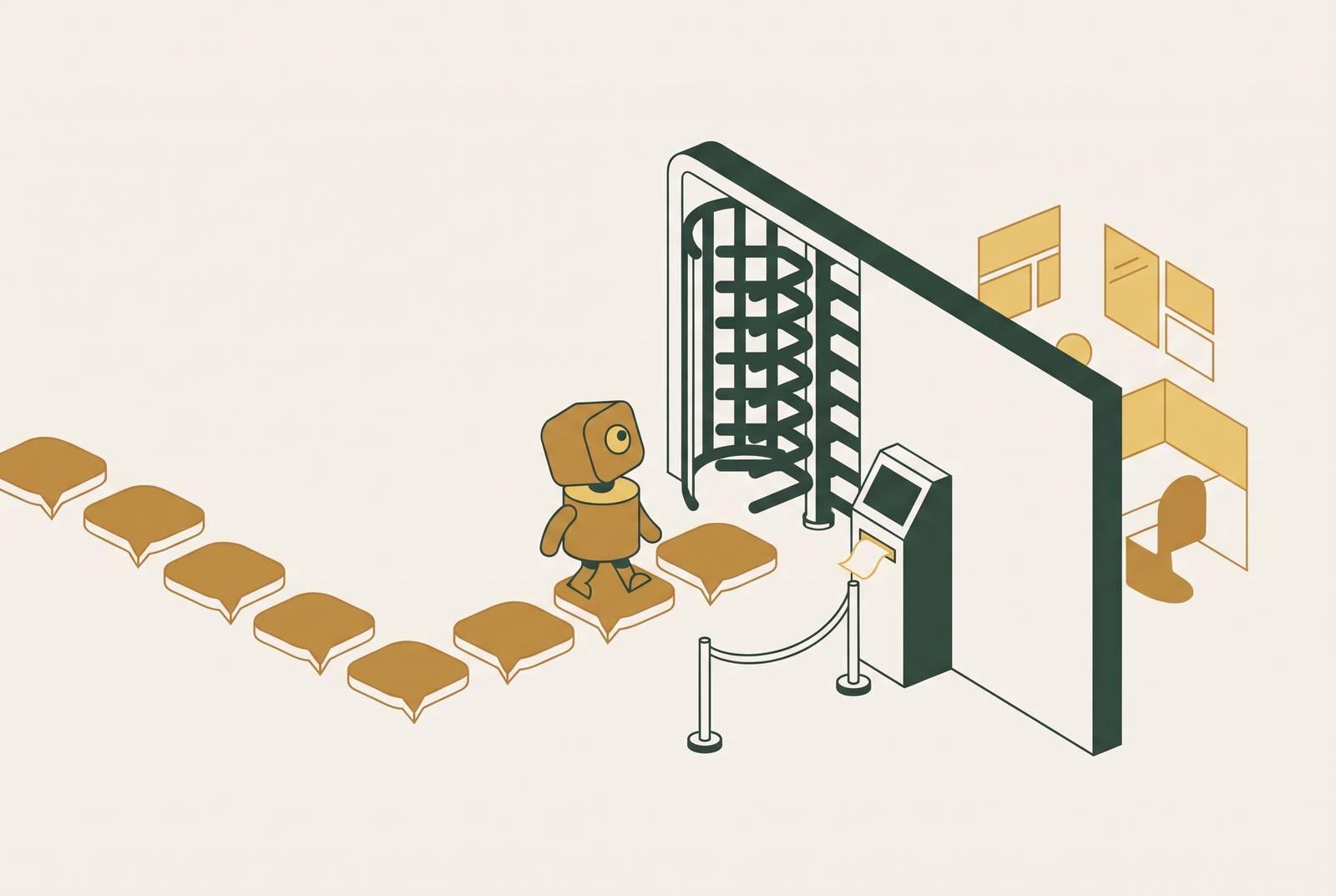
Enterprise AI agent enablement for non-technical employees requires more than putting a chatbot in Slack. Employees need agents that can get task-scoped access, handle credentials, and enforce policy without sending each new request for permission to IT. When those controls sit inside the agent layer, employees can get work done through Slack without entering a ticket queue.
Why the Slack-as-AI-interface vision breaks down at the access layer
Slack-based agents promise a single conversational interface for work, but that promise depends on access being ready when the work begins. Employees are meant to describe what they need without knowing which system handles it. The agent then reaches a system it has not been authorized to use, and the conversation stops being useful. Someone has to request permission, wait for approval, and return to the task. The interface changed, but the dependency did not.
That gap is becoming harder to ignore as Slack becomes a primary deployment surface for enterprise AI agents. The number of AI-enabled apps built for Slack has grown sharply year-over-year, so enterprises now widely expect to work through a single interface. Yet being available in a familiar channel is not the same as being able to act. An employee can reach the agent immediately while the agent still cannot reach the system needed to complete the request.
An IT service desk agent makes the distinction clear. It may understand a request perfectly and explain what needs to happen next. But if it lacks runtime access to the ticketing or identity system, it cannot resolve the request itself. It escalates to a human instead. In that situation, the supposed autonomous agent is a chat interface feeding the queue it was meant to replace.
How existing IAM infrastructure creates the ticket reflex
The ticket queue persists because existing identity and access management, or IAM, infrastructure was built around human logins and static roles. In that model, a person signs in and gets a set of permissions. Agents introduce a different relationship between identity, permission, and action. They act on behalf of users under delegated authority.
An agent may need permission both when a session begins and at the moment it calls a tool. It may also create sub-agents with different permission sets, producing a chain of delegated authority. Static roles cannot adequately describe those multi-level relationships. Meanwhile, many agents share service accounts, inherit broad infrastructure permissions, or have no identities that can be verified. Those shortcuts make a connection possible without clearly establishing whose authority supports each action.
If the identity system cannot represent the agent, its delegated authority, and the task at hand, it cannot reliably decide what access to give it. A ticket inserts a human checkpoint where that authorization mechanism is missing. The checkpoint is slow, but its purpose is understandable. Blaming the team for using it confuses the response with the cause.
That diagnosis changes what a useful fix looks like. A faster approval process can shorten the wait, but it cannot give static roles a coherent model of agent delegation. Nor can a better conversation in Slack give an agent an identity that the system behind it does not recognize. The missing capability belongs in the architecture. Treating it as a service desk problem leaves the same mismatch waiting behind every new integration.
Why simply opening access to MCP-connected systems is not the alternative
Giving agents broad access to Model Context Protocol, or MCP, servers may seem like a way out of that mismatch [1][2][3]. Agents can connect to tools and data without waiting for each permission gap to be resolved. But a standard connection does not establish trustworthy authority. Opening access broadly substitutes exposure for delay while leaving each action’s authority unverified.
The Cloud Security Alliance’s draft Agentic MCP Security Best Practices Guide catalogued nearly 7,000 internet-exposed MCP servers by early 2026, with roughly half operating without authentication controls [1][2][3]. It shows why the existence of an MCP connection cannot serve as evidence that the connection is safe. Earlier versions of MCP’s authorization specification also used anonymous Dynamic Client Registration, which let clients register as valid OAuth clients without saying who they were. The 2026-07-28 revision deprecated that approach in favour of Client ID Metadata Documents, but a protocol change does not replace enterprise access policy.
Authentication alone would not settle the problem anyway. Invariant Labs demonstrated a tool-poisoning attack against Cursor in which a hidden instruction silently exfiltrated SSH private keys. The attack placed malicious instructions in a tool description, content that most host interfaces do not show but that the model reads as instructions. A familiar interface offered no protection against that misplaced trust.
The University of Connecticut’s A Systematic Survey of Security Threats and Defenses in LLM-Based AI Agents identifies principal trust inversion as the root cause of every Tool Execution layer attack it surveyed. In plain terms, the agent treats an untrusted source as an authority. Broad permissions make that error more consequential because the agent has more power to act on the instruction. The CSA guide also records early-2026 vulnerabilities across MCP servers, clients, and infrastructure, with the highest-severity finding receiving a CVSS score of 9.6. These findings rule out “connect everything and trust the protocol” as a credible alternative to tickets.
The real cost of leaving the ticket queue in place
Rejecting open access does not make ticket-gated access a sustainable holding position. A permission queue limits what an agent can accomplish, even when its reasoning and integrations are otherwise capable. The work still depends on a person clearing the next obstacle. Non-technical employees depend on someone who can arrange the agent’s access even when they know how to ask it to do the work.
Malt is Europe’s largest freelance marketplace. Employees had overwhelmed its support team by asking the same questions about contract terms, tax details, and country-specific product information. Malt put a Dust agent in Slack to answer internal product questions. Everyone on its customer experience team uses Dust agents every day.
The results also require careful attribution. Malt’s support team cut ticket closing time in half through the full suite of Dust agents, including automated external ticket drafting and the internal Slack agent. Appropriately scoped access makes such workflows possible. When access comes through a queue three days later, the agent cannot do the work right away.
Cisco’s 2026 AI security survey found that most enterprises have deployed or are planning AI agents, yet fewer than a third believe they have adequate agent security capabilities. Keeping human approval in front of access does not, by itself, produce the full action tracing needed for governance. EU AI Act Article 12 and SOC 2 Type II requirements make auditability an architectural responsibility from the outset. The cost of the gap extends beyond lost time.
What agent-native access provisioning actually requires
Access provisioning, credential handling, and policy enforcement must be embedded into the agent layer. That layer must make decisions at the point where an agent uses a tool, because that is where its request becomes an action. Approving a conversation is too far from the point where the agent acts. The system needs to establish who is acting, what the task permits, and whether the particular invocation is allowed.
The system issues just-in-time, task-scoped credentials programmatically for a specific tool call and expires them afterward, replacing reliance on a broadly privileged service account. Access follows the task rather than accumulating around the agent. This gives the agent a way to act without waiting for a person to provision each connection.
Identity must remain tied to every action. SSO and SCIM-linked agent identity provide the basis for associating tool calls with a verifiable principal and the initiating user. That association is necessary to distinguish authorized delegation from an instruction that merely claims authority. It addresses the trust boundary identified by the University of Connecticut survey. Identity is not a complete defense against malicious instructions, but policy cannot enforce delegated authority if the system cannot establish whose authority is in use.
The TU Berlin and Max Planck Institute for Security and Privacy paper Toward Securing AI Agents Like Operating Systems argues that the agent runtime should play the role of an operating-system kernel. A kernel centrally mediates programs’ system calls. With the same approach, agent policy applies at tool-call depth, and agents have no way around it. This is stronger than checking the conversation at the perimeter.
Static rules still leave a detection gap. Tool poisoning, prompt injection, and intent drift require real-time behavioral detection at the protocol level, session by session. Tamper-proof audit logs and full tracing provide a record of the actions taken, supporting the compliance needs already described. The controls themselves also need scrutiny. An audit system that is treated as an afterthought cannot provide a dependable basis for governing agent activity.
Dynamic authorization shifts trust to the policy engine. A compromised policy engine could approve actions it should prohibit, so the policy layer needs defense in depth, tamper-proof logging, and anomaly detection of its own. That calls for robustness engineering. An approved ticket cannot detect what happens after access has been granted. NIST’s “Accelerating the Adoption of Software and AI Agent Identity and Authorization” initiative, whose public comment period ran from February to April 2, 2026, signals that standards work is moving toward this agent-native model.
How a unified platform gives non-technical staff access to AI agents in Slack
For a Slack-first rollout, the practical requirement is a platform that joins employee enablement, access control, and security in one operating layer. A separate agent builder, gateway, and security tool can reproduce the coordination gap if each handles only its own part of the request. A unified platform must support the path from employee request to authorized tool call end to end without handing the missing pieces back to IT.
In that model, an employee triggers an agent from Slack, and the platform handles OAuth and credential provisioning against the specific tool call. No ticket or platform engineer is needed in that moment. The employee does not have to understand the access machinery to use it. For enterprise AI deployment to thousands of non-technical employees, that separation is central.
A single governed surface also makes a growing ecosystem of MCP servers available without a proliferation of separately configured connections. This addresses discovery as well as access. Employees cannot seek out specialized tools they do not know exist, so documentation alone cannot make those tools part of routine work. The governed path needs to be the normal route through Slack. Identity-linked tracing and protocol-level detection then operate as integral parts of that route.
Thena’s MCP server illustrates both the opportunity and the boundary. It allows tickets from Slack, Email, Web, Discord, and more to be read and acted on through Claude, Cursor, Windsurf, Raycast, or other MCP clients. The integration makes those actions reachable. It does not, by its existence, settle the enterprise questions of delegated identity, task-scoped access, policy enforcement, or behavioral detection. Those are the responsibilities a unified platform must cover around the connection.
For buyers, the useful comparison is therefore between complete governed execution and a collection of connected features. An agent builder can make an agent available, while an MCP integration can make a tool reachable. Neither fact alone shows that a business user can complete work safely without an IT handoff. A platform that handles the full path lets security and IT teams enable company-wide adoption through shared controls.
Sources
- A Systematic Survey of Security Threats and Defenses in LLM-Based AI Agents: A Layered Attack Surface Framework
- Agentic MCP Security Best Practices Guide
- Toward Securing AI Agents Like Operating Systems
- MCP Security Crisis: Systemic Design Flaws in AI Agent Infrastructure
- The AI Agent Governance Gap: What CISOs Need Now
- AIUC-1 Q2 Refresh: MCP Security and Agent Identity Controls