AI Agent Audit Logs and Tamper-Proof Logging Requirements
Regulators now require tamper-proof audit trails that most AI deployments cannot yet produce.
Most AI agent deployments already produce logs. Those logs are the wrong artifact for what regulators, auditors, and forensic investigators require. An audit trail is a different thing entirely, and enterprises that treat the two as interchangeable will find that out at the worst possible moment.
Why logs and audit trails are not the same thing
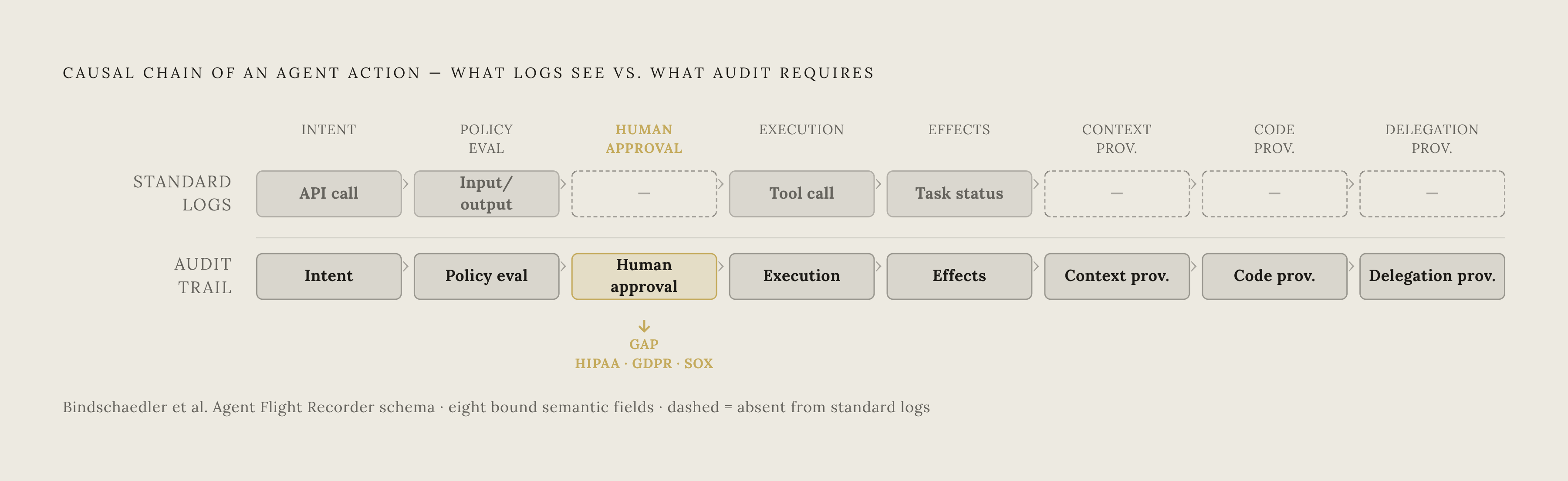
The regulator calls. Infrastructure logs record API calls. Model logs record inputs and outputs. Orchestration logs record task execution status. None of them record what regulated data was accessed, by which specific agent, under what authorization, at what time, and with what policy outcome. An audit trail answers what an autonomous actor decided to do on your behalf, with your tools, and why.
The second structural problem is editability. Standard logs can be altered by anyone with server access. Auditors are now trained to discount logs that cannot prove they were not altered. Every agent action is a potential compliance event because agents execute tool calls, delegate to subagents, and take real-world actions. The dominant failure mode in long-horizon agents is a wrong sequence of actions, not a wrong answer. Bindschaedler et al. identify this in their Agent Flight Recorder paper at BCCA 2026: current observability stacks such as OpenTelemetry spans and vendor dashboards assume mutable internal logs and a single party that both produces and consumes telemetry. Neither assumption holds for agents acting on behalf of an enterprise.
What an agent action actually is, and why it creates a longer evidence chain than any prior software
An agent action is not a discrete API call. It is a causal sequence: intent, policy evaluation, tool invocation, delegation, effect, and provenance. An audit system that cannot reconstruct that full sequence cannot answer the questions a regulator will ask. Bindschaedler et al. define an agent action as any discrete step in a long-horizon execution: a tool invocation, an approval gate decision, a delegation request, or an external side effect such as a file write, an API call, or a database mutation. The unit of harm is the sequence, not any single step. A destructive command that ran in production or a prompt injection that propagated across agents leaves a trail that spans multiple systems and multiple identities.
Multi-agent and MCP-based architectures make the chain longer. Agents delegate to subagents, which may themselves call tools. The chain of authority must be traceable end to end, not just at the entry point. Traditional IAM frameworks assign identities to humans and static service accounts. Agents in multi-agent architectures need dynamic, scoped identities provisioned just in time. The 2026 Singapore Consensus on Global AI Safety Research Priorities identifies traceable identity as a core agentic risk management principle, recommending that every agent action be attributable to a specific agent instance with a bounded, verifiable identity. The NIST NCCoE concept paper from February 5, 2026 makes the same recommendation: treat AI agents as identifiable entities within enterprise IAM systems, not anonymous automation operating under shared credentials.
The authentication gap shows how far most deployments are from that standard. Research documented more than 1,800 active MCP servers on the public internet with no authentication. An agent acting through one of those servers has no verifiable identity attached to its actions at all. The evidence chain breaks before it begins.
The minimum schema an audit trail must capture, field by field
Across every major framework, the requirements converge on a minimum set of fields that most enterprise AI logging does not capture today. The hardest field is individual human attribution, not retention period, not encryption, not format. Bindschaedler et al.'s Agent Flight Recorder captures eight semantic fields per event, bound into a single canonically serialized record: intent, policy evaluation, human approval, execution, effects, context provenance, code provenance, and delegation provenance. For every consequential action the trail must capture the recommendation, meaning what the agent proposed; the approval, meaning which human signed off under what policy; the action, meaning what the agent actually did at the tool boundary; and the outcome, including errors or escalations. Missing any one of these four leaves a hole the auditor will find.
A common failure pattern illustrates the gap. The log records that an agent escalated for human review but never records whether the review was completed or what it concluded. The auditor sees the question and cannot see the answer. The most commonly missed field is authenticated human user identity. AI systems frequently access regulated data under a service account or API key, and no log records which individual directed the access. HIPAA's unique user identification rule, GDPR's accountability principle, and SOX's audit trail requirements all demand individual attribution that service account logging cannot provide.
A critical 2026 shift concerns reasoning. Human-readable reasoning will be required under the EU AI Act's right to explanation, Article 86, applying from December 2, 2027, and under GDPR Article 22. Scale is a real infrastructure consideration. An enterprise running a high volume of agent decisions per day may generate audit data measured in terabytes per week. The schema must be designed for that volume from the start, not retrofitted after the storage bill arrives.
What the regulations now actually require, and when enforcement started
Three regulatory events in the first half of 2026 converted AI audit trail requirements from guidance into enforceable obligations. On February 23, 2026, COSO published "Achieving Effective Internal Control Over Generative AI." For public-company accountants, a control that cannot demonstrate a complete audit trail capturing prompts, inputs, outputs, model and configuration versions, and evidence of human review may not survive PCAOB AS 2201 scrutiny. On March 19, 2026, the SEC announced a dedicated SOX enforcement group targeting audit firm misconduct. AI-touched controls are squarely in scope, with tighter penalties and lower tolerance for ICFR failures.
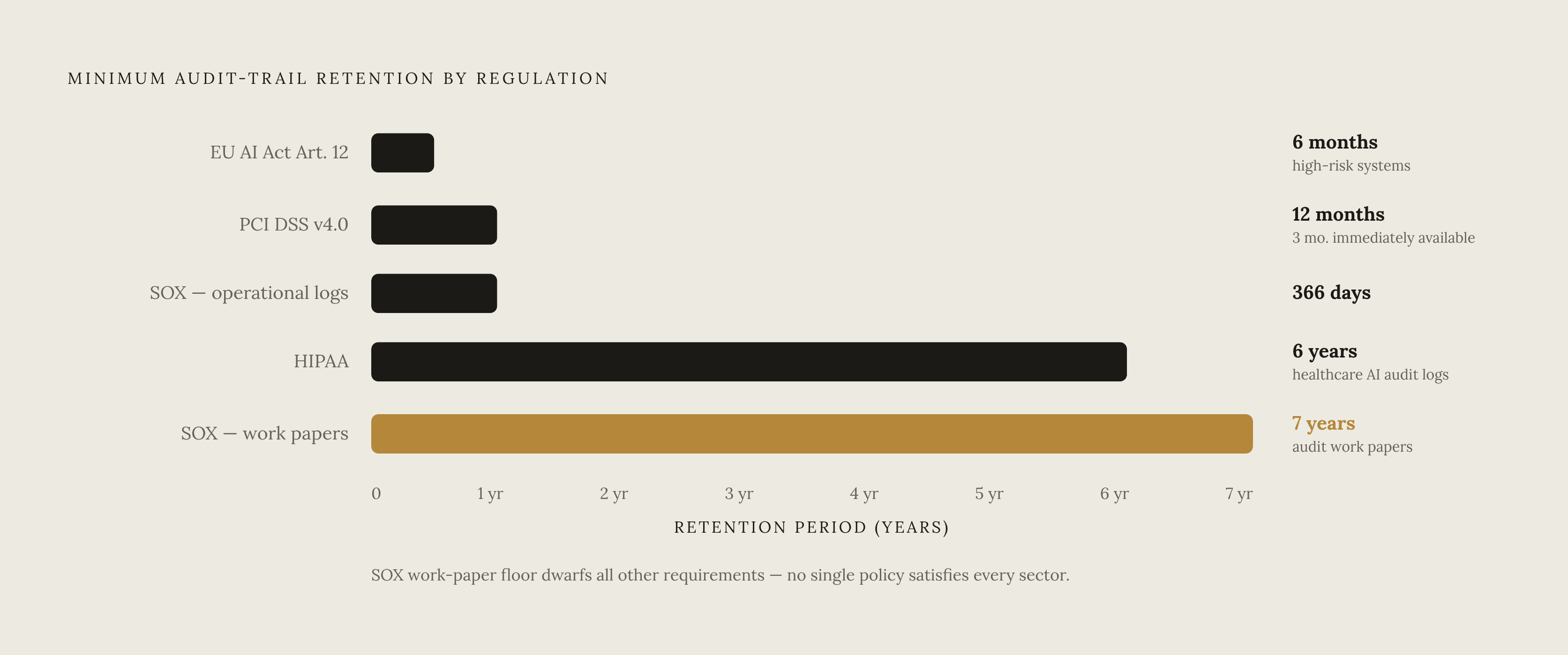
The EU AI Act applies to most consequential agent deployments. Enterprise agents that touch hiring, credit, customer service triage, or medical recommendations fall into the high-risk category under Annex III, triggering mandatory requirements under Articles 10, 12, 14, and 49. Retention floors differ enough by sector that a single policy will not satisfy all of them simultaneously. EU AI Act Article 12 requires a minimum of 6 months for high-risk systems. SOX-relevant systems require at least 366 days of operational logs and 7 years of audit work papers. HIPAA requires 6 years for AI audit logs in healthcare. PCI DSS v4.0 requires 12 months, with 3 months immediately available.
The U.S. federal signal points higher. NIST's AI Agent Standards Initiative launched February 17, 2026. The proposed AI Agent Accountability Act in the U.S. Senate aims to establish clearer liability frameworks for autonomous agents involved in hacking incidents. The PunkGo "Right to History" paper frames the point clearly: the absence of verifiable agent history is now a regulatory liability, not a design gap.
How MCP's security vulnerabilities turn an incomplete audit trail into a forensic dead end
MCP has become the dominant agent integration layer, and its vulnerability surface can corrupt both agent behavior and the audit record simultaneously. Wiz Research found MCP servers in a large majority of observed cloud environments in early 2026, establishing MCP as infrastructure rather than experiment. Between January and February 2026, security researchers filed more than 30 CVEs targeting MCP servers, clients, and infrastructure components. The vulnerability surface is actively exploited.
The confused deputy attack is specifically relevant to audit integrity. An MCP server with ambient authority gets manipulated into performing unauthorized actions when broad permission scopes and missing per-action authorization allow an attacker who influences model inputs to redirect the server's elevated privileges without authenticating directly. Logging only the handshake and not the subsequent tool calls is the equivalent of recording who entered a building but not what they did inside.
Palo Alto Networks Unit 42 measured a high attack success rate when multiple MCP servers were connected to a single AI agent, quantifying the risk of the multi-server architectures enterprises commonly deploy. That creates prompt injection, tool poisoning, and indirect injection surfaces requiring defense-in-depth. The 2026 Singapore Consensus identifies adversarial resilience as a distinct principle alongside auditability, precisely because attacks can undermine the audit record itself.
Credential isolation addresses part of this. The MCP server acts as a credential boundary. Runlayer's control plane ties identity to every action through SSO, SCIM, and just-in-time credentials, and it maintains tamper-proof audit records across the full causal chain from intent through delegation to final effect.
What tamper-evident actually means in implementation, and where the genuine hard problem lies
Hash chaining and on-chain anchoring solve the post-capture tampering problem decisively. Bindschaedler et al.'s Agent Flight Recorder demonstrates how. Each event is canonically serialized, binding the eight semantic fields. Periodic on-chain anchoring of epoch roots lets any third party with the payload and Merkle proof check the record independently, without trusting the operator or agreeing on an intermediary in advance. The full integrity stack detects edit, delete, reorder, and fork tampering at 100 percent with zero false positives in evaluation. L2 anchoring costs $2.30 per 100,000 events. This is not expensive in compute or in money.
Zhang's PunkGo sovereignty kernel takes a complementary approach. It uses RFC 6962-style Merkle tree audit logs, capability-based isolation, and a human-approval mechanism built at the kernel level. The trusted computing base is the verified kernel, not the LLM. A 2026 architecture paper motivated by an OpenAI and Hugging Face incident proposes blockchain-anchored cryptographic commitments for selected agent communications, human-in-the-loop approvals, tool calls, and process artifacts, without placing sensitive content on-chain. That addresses the privacy concern in regulated industries.
The harder and less-discussed problem is pre-capture integrity. If the agent or operator controls the logging layer, a sophisticated attacker can fabricate a clean record before it is ever hashed. This is not a reason to reject tamper-evident logging. It is a reason to understand its assurance boundary: it proves the record was not altered after capture, not that it was complete and accurate at the moment of capture.
The 2026 Singapore Consensus treats auditability as a first-class principle, Principle 3, alongside least privilege and traceable identity. The technical architecture of audit trails is a safety question, not only a compliance question. Systems designed for agent governance embed immutable audit recording directly into the control plane, as Runlayer does, so that every agent decision, authorization check, and tool invocation is locked in as evidence rather than a mutable claim.
Building audit trails into agent architecture from day one, not retrofitting them afterward
A retrofitted audit trail is structurally weaker than one built into the enforcement layer. Only a trail that is a byproduct of the agent's own policy enforcement can guarantee that every consequential action was captured at the moment it occurred. An agent that can act without going through the enforcement gate can act without creating a record.
The correct architecture for per-agent identity is also the architecture that makes individual attribution possible. Just-in-time provisioning, scoped credentials, automated rotation at short intervals for production workloads, granular MCP consent scopes, an agent that reads Slack messages should not hold a token that can also delete them. These are the same mechanisms that make the audit trail defensible. Least privilege, traceable identity, and auditability are not three separate controls to layer on. They are three expressions of the same architectural commitment, designed in together.
The platform question is where this meets operational reality. Platform engineers become bottlenecks when every team that wants to deploy an agent needs custom auth and logging plumbing built for them. A unified platform that provides built-in credential handling, SSO and SCIM-tied identity, and per-tool-call audit logging at the infrastructure level lets security teams become enablers rather than gatekeepers. Only a platform that provides the golden path for agent deployment can ensure that the agents employees actually use are the ones that produce defensible records. The governance structures being built now, the CISO's controls, the platform team's tooling, the compliance team's retention policies, will be audited against the full schema as a baseline. The teams that build this into their architecture in 2026 will answer the regulator's first call with a query, not a scramble.