JIT Credential Provisioning for AI Agent Tool Access
Dynamic token expiry blocks standing privilege only with per-invocation policy checks.
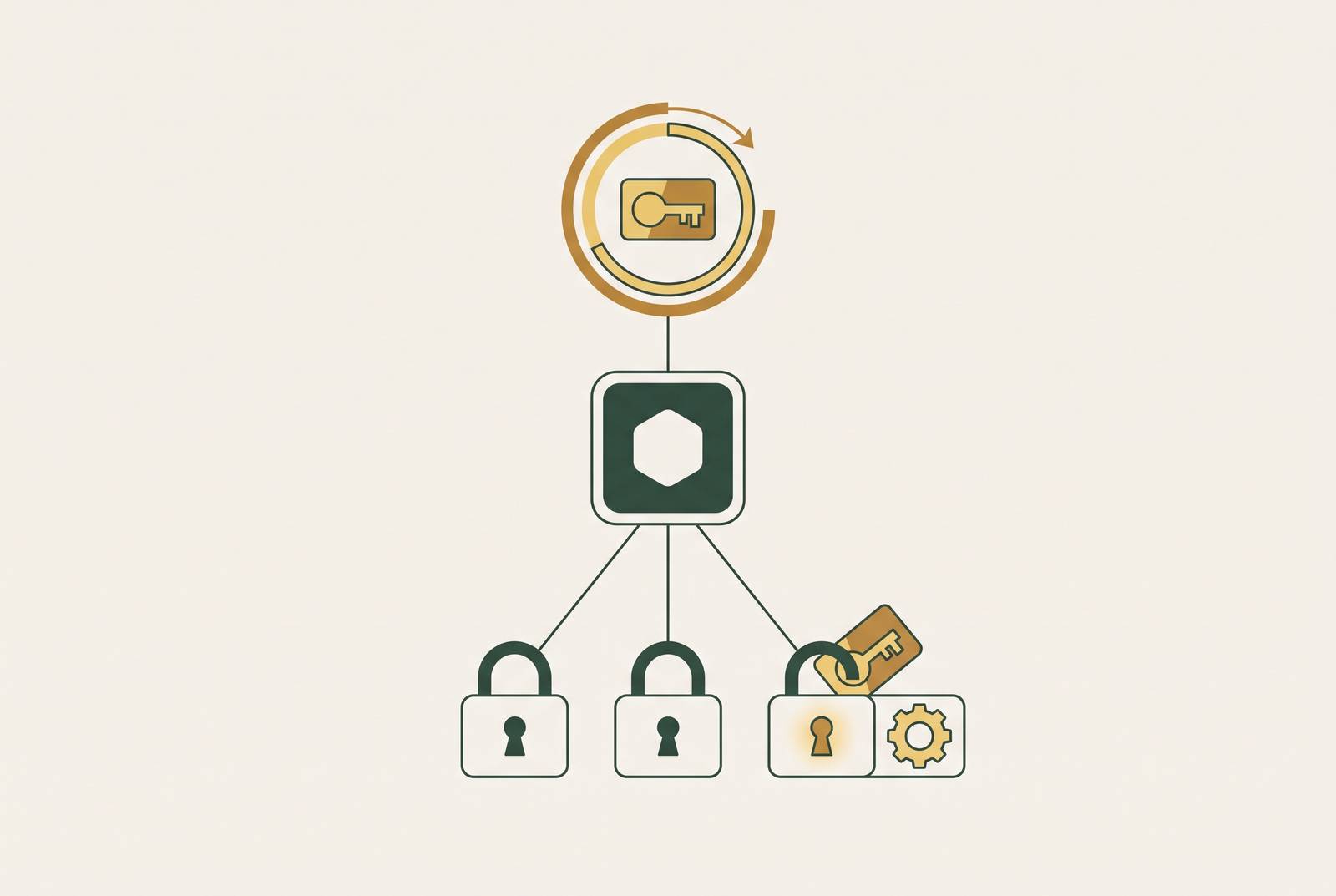
Securing OAuth credentials for enterprise AI agent tool calls requires just-in-time provisioning, with access issued for a specific invocation and revoked when the task ends or its context changes. Static credentials let agents keep authority they do not need at the time. JIT closes that gap only if each new request goes through fresh policy checks, with limits that stop repeated requests from building standing privilege back up.
Why AI agents break the identity model that enterprise security was built on
An enterprise agent deployment can start with API keys hardcoded in config files, OAuth tokens with no expiration, and service principals whose permissions came from a developer’s testing account. These credentials may never enter an inventory or receive a review. The patchwork becomes the production access model. When an agent takes an unexpected action, the organization cannot say who authorized it or what it was supposed to do. That is an accountability failure before it is a token-management problem.
The underlying model assumes a human who logs in, performs bounded work, and logs out. Agents choose tools and the steps between them at runtime. Speed removes the chance for human intervention. An agent can complete one action and invoke the next tool before a reviewer could respond, while subagents introduce delegation boundaries whose trust relationships are rarely cryptographically verified. Agents that exist only long enough to finish a task also make pre-provisioning every identity impractical. Authorization therefore has to govern a changing sequence of actions.
How standing permissions turn into a compounding liability as agents multiply
Machine identities already far outnumber human ones, and each agent deployment adds more access relationships to keep track of. One agent may have credentials for CRM, email, cloud infrastructure, and payment systems all at once. One compromise exposes the whole credential set. As deployments multiply, the inventory grows while the links between agents, owners, purposes, and permissions become harder to follow. Standing access turns that governance lag into usable authority.
A code review bot may have permission to read a repository and to use an external code-quality service. Both permissions can look reasonable in isolation. Together, they can create an exfiltration path that no policy writer anticipated. Dynamic tool discovery through configured MCP servers further weakens policies written for fixed tool registries, because the available actions need not stay within the original assumptions. Privilege accumulation is therefore a product of how agents compose capabilities. The resulting sequence must stay within the intended task.
What JIT credential provisioning actually does, and what it replaces
JIT credential provisioning replaces a pre-provisioned, long-lived credential with one issued at runtime for a bounded task. Before issuing it, a policy engine evaluates the agent, the operation’s sensitivity, the delegating principal, and the current risk state. The credential is bound to the workload identity of the running software. It contains only the permissions needed and expires with the task, with automatic revocation when the context changes or a policy condition stops being satisfied.
Two provisioning models support different agent lifecycles. Minimal Profile JIT gives ephemeral or external agents a unique identifier and token-based attributes, including OAuth scopes or JWT claims, without requiring a full directory entry. Full Profile JIT registers recurring internal agents with richer attributes, including provenance, delegation chain, time to live, and risk classification. Each tool that is exposed needs its own scope string, a named permission that allows that tool to run. With runtime checks and a record of each invocation, the data it accessed, and its outcome, this architecture does more than give broad credentials a shorter life.
The MCP authorization gap that makes JIT necessary right now
The Model Context Protocol has become a primary layer for enterprise agent tool access, but its authorization rules have an important boundary. Authorization itself is optional. An HTTP-based deployment can remain spec-compliant without requiring authentication, even though implementations supporting authorization should follow the specification. Under that model, servers must use OAuth 2.0 Protected Resource Metadata as set out in RFC 9728, clients must send the resource parameter defined in RFC 8707, and servers must reject tokens that were not issued for them. Those requirements bind tokens to their intended resource, but they do not make every deployment authenticated.
Enterprise-Managed Authorization, shipped June 18, 2026, enables zero-touch OAuth for remote MCP servers at scale. The authorization guidance also says to check every tool invocation and deny access by default. In April 2026, OX Security reported a flaw in the underlying architecture that affected vulnerable instances across a supply chain with hundreds of millions of package downloads. Check Point Research disclosed remote code execution in Claude Code through poisoned repository config files, while Antiy CERT reported over a thousand malicious skills across ClawHub, the marketplace for the OpenClaw AI agent framework. These exposures make broad credentials especially dangerous. JIT and per-invocation enforcement must work above the protocol because following the protocol does not guarantee protected access.
How per-invocation scoping and task-bound expiry work at the tool-call level
Step one is to establish the requesting agent’s identity and authority. Kurtz & Krawiecka (2026) formalize an AI Identity Registry containing a unique identifier, identity type, business purpose, provisioning date, access grants, associated systems, and designated human owner. SPIFFE/SPIRE supplies cryptographically verifiable identity tied to a workload. Delegation needs its own proof as well. The OpenID Foundation’s framework for Identity Management for Agentic AI calls for explicit “on-behalf-of” delegation, so the agent proves both its identity and its permitted authority without presenting itself as the user.
Step two is to evaluate the principal, tenant, and specific action separately at invocation time. The agent must establish its task and why current policy permits the request before a token is issued. Step three is to grant only the scope that the tool needs. Permission to run one tool does not authorize the next tool in the chain, which must face its own decision. Finally, the credential is revoked when the task ends or the execution context changes, so it does not remain unused but valid until calendar-based rotation takes place. The target is Zero Standing Privilege, with no credential held at rest. The accompanying audit record captures tools invoked, permissions granted, data accessed, and outcomes, rather than merely recording that the agent authenticated.
Why short-lived tokens alone do not prevent privilege accumulation through rapid re-request
An agent can finish an action, request another credential, and move immediately to a different tool or workflow. If the issuance path checks only an existing role, expiry changes little about effective access. The agent simply renews its authority in bursts. Sequential short-lived tokens can preserve continuous access to a sensitive system, while individually approved calls combine into a trajectory nobody approved. JIT is necessary, but token expiry alone is insufficient.
This limit is harder to spot in long-running and multi-agent workflows because there may be a valid reason to renew access. A workflow may resume after interruption or delegate part of its work to a subagent. Legitimate renewal can still expand effective privilege. Kurtz & Krawiecka identify the aggregate effects of individually authorized steps as a distinct governance challenge and treat agent-to-agent delegation as a separate accountability surface. Every new credential request must be evaluated against current intent, data sensitivity, destination, and risk state. That is closer to intent-based authorization than a role check made once at enrollment, because it asks what the agent is trying to accomplish now.
How do you enforce access policies on MCP tool calls?
The enforcement point must sit on the credential request path, with policy-as-code evaluating each issuance and re-issuance. The agent must prove its workload identity, the task it has declared, and its permission to act now. A previous token is not fresh approval. At the MCP server, deny-by-default rules mean that the tool invocation must have an explicit scope that allows it under current conditions.
Re-issuance controls must also evaluate the workflow as a whole. Explicit limits on request frequency and cumulative scope stop sequential tokens from reconstructing standing privilege. Context changes must trigger revocation as well. A different downstream tool, data sensitivity tier, or tenant requires a new decision. Each fresh check must take account of the access the workflow has built up, because that history is needed to enforce a cumulative limit.
Delegated work requires explicit “on-behalf-of” assertions and cryptographic verification at every boundary. A subagent must prove its own identity and the chain of authority from the delegating principal. Each tool still requires a separate permit. Behavioral monitoring then keeps policy signals flowing when intent drifts or prompt injection and tool poisoning change how the work runs. Those signals belong in the live decision path, where they can affect access, rather than only in an audit reviewed after completion.
What the regulatory floor now requires from agentic credential governance
The EU AI Act starts to apply in general in August 2026, including Article 50 transparency and GPAI enforcement powers, while high-risk AI rules were pushed back to December 2027. Those distinctions limit the compliance claim. Not every enterprise agent is a high-risk AI system, and the Act does not prescribe JIT credential provisioning by name. For high-risk systems, Article 12 requires automatic event logging with enough detail to trace how the system works, help identify risks, and support post-market monitoring and oversight by the deployer. Per-invocation records provide a technical basis for that traceability.
The minimum six-month log-retention provisions come from Article 26(6) and Article 19, supplementing Article 12’s logging provisions. Article 12(3)’s specific requirements concerning reference databases, input data leading to matches, and people verifying results apply to remote biometric identification systems. They are not universal agent-logging requirements. The Act also does not expressly require proof of how decisions were reasoned through or which governance policy was used at every execution point.
US state-level rules for automated decisions, including the Colorado AI Act and California’s ADMT regulations, also require audits. For a JIT implementation, the lesson is to retain tamper-proof records of invocations, permissions, data access, and outcomes, linked to the agent and delegating principal. Authentication logs alone leave too much unexplained. Recording which policy was used and tracing delegation chains helps show how an outcome came about, though the exact legal duty depends on the system and the rules that apply.
What a production-ready JIT credential architecture looks like end to end
A production architecture begins with a distinct machine identity linked to a named owner, approved purpose, trust level, lifecycle state, and credential expiration details. Cryptographically verifiable workload identity establishes which agent is running, while delegation assertions establish whose authority it may exercise. The request then reaches the policy engine. That engine evaluates the intended task, data sensitivity, destination, and current risk state before provisioning a tool-scoped credential. The MCP server enforces the explicit permit, and task completion or context change ends the grant.
The next request must go through the same path and get fresh approval. Re-issuance limits and cumulative-scope caps constrain the workflow, while behavioral monitoring can change the decision during execution. Audit completes the chain of control. Tamper-proof per-invocation records capture the tool, scope, data, outcome, and applied policy, while full OTEL tracing connects agent-to-agent delegation from the triggering principal to the terminal action. A system that expires credentials but cannot constrain their replacement has automated renewal and retains standing privilege.