Slack and Collaboration Tool Integration as an AI Agent Onramp
Making Slack the safest entry point for enterprise AI agents.
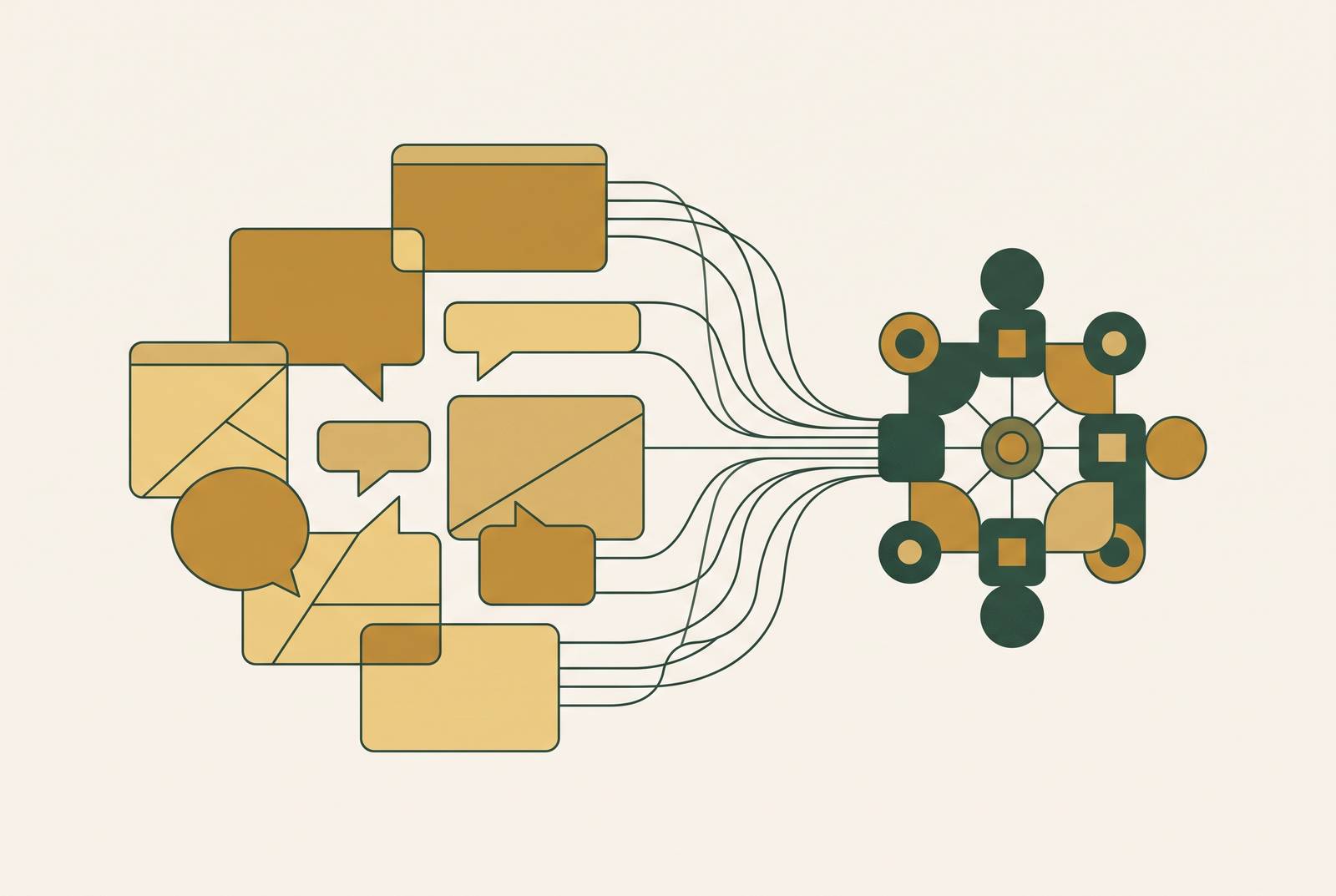
Employees already spend the majority of their working day in Slack, and context switching is the enemy of adoption. Every extra click between a question and an answer is a small tax on attention, and enough of those taxes add up to nobody using the tool.
The math backs this up. Slack's own research puts the average enterprise juggling more than 1,000 applications, with as much as 40% of productivity lost to copying, pasting, and hopping between them Unlocking the Power of Conversation: How Slack’s New Platform is Fuel…. That's nearly half a workday spent on friction instead of work. When Slack surfaces the right data inside a channel instead of forcing someone to go find it, teams save an average of 97 minutes a week, Slack's own figures show Unlocking the Power of Conversation: How Slack’s New Platform is Fuel….
Scale matters here too. Slack counts more than 750,000 paying customers, an installed base no purpose-built agent interface is going to match anytime soon Slack Platform Overview | Slack Slack Blog. A brand-new AI app has to convince someone to adopt a habit from zero. Slack just has to get better at the habit people already have.
None of this is a verdict on which language model is smartest or which consumer AI app has the slickest interface. Narrower and more practical, the task is making Slack a governed, enterprise-grade entry point for AI agents, which takes more than making it a convenient one. Convenience got Slack the invite. Governance decides whether it keeps the seat at the table.
Slack's dual MCP role, server and client in the same platform
Slack didn't just plug AI into chat.
First came the server. In February 2026, Slack switched on an MCP server at mcp.slack.com/mcp, letting outside AI tools like Claude, Perplexity, and Google Agentspace pull conversational data out of Slack and act inside it Metrigy. Then, in June, Slack flipped the direction Metrigy. On June 18, 2026, Slack announced MCP client support for Slackbot, meaning Slackbot now reaches out, via MCP, to any knowledge base or tool that offers MCP support Metrigy.
The server side runs on a fairly disciplined setup: Streamable HTTP, Confidential OAuth 2.0 with permissions scoped to the individual user, and a hard rule that only directory-published or internal apps can connect, unlisted apps get shut out.
For a platform team, that's a significant architectural footnote. It means every single agent integration now has two possible directions data can flow, and each direction needs its own authorization model and its own audit trail. Slack has built its client side to plug into existing compliance and governance controls, with MCP access managed through the Slack Marketplace Registry, which is the lever enterprises will actually pull when they want to control this.
This is happening now, and this growth curve turns an architecture question into an urgent one. Two distinct MCP moves occur in sequence. As a result of this dual posture, Slack is simultaneously a data source for external agents and an orchestration layer that dispatches Slackbot to external systems, and no other enterprise messaging platform has deployed both roles. Slack Blog reports a 25x increase in both RTS queries and MCP tool calls since limited release, the adoption signal that makes this architectural question urgent, not theoretical.
The March 2026 "Agentic OS" launch and Slackbot's new capabilities
On March 31, 2026, CEO Marc Benioff and co-founder and CTO Parker Harris unveiled more than 30 new AI-powered features in San Francisco, repositioning Slackbot from a conversational assistant into an autonomous digital coworker Slack Platform Overview | Slack Metrigy.
With MCP client capability, Slackbot can now reach across a genuinely large footprint: more than 2,600 Slack Marketplace apps and more than 6,000 Salesforce AppExchange integrations Slack Platform Overview Slackbot Becomes a 30-Feature Autonomous Work Agent via MCP | AI2Work.
What does that look like day to day? Slackbot can transcribe a Zoom call, keep track of what's on someone's desktop for context, draft a multi-step workflow off a single instruction, and route a specialized request straight to Salesforce Agentforce without anyone lifting a finger.
The rollout has been staged, and the staging matters for anyone planning around it. Core agentic features went live January 13, 2026, for Business+ and Enterprise+ subscribers. Free and Pro users got a limited version starting in April 2026. MCP client support followed on June 17, 2026, at no extra cost to existing Slackbot customers.
The partner list reads like a who's-who of the space: more than 50 partners, including Anthropic, Google, OpenAI, and Perplexity, are already building context-aware agents on top of the platform Slack Blog. Trivago offers a concrete early data point here. Its internal AI tool, Trivago Copilot, reported positive early feedback testing Slack's MCP, pulling live Slack context into its workflows and posting updates back to Slack without ever switching context.
Zooming out, the scale gets almost hard to grasp. If Salesforce eventually ships MCP client support across its full base of 750,000-plus paying customers, this becomes one of the largest MCP client deployments by user count that exists anywhere, dwarfing the developer-focused MCP clients the ecosystem was originally built around. Slackbot as MCP client can now orchestrate across a defined set of systems. 20+ MCP-capable apps were announced at the June 2026 launch, spanning analytics, document management, workflow management, collaboration, and software development vendors.
The attack surface that opens when agents route through Slack
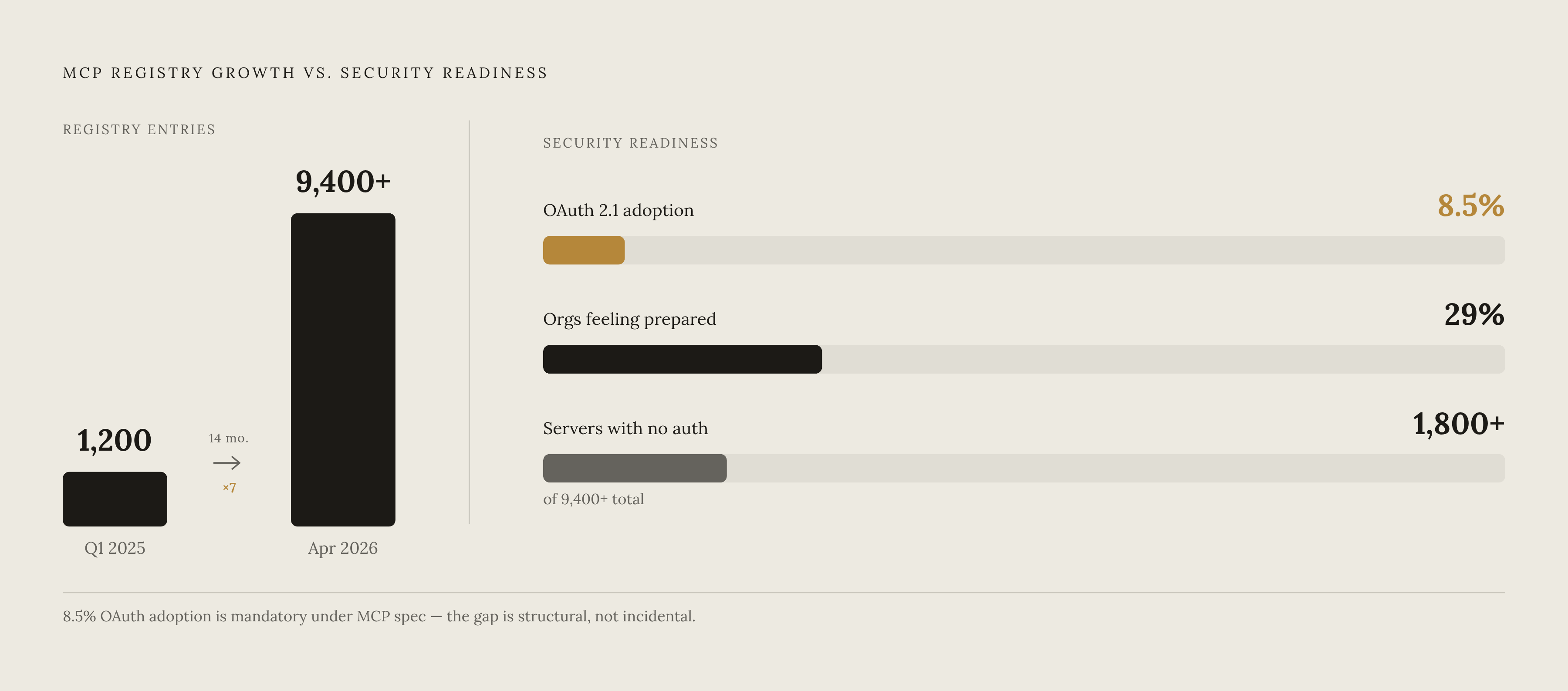
Growth this fast tends to outrun the guardrails, and MCP is no exception. The public MCP server registry went from around 1,200 entries in the first quarter of 2025 to more than 9,400 by mid-April 2026, better than 7x growth in fourteen months. Governance did not grow at the same pace.
Start with the authentication gap, because it underlies everything else. Only 8.5% of MCP servers currently implement OAuth 2.1, even though it's supposed to be the mandatory standard for remote deployments, and researchers found more than 1,800 active MCP servers on the open internet with no authentication at all. Against that backdrop, Cisco's State of AI Security research found only 29% of organizations feel prepared to secure agentic AI deployments. That's the baseline every other number below has to be read against.
Four categories of threat matter most once agents start routing through Slack.
Tool poisoning comes first: malicious tool descriptors dress themselves up as legitimate tools, and once an agent uses one, it hands over access to MCP infrastructure, a supply chain problem specific to how MCP works. Prompt injection is second, and it's growing fast. Attackers hide commands inside Slack messages or in external data that Slackbot fetches, and HackerOne's 9th Annual Hacker-Powered Security Report recorded a 540% surge in prompt-injection vulnerabilities, calling it the fastest-growing threat in AI security Unlocking the Power of Conversation: How Slack’s New Platform is Fuel….
Command injection and path traversal round out the middle. Equixly's assessment covering 2025 into February 2026 found 43% of tested MCP servers vulnerable to command injection, and Endor Labs, looking at 2,614 MCP implementations in 2025, found 82% of those using file operations were prone to path traversal. Then there's server-side request forgery and unmanaged shadow MCP servers: BlueRock Security's 2026 research found 36.7% of more than 7,000 servers vulnerable to SSRF, and shadow MCP servers, meaning unmanaged instances employees connect on their own without telling IT, extend all of the above risks into places governance teams can't even see.
None of this is hypothetical. In April 2026, OX Security disclosed a systemic architectural flaw that touched an estimated 200,000 vulnerable instances, sitting inside a supply chain with more than 150 million package downloads. Enkrypt AI's scan of 1,000 servers found 33% carrying critical vulnerabilities, which is a structural baseline problem, not an outlier.
The part specific to Slack works as follows. Because Slackbot now acts as an MCP client reaching out to external tools on behalf of users, a single poisoned or badly configured external server doesn't just compromise one developer's laptop Metrigy. It can compromise a workflow running on behalf of every Slackbot user in the workspace at once.
Privilege escalation and credential sprawl compounding in multi-agent Slack workflows
Shared service accounts are where a lot of this goes wrong. When an agent authenticates through one shared account, every query it runs carries that account's full combined privileges, and the actual permissions of the person who triggered the request just disappear from the equation.
Privilege escalation follows naturally from there. A breached tool or agent uses whatever initial access it has to climb toward higher-level permissions, moving from a narrow foothold to system-wide control, and lateral movement becomes almost trivial once an environment is loosely secured. Multi-agent chains make this worse, not better. When Slackbot, acting as an MCP client, routes a request to an external agent, and that agent calls a second tool through MCP, the permission model has to account for every hop in that chain Metrigy. Trust is not supposed to escalate as it passes along, but without explicit controls in place, it often does anyway.
This is the confused deputy problem, and it appears directly in Slack workflows. If Slackbot calls an upstream API, it needs to hold its own token and act as a genuine client, otherwise the intermediary ends up holding more authority than the original caller was ever entitled to.
Credentials themselves are part of the fix. Long-lived API keys sit around creating standing access indefinitely, while runtime-scoped, ephemeral credentials shrink the blast radius and force a real policy decision at the exact moment an action happens. Every MCP server an agent connects to is a new credential path into a system, and Nudge Security's research documents MCP server sprawl as a fast-growing extension of the SaaS attack surface that ordinary discovery tools simply don't catch.
The structural fix is workspace isolation. A finance agent should only ever see finance systems, a sales agent only the CRM, so the blast radius of any single compromise is bounded by design rather than left to hope.
The MCP 2026-07-28 protocol revision's changes for enterprise authentication
MCP's maintainers didn't tinker at the edges this time. On May 21, 2026, they published the release candidate for MCP 2026-07-28, described as the largest revision of the protocol since it launched. Sessions are gone. The initialization handshake is gone. Three core features have been deprecated, authorization has been rewritten from the ground up, and a new framework for extensions has been added, formally putting MCP servers into OAuth 2.1 resource server status.
Two changes matter most for enterprise teams. MCP servers must now implement OAuth 2.0 Protected Resource Metadata under RFC 9728, so a client can automatically find the correct authorization server instead of guessing. And MCP clients must implement Resource Indicators under RFC 8707, spelling out exactly which server a given token is meant for, which closes off a specific attack where a malicious server tricks a client into handing over a token meant for somewhere else.
The spec also adds role-based authorization, letting developers use annotations to restrict which tools a given user role can touch, which is exactly the abstraction enterprises need where access varies by job function. Fine-Grained Authorization, or FGA, takes it a step further: instead of granting access to an entire service, it grants access to specific tools within that service, which is what actually makes least-privilege enforceable rather than aspirational.
Even with all that, the spec leaves a real gap open. OAuth 2.1 can prove an agent is who it claims to be, but it says nothing about who authorized that agent, what it's allowed to do on behalf of which human, or whether a downstream service can check that whole chain without having coordinated on it beforehand. An identity layer is starting to fill that gap. It addresses agent identity chain verification directly, but it's still an emerging standard, not something enforced across the ecosystem.
Slack's own posture is tighter than the spec technically requires: Confidential OAuth 2.0 with user-level permissions, and unlisted apps blocked outright. That discipline, though, only covers Slack's own MCP server. Every external server Slackbot reaches out to as a client runs under its own authorization setup, which may be considerably weaker.
Requirements for a governance-ready Slack AI deployment before broad rollout
Think of this as a checklist built around five layers: discovery, identity, authorization, monitoring, and incident response.
Discovery comes first, because you can't govern what you can't see. That means enumerating every MCP server Slackbot can reach, both the directory-published apps sitting in the Slack Marketplace Registry and any servers employees have connected through unofficial paths. That second category, shadow MCP usage, is the failure mode most likely to slip past everyone entirely, since standard SaaS discovery tools don't surface it.
Identity and credentials come next. OAuth or SAML identity passthrough should let agents authenticate as the actual end user and inherit that person's real permissions, which is the only thing that makes role-based access control mean anything once agents start acting. Shared service accounts and long-lived API keys need to give way to task-scoped, ephemeral credentials wherever that's practical. SSO and SCIM integration tie every single tool call back to a real human identity, which is what makes an audit log worth anything later on.
Authorization has to work at the level of the individual tool call, not just the connection. Scope each agent to the specific tools and data it needs for its job, excluding the entire capability surface of whatever MCP server it happens to be talking to. Role-based annotations, using the FGA model the 2026 spec introduced, apply that discipline at the tool level. And in multi-agent chains, trust needs to be granted explicitly and non-transitively. Agent B should never inherit Agent A's permissions just because it's downstream in the chain, that has to be a deliberate decision someone made on purpose.
Monitoring has to be built for MCP specifically. Generic SIEM rules written for ordinary API traffic won't catch tool poisoning, prompt injection, intent drift, or exfiltration, because those patterns don't look like conventional attacks. Tamper-proof audit logs paired with full OTEL tracing give a regulated enterprise the chain of custody it needs to answer a very specific question after the fact: what did this agent do, on whose behalf, and under what authority.
An MCP gateway is what ties all of this together in practice. It acts as the centralized control plane handling authentication, routing, security policy, and observability for every agent-to-tool interaction, and without one, each team ends up managing its own integrations, which makes governance impossible once things scale. The capabilities worth checking for include OAuth 2.0/SAML/SSO authentication, complete audit trails, role-based access control at the tool level, SOC 2 Type II audited status, and real-time monitoring dashboards. Setup time varies enormously depending on the path chosen: MintMCP's published comparison shows setup time ranges from 15 minutes for managed SaaS gateways to 2 weeks for self-hosted deployments, and the operational cost of the self-hosted path is often underestimated.
None of this works, though, until someone in the organization actually owns it. Security and IT teams need to own the MCP registry, the credential lifecycle, and the detection stack before broad enablement happens, not after. Leaving that question unanswered lets shadow MCP usage fill the vacuum on its own.
Evaluation of MCP gateways built for Slack integration
Connect a handful of agents to a handful of tools and the number of individual connections to secure, monitor, and audit multiplies fast. An MCP gateway solves that by sitting in the middle as a single control plane between agents and tools like Slack, cutting down credential sprawl and making governance something a platform team can actually manage instead of chase.
For a platform team evaluating options, the questions come back to the same five layers laid out above: can it enumerate every server in use, including the ones nobody officially approved? Does it enforce identity passthrough so an agent's actions map back to a real person? Can it scope authorization down to individual tools rather than whole services? Its monitoring needs to understand MCP-specific attack patterns, beyond generic API traffic. And does it produce audit logs detailed enough to survive a real incident review?
A gateway that answers yes to all five is doing the job Slack's own dual MCP role demands. Slack got employees in the door by being the place they already worked. Slack becomes the trusted front door for enterprise AI, rather than just the fastest one, only if that governance layer gets built before the rollout, not after.
Sources
- Slack Platform Overview | Slack
- Slack Extends Slackbot via MCP - Metrigy
- Slack Securely Powers Your Third-Party Agents With Your Business Context | Slack
- Unlocking the Power of Conversation: How Slack’s New Platform is Fueling the Agentic Era
- Slackbot Becomes a 30-Feature Autonomous Work Agent via MCP | AI2Work
- The 2026-07-28 MCP Specification Release Candidate | Model Context Protocol Blog
- Best MCP Gateways and AI Agent Security Tools (2026) | Integrate.io
- Salesforce announces an AI-heavy makeover for Slack, with 30 new features | TechCrunch