Platform Engineering Bottlenecks in Enterprise AI Agent Scaling
Credential management becomes the bottleneck blocking enterprise AI agents from scaling.
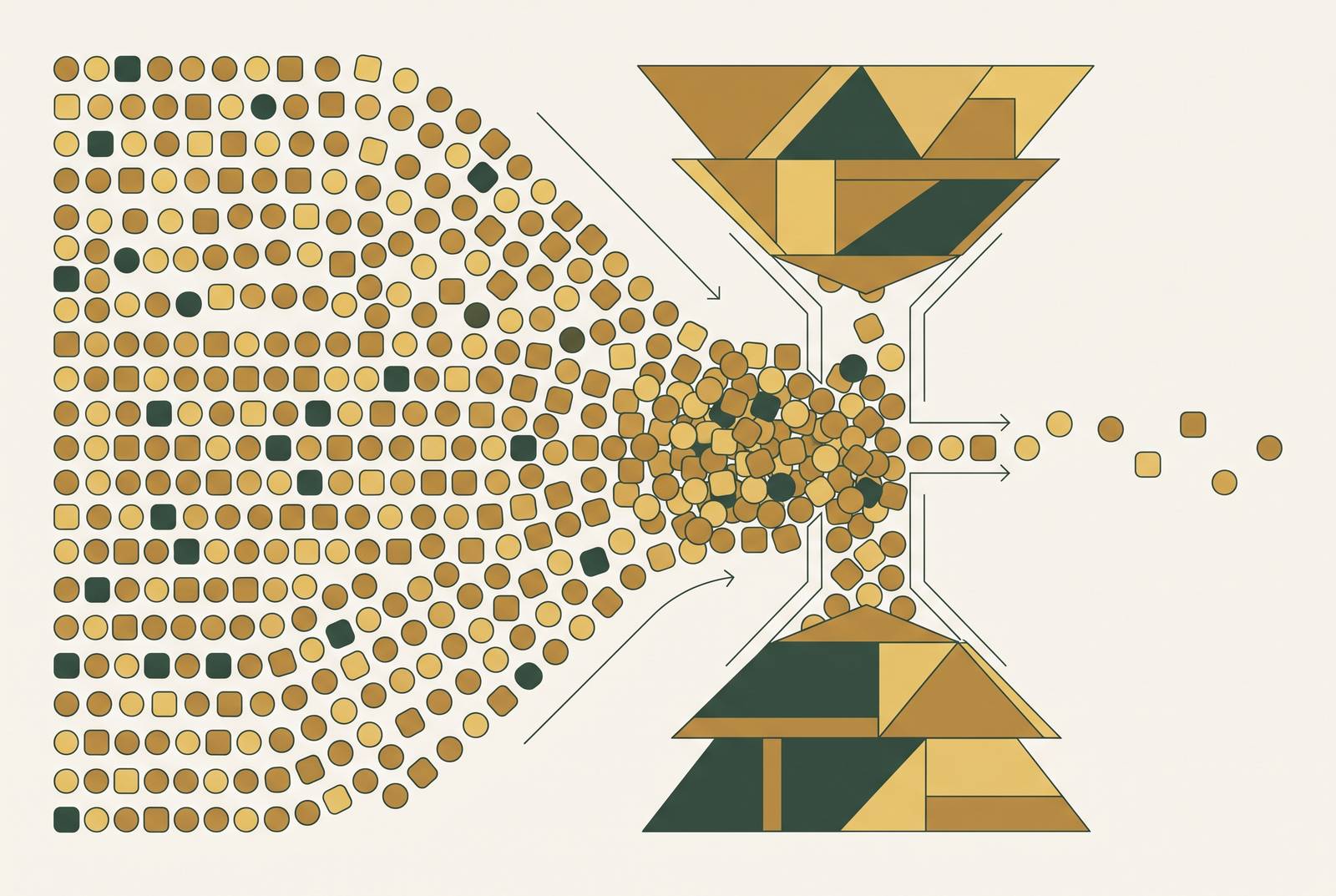
Enterprise AI agents stall on the way to scale when each new tool connection makes platform teams rebuild auth, credential handling, and access controls. Securing OAuth credentials for enterprise MCP tool calls requires a shared layer that manages credential lifecycles, enforces access policy on each call, and ties actions to identity.
Why only 14% of enterprise AI pilots reach production scale
Only 14% of enterprise AI pilots make it to production scale. That leaves a wide gap between getting an agent to work in a trial and making it dependable in daily business operations. The March 2026 survey places that gap at the center of the enterprise AI deployment problem. A working pilot establishes that a task can be done, but it does not establish that the organization can support it at volume.
The investment pattern helps explain the divide. Stalled organizations may spend enough overall while investing proportionally more in model selection and prompt engineering, and less in evaluation infrastructure, monitoring tooling, and operational staffing. That imbalance leaves the work of running agents underfunded even when the work of building them receives plenty of attention.
The five root causes, and why integration complexity stands apart
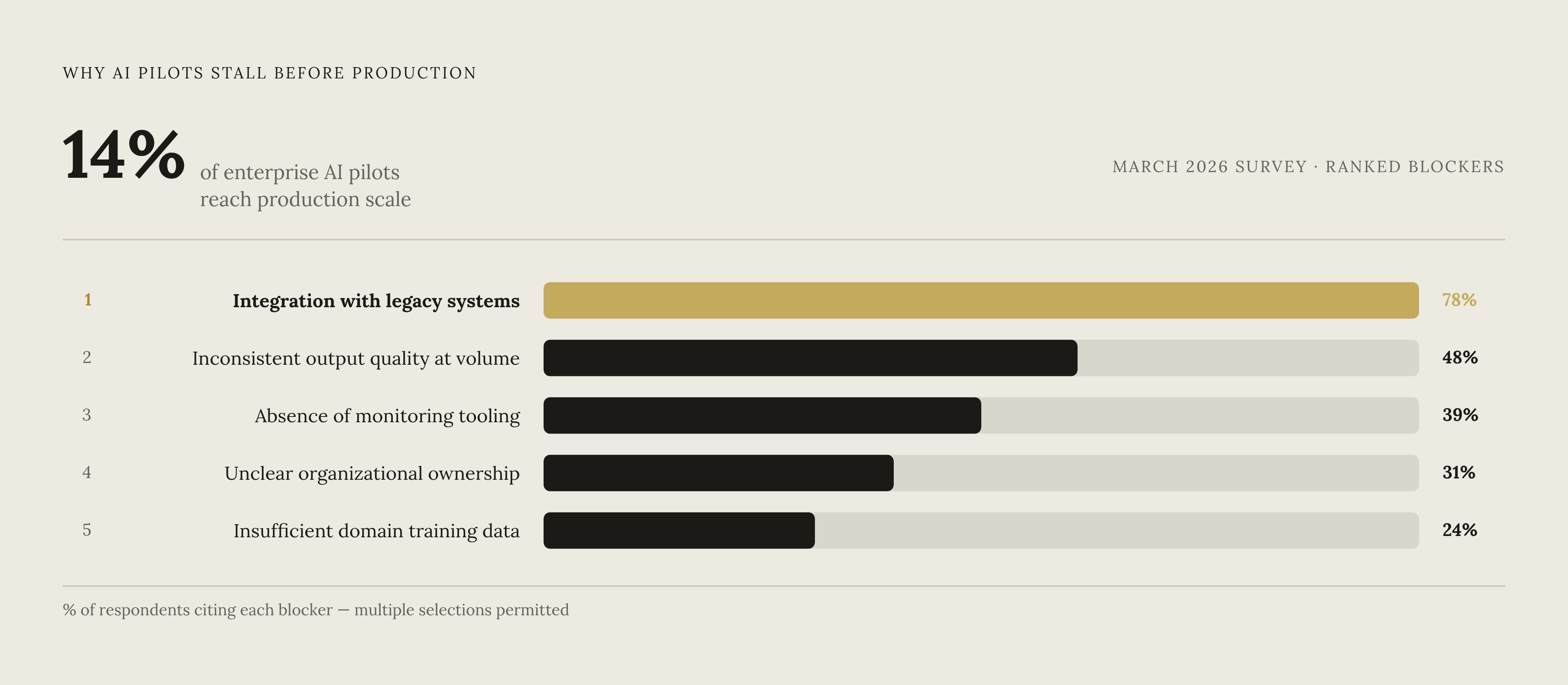
The March 2026 survey ranked five blockers, namely integration complexity with legacy systems, inconsistent output quality at volume, absence of monitoring tooling, unclear organizational ownership, and insufficient domain training data. Integration complexity came first. The other four matter, but they do not operate in isolation. When no one owns the work, holes in monitoring go unfilled, which can hide quality problems as they build up. Integration failures are often the first domino rather than one separate item on a project risk register.
An agent's integration surface expands non-linearly as its scope grows. An agent with a narrow document classification task may need just one data connection. A customer service agent handling billing, orders, and account management needs many more connections, each with its own latency variability, authentication requirements, and failures to handle gracefully. Broadening the task therefore adds more than business logic. It adds a growing set of dependencies that must work together in production.
SoftServe's 2026 platform engineering guide identifies a similar cluster of problems, including unchanged business processes, lack of control and platforms, insufficient organizational change, and no scalable architecture. Gartner predicts that a large share of agentic AI projects will be canceled by the end of 2027 because of escalating costs, unclear business value, and inadequate risk controls. Those concerns converge at the integration layer. At that layer, delivering an agent's intended business value depends on systems, permissions, and operational limits.
How auth and credential plumbing specifically becomes the recurring tax on platform teams
Within that integration work, teams keep having to pay the cost of authentication and credential management. Every new agent and tool connection forces platform teams to resolve how access is granted, which identity is used, and who owns the resulting credential. Organizations variously use workload identities, shared service accounts, or human user identities. Many agents inherit access originally intended for people or other systems. The connection may work, but its access model remains unsettled.
The deployment consequence is blunt. Few of the MCP servers that teams start to build reach deployment, mainly because getting auth requirements right at each integration point is so hard. Repeated infrastructure work blocks a usable tool connection from becoming a production service. Ownership fragmented across security, development, engineering, IT, and IAM makes that work harder to assign.
“Ephemeral permanence” describes what happens when the temporary arrangement outlives its purpose. Credentials issued for a pilot remain in configuration files and environment variables after the agent is decommissioned. The agent is gone, but the credential is not. The SANS 2026 NHI Survey found that the vast majority of organizations fail to rotate machine credentials even on a 90-day cycle. Gartner predicts that by 2028, 90% of organizations allowing humans to share credentials with AI agents will need significant investment to undo that design because of security and compliance issues.
Platforms like Runlayer centralize MCP credential and identity management across agent integrations, replacing repeated auth plumbing with a governed layer that can enforce policy at the credential level.
Why MCP's rapid adoption turned the auth problem into a security surface
MCP's adoption as the de facto agent-to-tool interface has raised the stakes of those scattered credentials. The protocol is implemented across tens of thousands of enterprise servers, has hundreds of millions of monthly SDK downloads, and has been adopted by major platform vendors. Auth gaps at that scale create a broad attack surface across the connections that agents use to reach enterprise tools.
Security researchers catalogued thousands of internet-exposed MCP servers in early 2026, with roughly half operating without authentication controls. In environments without centralized credential management, each server maintains its own authentication configuration. Developers store API keys in environment variables and hardcode OAuth tokens in configuration files. The same fragmentation that slows deployment also leaves security teams with separate access arrangements to understand and defend.
The Sandworm_Mode campaign made the risk concrete by February 2026. It used npm typosquatting to target AI coding assistants including Claude Code, Claude Desktop, Cursor, VS Code Continue, and Windsurf. Malicious packages installed rogue MCP servers that used prompt injection to exfiltrate SSH keys, AWS credentials, and npm tokens. Wiz Research disclosed a flaw in the Amazon Q VS Code extension in June 2026 that let a crafted workspace MCP configuration file allow arbitrary code execution and the theft of cloud credentials. A related symlink CVE accompanied that disclosure.
These threats also expose a limit of conventional network controls. An agent task can generate a sequence of legitimate, authenticated requests even when a document read several steps earlier has redirected its behavior through prompt injection. A gateway that cannot interpret MCP protocol semantics cannot detect that semantic-layer attack. Security therefore requires visibility into which agent calls which tool, under what identity, and whether the connection shows policy violations or threat patterns.
How platform teams become a permanent bottleneck when auth is rebuilt agent by agent
That security work falls to the same platform teams that already handle integration work. Without a shared foundation, teams must handle credentials, decide on access, and set up monitoring again for each new agent. Hiring more engineers can distribute the work, but it does not remove the duplication. The constraint is structural because the organization keeps creating the same obligation with every deployment.
SoftServe's platform engineering analysis compares this with the early cloud-native era. Teams could build applications that worked, but as they added more, the work grew more complex, standards were missing, and maintenance left less time for delivery. Internal Developer Platforms, or IDPs, addressed that pattern by giving teams a shared foundation. Agents need the same structural answer across lifecycle management, orchestration, observability, security, and integration with organizational systems.
Without a unified control plane for authentication, authorization, and observability, such as the MCP gateway Runlayer provides, ownership gaps and monitoring blind spots remain spread across agent-to-tool connections. Those gaps also make output quality and other operational problems harder to detect and resolve. Organizations that tried to scale without anyone dedicated to owning operations were 6x more likely to have production incidents that needed rollback.
The March 2026 survey found that successful production deployments began with a single, well-defined task and expanded only after the narrow version proved stable for 90+ days. Even that smallest useful agent still needs auth and credential handling. A disciplined rollout cannot substitute for infrastructure that makes those requirements reusable.
What governance and compliance requirements are now demanding from the infrastructure layer
Compliance makes this shared foundation more than an operational preference. The EU Digital Omnibus on AI was signed on 8 July 2026, published in the Official Journal on 24 July 2026, and entered into force on 27 July 2026. It changed the original EU AI Act and kept the general application date of 2 August 2026. It deferred the high-risk AI obligations under Annex III to 2 December 2027, while the transparency obligations and enforcement powers apply to enterprises with EU operations from the general application date. That distinction matters because deferral of high-risk obligations does not mean enterprises can ignore how they govern agent access.
The practical demand is an audit trail that ties identity to action. Compliance requires tamper-evident logs of every agent action, rather than a collection of records that show only that a shared credential was used. Scattered credentials and per-agent auth arrangements cannot reliably supply that traceability as a common infrastructure capability. Access must be governable across the fleet.
The CSA-Oasis State of NHI and AI Security 2026 found that a large majority of organizations have no documented policy for creating or removing AI identities. An organization needs to manage agent identity beyond setup to keep a lasting record of who did what. Governance requirements push identity creation, access management, action logging, and removal into the infrastructure layer that supports every agent.
How to secure MCP OAuth credentials and enforce access policies in practice
A dedicated agent platform layer handles auth, credential lifecycles, and access controls centrally. For enterprise MCP tool calls, the key criteria are credential governance, tool-call policy enforcement, identity-tied traceability, and MCP-aware threat detection. A connection that can obtain an OAuth token addresses only part of that job. The platform must also govern what access that credential permits and how its lifecycle ends.
SoftServe's analysis describes the agent platform as the counterpart to the IDP for microservices. It gives teams ready-to-use environments, standard pipelines, observability tools, and security mechanisms so they can use those foundations without having to manage them. For agents, machine-readable interfaces need clearly defined permissions and access boundaries. Automated validation and policy enforcement belong at the tool-call level, while production access must be controlled and auditable. Feedback on how agents run must be structured so it can support both human oversight and automated monitoring.
Credential lifecycle management must cover provisioning, rotation, and decommissioning. SSO, SCIM, and just-in-time credential provisioning support the move from static, broad permissions toward dynamic, least-privilege access. Identity must stay tied to every action so the audit trail shows what the agent did as well as which credential it used. This is what closes the gap between granting access for a pilot and governing access throughout its life.
Runlayer illustrates this architecture through its MCP-specific security layer and tamper-proof audit logs. Its controls address tool poisoning, prompt injection, intent drift, and exfiltration at the protocol level. Those capabilities show why centralized credential management and runtime security belong together. One governs access to the tool, while the other examines how that access is being used.
How enterprises should reframe platform engineering's role in AI agent scaling
The organizational shift is to treat auth and access infrastructure as an enabling layer. Spending on model selection and prompt engineering cannot make up for a lack of credential governance, monitoring, and operational ownership. The cloud-native lesson applies directly. Shared platforms accelerate delivery by removing the recurring work of environment setup, pipelines, and security controls from each new service. A shared agent platform serves the same purpose for tool access and runtime governance.
The March 2026 survey found that successful scalers had a dedicated AI operations function, distinct from both IT and the business unit, responsible for evaluation frameworks, production monitoring, and incident response. A common platform makes that function scalable rather than another queue through which every project must pass. TrueFoundry's framework describes the mandate shift as governing how AI behaves at runtime, which models teams may access, and what those models may do with live business systems. Platform engineering now has to support that mandate alongside code artifacts and deployment pipelines.
The immediate readiness test is whether the platform team can add a new agent and a new MCP tool integration without rebuilding auth, credential handling, and access controls from scratch. If it cannot, the constraint will compound as the agent count grows.