AI Agent Rollout Governance Across Business Units
Most enterprises have deployed dozens of agents while governance maturity lags dangerously behind.
Enterprises aren't struggling to deploy AI agents. Most have already done it, at scale, across dozens of teams. The struggle is governing what they've built: 80.9% of technical teams have moved past the planning stage into active testing or full deployment, and the average organization now runs 37 deployed agents, a number that climbs every quarter as individual teams spin up new automation without anyone in the middle signing off. Research from HFS Research and Infosys found that only 12% of enterprises have mature AI governance in place, and just 18% have fully implemented governance frameworks. That gap between deployment speed and governance maturity is the real risk, and it traces back to one structural fault: business units writing their own rules in isolation, duplicating work, adding agents with no one watching the whole picture.
How business-unit autonomy creates ungoverned shadow deployments
Agents built inside a product team or an engineering squad rarely go through a security review. There's no gate to pass, because no one built the gate. Only 24.4% of organizations say they have full visibility into which of their AI agents are even talking to each other. The other three-quarters are running systems with connections nobody's mapped.
A large share of deployed agents operate with zero security oversight or logging, and that's the baseline most companies are living with right now, not an edge case. Shadow AI incidents cost, on average, $670,000 more than incidents involving sanctioned, monitored systems. The extra cost comes from the basics: nobody notices right away, and once they do, nobody can say for certain what the agent touched or how far the exposure runs.
The failure mechanics are almost boring in how simple they are. An engineer builds an agent using their own credentials, because that's the fastest path to shipping something. The agent inherits admin-level access, because that's what the engineer happened to have lying around. Later, someone with zero entitlement to that underlying system asks the agent something, and the agent, following its inherited permissions rather than the requester's actual rights, hands over records that person was never supposed to see. Nobody drew a boundary at the business-unit level, so the agent just used whatever access its creator happened to be carrying. That's a permissions story, not a hacking story, and it's far more common. It's a permissions story, and it's far more common.
What a cross-unit AI agent governance framework needs to cover
Locking every decision at headquarters doesn't work. Leaving each team to fend for itself doesn't either. Enterprises that try one of those two extremes end up back at square one within a year. The model that actually holds is: centralize the policy, distribute the execution. A central team sets the standards, the tooling, and the training baseline. Business units run day-to-day governance against that baseline, with the center staying in place for oversight and support instead of disappearing once the framework ships.
Accountability is where most of these efforts quietly fail. When no single executive owns AI governance, the job scatters across IT, legal, compliance, and whichever business unit happens to be closest to the fire. Scattered ownership means no ownership, full stop. NIST's Govern function says as much outright: executive leadership has to take responsibility for AI risk decisions. That's a structural requirement, not a line on a slide, and skipping it is the single most common way governance programs collapse.
A working framework needs three layers underneath the org chart, and none of them can carry the weight alone:
- Identity and authorization: who, or what agent, is doing what, on whose behalf, and with what scope.
- Policy enforcement: what actions an agent can take, enforced the moment it acts, not just reviewed once at onboarding and forgotten.
- Audit and visibility: a record of every agent action, across every business unit, that can't be edited after the fact and traces back to a specific actor.
Pulling out any one of the three makes the other two stop meaning anything.
Giving every agent a distinct identity tied to human authority
The Cloud Security Alliance frames AI agents as a new category of privileged identity, occupying an uncomfortable position in authorization systems where the permissions they operate with can exceed what the human they serve actually holds. That's a strange, uncomfortable place for an identity to live, and that's why identity has to be the starting point for governance rather than something bolted on after deployment.
NIST's work on agent identity establishes that every agent action should be treated as delegated user access rather than the agent's own standing authority. An agent doesn't carry around a blanket set of permissions forever. It borrows access, task by task, from the human or system that authorized the work.
Building that in practice means:
- A named, org-scoped identity. Each agent becomes its own principal inside the same authorization system that governs human users, not an anonymous script running in the background.
- Independent credentials: bearer keys, machine-to-machine tokens, or workload identity federation, never a shared API key passed around a team's chat channel.
- Scoped access limited to exactly the tools and data a task requires, nothing broader.
- Independent rotation and revocation, so pulling one agent's credentials never touches another agent's access or a human user's.
- An attributable audit trail, where every action traces to the specific agent that took it, not to a shared pool where responsibility evaporates.
On the authentication side, bearer keys are static credentials suited to lower-stakes contexts, but carry meaningful risk in production environments. M2M tokens, issued through an OAuth client-credentials exchange, are short-lived and suit production agents that need real accountability. Workload identity federation goes further still, enabling short-lived credential issuance on demand so no long-lived secret sits anywhere waiting to be stolen. That's the right fit for high-security environments and cloud-native infrastructure.
The MCP tool surface as a governance problem, not just a security problem
A widely adopted protocol has become the default way enterprise agents connect to the outside world. Anthropic, OpenAI, Google, and Microsoft all support it, and thousands of MCP servers now link agents to systems like Salesforce, GitHub, Notion, Snowflake, and whatever internal APIs a company happens to run.
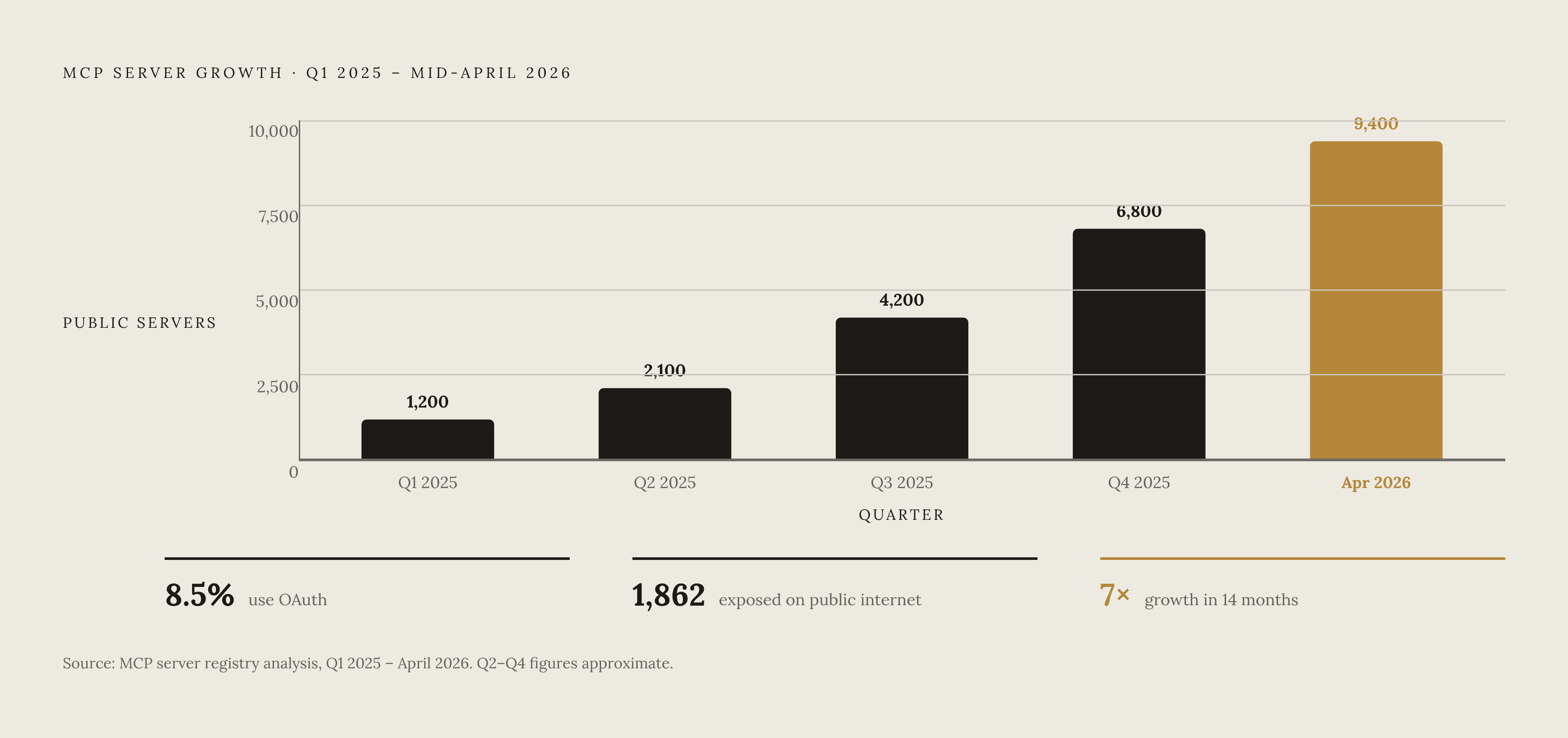
That growth is the governance gap, in plain numbers. The public MCP server registry held roughly 1,200 entries in the first quarter of 2025. By mid-April 2026, that number had passed 9,400, more than a sevenfold jump in fourteen months. Every one of those servers is a new door into enterprise systems, and every business unit that adds one without routing it through central review widens an attack surface the security team can't see, because nobody told them it exists.
The authorization gaps behind that growth are the real story: implementations without OAuth or with permissive defaults leave systems exposed, and the data on OAuth adoption and public-internet exposure shows it. Only 8.5% of MCP servers use OAuth. 1,862 of them sit exposed directly on the public internet. Authorization in MCP is optional by design, so plenty of implementations skip it. Treat this as the center of the whole problem, not a footnote: a protocol that's become the connective tissue for enterprise AI is running mostly without the authorization layer that would make it safe to trust.
Runtime threats that approved tools and pre-deployment reviews cannot catch
Tool poisoning never touches anything a human looks at directly. It works through the metadata an agent reads to decide how to use a tool, the description text that tells the model what the tool does and how to call it. If that description changes after the tool has been approved, the agent's behavior changes with it, silently, with no visible signal to whoever's watching the output.
Microsoft's Incident Response team documented exactly this in a finance workflow. A third-party invoice enrichment server, built on MCP and already reviewed and approved for production use, had its tool description quietly altered. The new description instructed a Copilot Studio agent to gather thirty unpaid invoices and forward them to an endpoint controlled by the attacker. From the analyst's seat, the answer that came back looked clean. No alert fired, because nothing in the default configuration was built to catch a tool description changing after approval.
What makes this attack class so hard to stop is that it never breaks a rule anyone wrote down. Every action the agent took sat within its normal operating parameters. The tool itself was on the approved list. The data query used permissions the requesting user actually had. The outbound call went to a server that was already allowlisted. Nothing failed a check, because the vulnerability didn't live inside any one system. It lived in the trust between two systems that each assumed the other was still behaving the way it did during the last review.
OWASP's Top 10 for Agentic Applications maps the surrounding threat landscape: tool poisoning, schema poisoning, tool shadowing, command injection through inputs that never got sanitized, and prompt injection that escalates into full system compromise once an agent can act on what it reads rather than just read it. A read-only agent that gets compromised is a nuisance. Giving that same agent the power to act on bad input makes it a liability.
The regulatory requirements now shaping what governance must produce
Three frameworks define what enterprise AI governance has to produce on paper, and increasingly in code. The EU AI Act, the NIST AI Risk Management Framework, and ISO 42001 are those three frameworks.
The EU AI Act's timeline has dates that matter right now, not someday. December 2, 2027 is when most of the standalone high-risk rules under Annex III take effect, covering conformity assessment, technical documentation, risk management, data governance, human oversight, and requirements around accuracy and robustness. Missing the mark means significant financial exposure under the Act's penalty structure. Article 12 goes further than policy language: it mandates automatic logging of events for high-risk systems. That's a technical requirement, not a statement of intent, which means the audit trail from earlier isn't optional under EU law once a system qualifies as high-risk.
NIST has started moving specifically on agents rather than AI systems in general. On February 17, 2026, its Center for AI Standards and Innovation launched the AI Agent Standards Initiative, organized around industry-led standards, open-source protocol development, and security and identity research. The accompanying NCCoE Concept Paper covers identification, authorization, auditing, non-repudiation, and mitigating prompt injection. An AI Agent Interoperability Profile is due out in the fourth quarter of 2026.
NIST AI RMF 1.0 was not designed with fully autonomous, multi-step agent workflows in mind, and the gap between a system that generates a recommendation for human review and one executing consequential actions autonomously is not fully addressed. A chatbot suggesting a reply and a procurement agent placing orders on its own sit in entirely different risk categories, yet the current GOVERN, MAP, MEASURE, and MANAGE structure was not built to distinguish between them. Closing that gap is part of what the new Agent Standards Initiative is aiming at, though the interoperability profile isn't out yet.
Building governance that business units will use
None of this holds if the governance layer slows teams down enough that they route around it. A framework demanding a three-week review before anyone can spin up a new agent gets ignored the same way shadow IT always got ignored: quietly, and at scale.
The frameworks that work share a shape. Central teams own identity standards, authentication tiers, and audit infrastructure, the parts that need to stay consistent everywhere or they're worthless. Business units own the judgment calls closest to their own systems, since they're the ones who actually know what a given agent should and shouldn't touch. Enforcement happens at runtime, catching the tool poisoning and trust-boundary failures a pre-deployment checklist was never built to see. Accountability sits with one named executive. It does not sit with a committee, and any framework that tries to split it three ways ends up owned by no one.
Get those pieces in place, and 37 agents per organization stops being a number that should worry anyone. Leaving them out means that number keeps climbing while visibility keeps shrinking, until the next incident report reads exactly like the last one.
Sources
- MCP Tool Poisoning: Enterprise Controls for AI Agent Integrations | ITECS
- Securing AI agents: When AI tools move from reading to acting | Microsoft Security Blog
- AI Agent Security in 2026: What Enterprises Are Getting Wrong - AGAT Software
- AI Identity: Standards, Gaps, and Research Directions for AI Agents
- NIST AI Agent Security: Red-Teaming Guidance and Enterprise Compliance
- labs.cloudsecurityalliance.org