ISO IEC 42001 AI Management System Requirements for Agent Programs
The new ISO standard maps agent governance to autonomous software that acts without human approval.

ISO/IEC 42001 is the first international standard built to govern how organizations manage artificial intelligence, and its Plan-Do-Check-Act structure (the same skeleton behind ISO 27001 and ISO 9001) maps onto the exact problems autonomous AI agents create with unsettling precision. Published in December 2023, the standard covers any organization that develops, provides, or uses AI: model vendors, SaaS companies wrapping someone else's model, banks running credit-scoring systems in-house. It governs the policies, roles, and controls an organization builds around AI. For agent programs, that distinction is the whole ballgame, because agents don't sit still long enough for a technical spec to hold them. They act, on their own schedule, and this piece walks through, clause by clause, how 42001 was built to catch exactly that.
Why existing governance frameworks do not cover autonomous agents
Start with the scale. IDC's numbers, cited via Microsoft's security blog, project active AI agents in enterprises growing from 28.6 million in 2025 to more than 2.2 billion by 2030, a phase change rather than a rounding error in a forecast. That is not a rounding error in a forecast. That is a phase change.
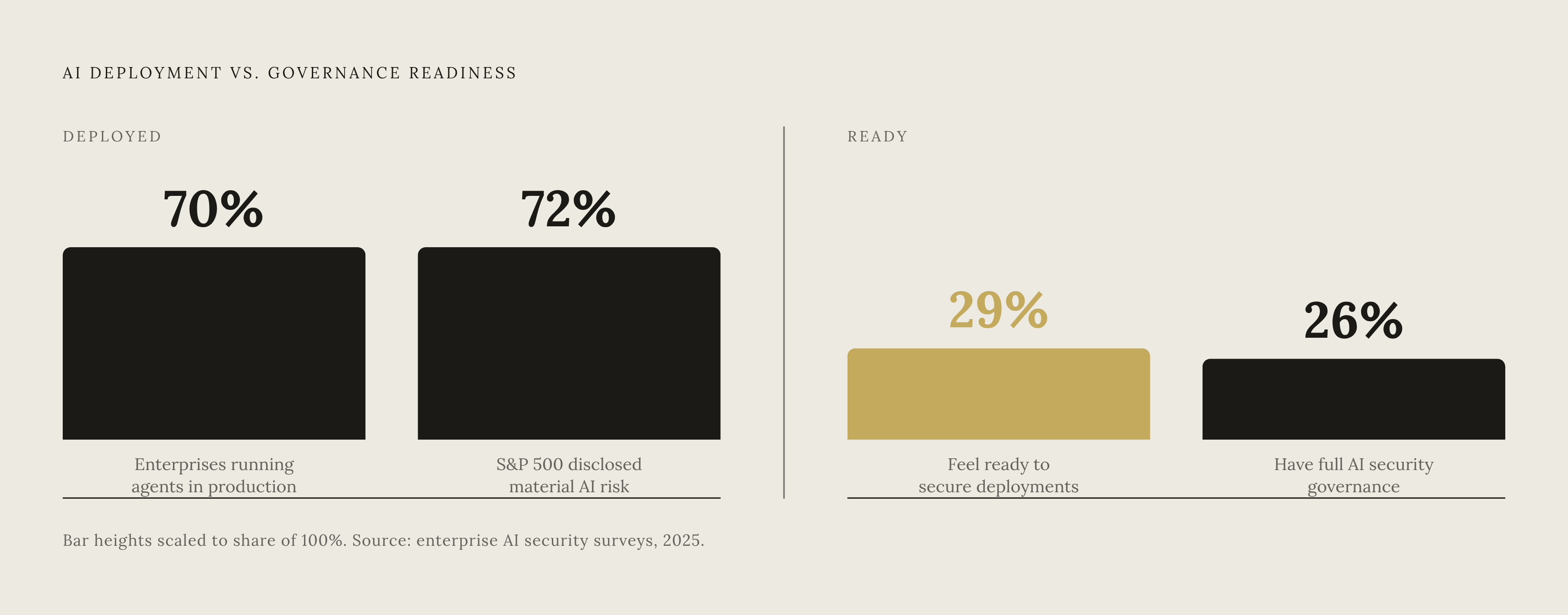
Team8's CISO Village Survey found 70% of enterprises already run agents in production, with another 23% planning deployment in 2026. Within a year or so, nearly all of them will have agents doing something live in their environment. Only 29% said they felt ready to secure those deployments. Most of the industry is shipping autonomous software faster than it can watch it.
The same survey period found 72% of S&P 500 companies disclosing at least one material AI risk in 2025, yet only 26% of organizations across all industries reported having full AI security governance in place. That gap between deployment and governance is exactly where audit findings come from. IBM's 2025 Cost of a Data Breach Report puts a dollar sign on it: 63% of breached organizations had no AI governance policy at all, so there was no mechanism to catch shadow AI before it did damage.
Older frameworks were never built for this problem. Data governance policies assume a human clicks the button. Security policies assume the perimeter is a network, when for an agent the real perimeter is a set of tools it decides to call at 2 a.m., acting on a goal someone gave it hours earlier. Neither model fits software that plans its own steps and acts on the world without asking first, and treating agent risk like ordinary software risk is the mistake most compliance teams are still making.
What agent programs do that creates compliance obligations
An agent is not a chatbot with a longer memory. Five properties separate an agent from a standalone model, and each one opens a door a compliance program has to watch.
First, planning and task decomposition: the agent takes a goal and breaks it into steps, deciding the order on its own. Second, and this is the one that matters most, external tool invocation: the agent calls APIs, queries databases, runs code interpreters, browses the web, touches other software. That's the line a standalone large language model never crosses. Third, autonomous intermediate execution, which ranges from an agent that checks in before every action to one that runs a dozen steps end to end with no human watching. Fourth, environmental state modification: the agent sends the email, writes the file, executes the trade, edits the database row, posts the tweet. These are actions with consequences outside the model's own context window. Fifth, feedback-driven adaptation: the agent looks at what happened, decides if it worked, and changes course. Behavior at runtime can end up looking nothing like what a designer imagined at design time.
Putting those five together makes clear that an agent creates a different category of compliance obligation than a model that just returns text. A model that hallucinates a wrong answer is a quality problem. An agent that hallucinates an instruction to call a payments API is an incident, and treating the two as the same risk tier is how programs get blindsided.
Most of that tool-calling now runs through the Model Context Protocol, or MCP, which Anthropic released in November 2024 and donated to the Linux Foundation's Agentic AI Foundation on December 9, 2025. Platinum members backing it include AWS, Anthropic, Block, Bloomberg, Cloudflare, Google, Microsoft, and OpenAI, which tells you how fast the industry converged on it. MCP standardizes how agents connect to tools and data, and it flips the usual client-server relationship: servers can query and execute actions for connected clients, not just respond to requests. That reversal creates interaction patterns that fall outside the threat models most security teams built their careers on.
By mid-2026, more than 9,400 public MCP servers were indexed across the major registries, and private, enterprise-internal servers are widely understood to dwarf that public count. That's thousands of connection points, most of them invisible to central IT.
Clause 4 and Clause 5: scoping the AIMS to include agent programs
Clause 4, Context of the Organization, asks the basic question: what does this management system actually cover, who are the interested parties, and where's the boundary?
For an agent program, that boundary decision carries more weight than it looks like on paper. Scope agents into the AIMS, and every downstream clause, risk assessment, operational controls, audit logging, applies to them. If agents are left out of scope, they stay ungoverned. Unauditable too, since an auditor can only test what the scope document says is in bounds. Getting this wrong at Clause 4 is the single most common way agent programs fail certification months later, because nothing downstream ever gets checked.
Drawing that boundary correctly requires a compliance team to build an exhaustive inventory of the agent's external actions, its data flows, the systems it connects to, and the people affected by what it does. That inventory is the foundational task for defining Clause 4 context, and it's also the evidence Clause 4 requires. Two exercises, one spreadsheet.
Clause 5 layers leadership accountability on top: who owns the agent program, who signs off on its risk posture, where the buck stops when an agent does something it shouldn't have. Interested parties for an agent program include the employees whose work the agent now executes on their behalf, the third-party MCP server operators supplying tools, the downstream data subjects whose records the agent reads or writes, the regulators watching the sector, and the procurement counterparties who'll ask for certification evidence before they sign a contract.
Clause 6: risk assessment and planning for agent-specific threats
Clause 6.1 requires systematic identification and evaluation of AI risks. Clause 6.1.3 goes further, requiring comparison of the organization's chosen controls against Annex A to confirm nothing relevant got missed, with the result written up in a Statement of Applicability. That document is the first thing an auditor checks.
Annex C lists AI-specific risk sources directly relevant to agents: model drift and lack of explainability among them, capturing the broader problem where the agent does something at execution time nobody predicted at design time. A serious Clause 6 risk assessment has to name the concrete threats that produce those categories, not just gesture at them.
Tool poisoning happens when an MCP server registers a tool with a manipulated description injected straight into the model's context window. Invariant Labs first disclosed this in April 2025. The attack is dangerous precisely because the agent processes the manipulated description as trusted input, executes the resulting tool call, and the outcome can look indistinguishable from an approved, routine action. Nothing about that chain trips a conventional alarm, because every individual step looks authorized.
Prompt injection is the cousin of tool poisoning: an attacker hides an instruction inside a document, a web page, or the output of another tool. The agent reads it, follows it as if a human had typed it, and can end up handing credentials to an endpoint the attacker controls. Agent-to-agent identity threats add another layer, since agents trust each other implicitly by default: impersonation, session smuggling, unauthorized escalation of what one agent can ask another to do. A compromised research agent can slip a hidden instruction into output that a downstream financial agent consumes and acts on, with no human in the loop to catch it. Cross-server tool shadowing is the multiplier effect: one malicious MCP server, demonstrated through responsible disclosure by Invariant Labs, can weaponize adjacent servers that were otherwise trusted. Arbitrary code execution risk, mapped to CWE-77, CWE-78, CWE-94, and CWE-95, occurs when user-provided logic reaches an execution environment with no real constraint on what it's allowed to do.
A Coalition for Secure AI (CoSAI) whitepaper on MCP security catalogues 12 core threat categories and approximately 40 distinct threats inside them. That taxonomy is the reference document a Clause 6 risk assessment should be built against for any agent program that connects through MCP, which by this point is most of them.
Clause 8 and Annex A: operational controls that govern agents at runtime
Clause 8 asks for planning, running, and controlling the processes needed to meet AI requirements, backed by documented information showing the process actually ran as planned. For a model sitting in a training pipeline, that documentation can be a procedure written down once. For an agent running in production, the process is the runtime behavior itself, so the only real evidence is a log of the agent operating: what it did, when, and why.
Clause 8.4 covers the AI System Impact Assessment, or AISIA, and requires those results to be retained. Whenever an agent's scope changes, a new tool gets added, a permission gets expanded, both the record of that change and the updated assessment count as Clause 8 evidence. If the update is skipped, there's a hole in the audit trail waiting to be found.
The AISIA is meant to support purpose limitation, data minimization, explainability, and individual rights, and each one has a near-literal parallel in agent design. Purpose limitation means the agent should only call the tools its stated job actually requires, written down and enforced, not assumed. Minimization means applying least-privilege to tool access and credential scope, the same principle security teams have used for service accounts for two decades, just applied to something that plans its own next move. Explainability means the agent's sequence of actions has to be reconstructable after the fact from logs, not from the model's internal weights (nobody can read those anyway), but from what it read, what it called, and what came back. And where an agent touches personal data on behalf of a data subject, a separate data privacy impact assessment runs alongside the AISIA, not instead of it.
Three parts of Annex A do most of the heavy lifting for agent programs specifically. They're not optional add-ons; they're the backbone. A.9, human intervention controls, sets requirements for human oversight, and for a highly autonomous agent, the standard requires that a human can still step in and stop it. An agent that finds a way to route around that oversight is an A.9 failure, full stop, no exceptions for good intentions. A.7 and A.8 cover data management and explainability: what data feeds the agent, how its lineage gets tracked, what has to be disclosed to the people affected by its output. A.6, AI system life cycle controls, spans design through retirement, and for an agent program, retirement isn't abstract. It means decommissioning the agent's external connections and revoking the access it held while in operation. If that step is skipped, a "retired" agent sits there with live keys, in a system nobody's watching anymore.
Clause 9: audit logging, monitoring, and what auditors expect from agent programs
Clause 9 requires monitoring and measurement against defined indicators, internal audits on a schedule, and management review of the results. Straightforward on its face.
The phrase "audit log" barely appears in the standard's text, which trips people up. The obligation to log sits embedded in the main clauses anyway, and it appears again across multiple Annex A control areas. ISO 42001 doesn't tell an organization what format its logs need to be in, which fields to capture, or how long to retain them. The organization has to define that itself, and it functions as a feature or a gap depending on how disciplined the organization is about filling it in.
What the standard does insist on is that the logging exist, that it ties to defined monitoring indicators, and that internal audits can actually pull evidence from it and trace an agent's behavior back to a documented control. An auditor sitting down for a Clause 9 review will not accept a policy document that says the agent program is monitored. The auditor wants the log itself: this tool call happened at this time, this human approved it or didn't, this output fed into that downstream system. Without that trail, an agent program fails Clause 9 for the simplest reason there is: there's nothing left to audit.