MCP Gateway Architecture for Enterprise Platform Teams
How enterprises govern agent tool access through a centralized control plane.
An enterprise MCP gateway secures agent tool calls by keeping credentials out of agents, enforcing access rules on each action, and recording who acted and why. It is not just a proxy, but the central control plane that turns scattered agent-to-tool connections into a governed hub-and-spoke system. Production architecture must combine identity, routing, policy, threat detection, and audit.
Why MCP traffic cannot be governed by the tools enterprises already have
The gap becomes clear when the CISO asks who can see what tools the agents are calling, and the platform team’s existing gateway cannot answer. That gateway can check whether a client is allowed to reach an endpoint. It does not necessarily know whether a particular agent may execute a particular tool, with these parameters, for this user, right now.
Traditional API gateways were built around deterministic app-to-app traffic, static API keys, and URL-level controls. Agents, by contrast, choose tools at runtime and link calls from one system to another. An innocuous prompt can lead to exports, writes, or deletions. Existing infrastructure can carry that traffic, but endpoint authorization alone cannot govern the decisions that produce it. Forged tool descriptions, cross-session data leakage, and servers overriding trusted tools create a different security surface.
How an ungoverned MCP deployment actually fails in production
The ungoverned deployment usually starts with useful work. One team runs local STDIO servers while another builds HTTP wrappers. Credentials and access rules spread with those connections, but there is no shared inventory to track them. Hardcoded tokens stay in local configuration files, and agents keep whatever access they were given at setup. With shadow agents, the productivity gain is visible and the security gap is not.
The operational failure appears when someone needs to review or revoke that access. A local server connected to a staging database or production API has no centralized audit trail through which security can reconstruct its activity. Without a common control point, permissions cannot be revoked uniformly when someone leaves. The N×M integration problem is therefore a governance problem as much as a connection problem. A gateway addresses it by making every agent action pass through one enforcement layer.
What an MCP gateway actually does architecturally — the hub-and-spoke control plane
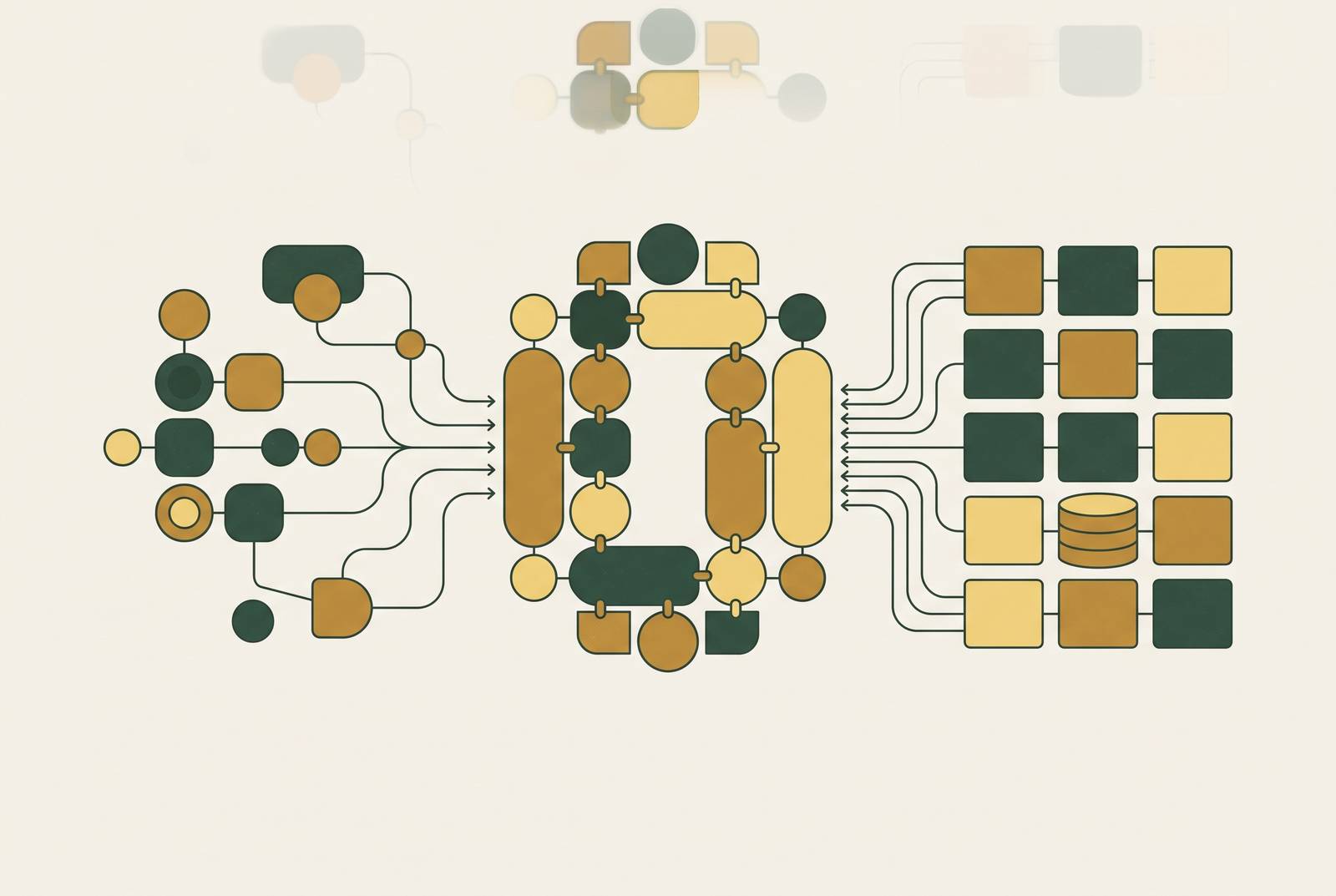
An MCP gateway sits between clients, including Claude, Copilot, and custom agents, and upstream MCP servers. It intercepts requests, applies authentication and policy, and routes permitted calls to the registered server. A simple flow diagram would place the clients on the left, the gateway in the center, and the servers on the right. Every connection would pass through the center rather than cross directly between clients and servers. That hub is the shared point for enforcement and visibility.
Inside this architecture, the data plane and control plane have different jobs. The data plane handles live traffic, including tools/list, tools/call, routing, rate limiting, caching, and observability. The control plane manages policies, the catalog, and team provisioning. Filtered discovery links the two by returning only tools the agent may use, so fewer capabilities are exposed and there is less context-window overhead.
A shared policy model does not require one deployment topology. In-process gateways favor latency, while sidecars offer isolation with near-equivalent performance. Centralized gateways simplify governance but can bottleneck at scale, while federated deployments trade operational simplicity for throughput and regional resilience.
Transport layer decision — why Streamable HTTP is the production baseline for enterprise MCP
MCP supports two primary transports, which are STDIO and Streamable HTTP. STDIO runs the server as a local process on the client’s machine. Streamable HTTP runs it as an independent network service reachable through a URL. For enterprise resources, Streamable HTTP is the production baseline because it allows shared access to sit behind centrally managed authentication and governance.
Streamable HTTP provides stateless request handling compatible with standard load balancers and reverse proxies, native OAuth 2.1 integration, and bidirectional streaming for long-running operations. Its latency tradeoff is acceptable for enterprise uses that prioritize correctness and security over raw speed. STDIO remains appropriate for local developer tooling that touches only the developer’s own resources. If a server uses a shared database, internal API, or SaaS system, it should run remotely with proper authentication in place. Otherwise, a compromised laptop can become a credential exfiltration path.
Authentication architecture — how to secure OAuth credentials for enterprise agent tool calls
Authentication starts with the protocol’s requirements. The MCP specification’s 2026-07-28 authorization revision requires servers to implement OAuth 2.0 Protected Resource Metadata under RFC 9728. Clients MUST send the resource parameter defined in RFC 8707 in both authorization and token requests. Servers MUST reject tokens that do not name them in the audience claim or otherwise verify that they are the intended recipient.
The transport distinction matters here. The specification says HTTP-based servers SHOULD follow OAuth 2.1, while STDIO servers SHOULD NOT and should get credentials from the environment instead. The June 2026 Enterprise-Managed Authorization extension formalizes enterprise identity providers as the authoritative provisioner of MCP server access. Separately, the 2026-07-28 revision deprecates Dynamic Client Registration under RFC 7591 in favor of Client ID Metadata Documents. DCR remains for backward compatibility with authorization servers that do not support those documents.
The enterprise pattern adds SSO through SAML or OIDC, with short-lived gateway tokens carrying group memberships for policy evaluation. Developers should not configure raw API keys in MCP clients. Instead, the gateway injects authorized credentials just in time for execution, so the agent can act without possessing the underlying secret. Runlayer combines built-in OAuth and JIT credential handling with SSO and SCIM integration, making identity part of setup. Agent-to-agent authentication still needs explicit design because the core specification leaves server-to-server authentication open, and the returning client credentials grant is covered by a draft extension.
Authorization and the tool catalog — enforcing least privilege at tool-call depth
Authentication establishes identity, but it does not settle permission. Authorization is technically OPTIONAL in MCP, so a gateway must check access even when a session has been authenticated. The enforcement unit is the individual tool invocation, including its parameters and user context. Credentials should be scoped to the action about to happen. That is least privilege at tool-call depth.
Team-based RBAC makes this practical across a deployment. Engineering can receive GitHub, Jira, and CI tools, while Sales receives CRM read/write and Slack, and Finance receives accounting read-only. When a team changes in the identity provider, access must change at once across the connected servers. The gateway is then the one place to update permissions across integrations.
The catalog gives employees an approved route to those capabilities. IT and security control what appears, who may use it, and which access requests require approval. Employees can search approved connectors instead of installing whatever they find in a public registry. Runlayer pairs a large MCP server catalog with policy enforcement at tool-call depth, so the tools agents find are governed when they run.
The MCP-specific threat surface a gateway must detect, not just route around
A valid identity and an allowed tool do not prove that an action matches the user’s intent. Tool poisoning uses forged descriptions to steer an agent toward unintended actions. A confused deputy attack redirects a server’s existing authority, particularly where broad scopes and missing per-action checks leave room for misuse. Token passthrough creates another boundary failure by forwarding credentials downstream instead of using OAuth 2.0 token exchange under RFC 8693.
Connector parameters can also enable forged server-side requests to internal network resources the agent was never meant to reach. Rogue server registration gives an unauthorized or compromised server a place in the trusted catalog. The OWASP MCP Top 10 (2026) identifies related categories including secret exposure, scope creep, tool poisoning, supply chain attacks, command injection, intent flow subversion, and insufficient authentication and authorization. JFrog described CVE-2025-6514, with a CVSS score of 9.6, as enabling arbitrary OS command execution when clients connect to an untrusted server through mcp-remote.
A gateway therefore needs runtime inspection as well as static access rules. Detection must examine tool responses for prompt injection, outbound data for exfiltration, and actions for drift from the user’s stated intent. Runlayer’s real-time detection checks for tool poisoning, prompt injection, intent drift, and exfiltration as part of this active layer.
Audit logging as a first-class architectural requirement, not a protocol feature
Detection addresses what is happening, while audit establishes what happened and under whose authority. MCP defines how tools are described and called, but it does not supply a complete audit record. The gateway must write that record. Because every invocation passes through it, the gateway is the natural point for uniform logging across the fleet. HTTP request metadata alone is not enough.
A useful record connects the user and agent to a real person through SSO. It captures the tool, parameters, response, and authorization context, including blocked attempts as well as completed actions. Multi-agent workflows also require the causal relationships between steps. A list of calls alone cannot explain why an agent chose one tool, changed its plan, or used what it learned earlier to make a later choice.
Structured logs and trace IDs must make that record queryable without stitching together separate systems by hand. The implementation standard is tamper-proof logging with full OTEL tracing and records that are immutable after writing. Runlayer’s audit logs and OTEL tracing illustrate this treatment of audit as architecture.
Regulatory pressure that makes audit and governance non-negotiable from a specific date
The EU AI Act began to apply generally from 2 August 2026. The Digital Omnibus deferred high-risk AI obligations to 2 December 2027 and 2 August 2028, so those dates must not be collapsed into one deadline. Penalties for prohibited practices can reach tens of millions of euros or seven percent of global annual turnover.
For agents that invoke APIs, internal services, third-party platforms, or MCP servers, the action layer falls within the Act’s cybersecurity and logging mandates. For multi-agent architectures, it ties traceability to how agent interactions relate to one another. Under the high-risk rules, immutable logs and a full delegation chain are requirements. A gateway serving those deployments must therefore capture the agent trajectory, including intent, tool choices, parameters, and blocked attempts. A record limited to HTTP requests and responses does not meet that audit requirement.
What a production-ready MCP gateway must implement, assembled as a checklist
The evaluation checklist starts with five implementation pillars, and each needs a concrete answer. The identity pillar must use action-scoped JIT injection to keep raw production secrets out of agents. The authentication pillar must combine OAuth 2.1, enterprise SSO, short-lived tokens, and the specified resource and audience controls. It must also account for Enterprise-Managed Authorization rather than build a separate identity system for each integration. Missing either pillar leaves credential handling incomplete.
The routing pillar must map tool namespaces to backend URLs, check server health, filter discovery, and support team provisioning. The policy pillar must evaluate identity and group membership on each request, with tool allowlists, action limits, approval checkpoints, and delegation limits. The observability pillar must produce structured logs, metrics, trace IDs, and immutable causal records. These are procurement criteria that require more than a proxy simply forwarding MCP traffic.
Beyond those pillars, checks must cover runtime threat detection and the ability to end an agent’s access to all connected servers in an emergency. A searchable catalog with approval workflows is needed to keep access governance manageable. Regulated deployments also need suitable VPC or on-premises options for data residency.
Build versus buy then becomes a question of integration burden. An agent builder, separate gateway, and separate scanner mean three integration points, policy stores, and audit records to reconcile. Runlayer brings the catalog, OAuth, identity controls, JIT credentials, tool-call policy, detection, and audit into one platform, making it an option to evaluate against the full checklist.