AI Enablement Program Structures Inside Large Enterprises
Governance must be built first, not bolted on after pilots succeed.
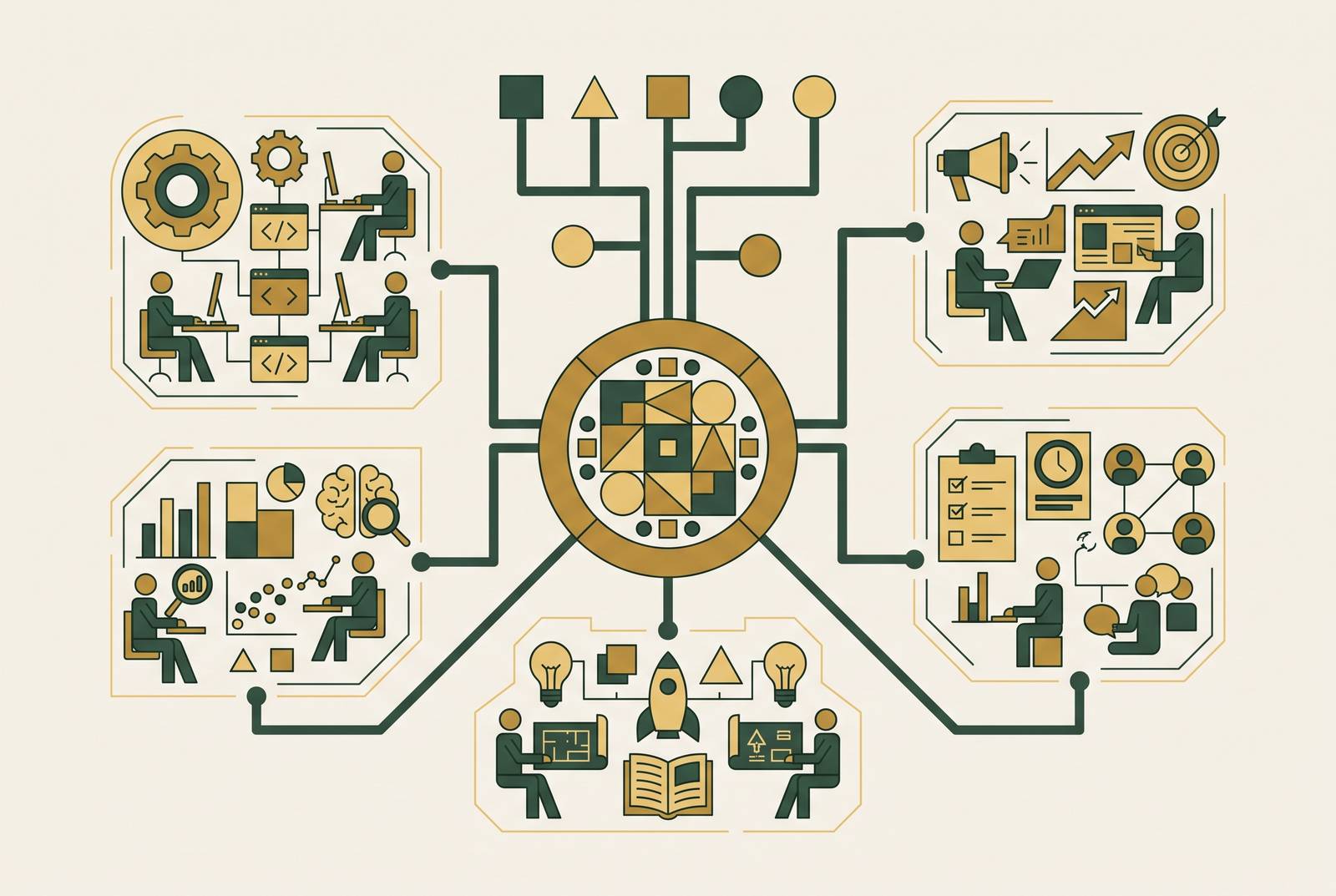
Most enterprise AI programs fail to scale because they were never built to survive contact with the full organization, not because the underlying technology falls short. The pattern is consistent enough to predict: a pilot succeeds, enthusiasm spreads, leadership greenlights a wider rollout, and the program slowly collapses once it meets the scale, complexity, and risk of the real business. A large majority of companies now use AI in some form, yet most remain stuck in fragmented pilots and siloed experimentation. The ambition is there. The infrastructure to carry that ambition past a single team is usually not.
The Deloitte case involving the Australian government makes the stakes concrete. A AU$440,000 assurance review reached a paying client containing fabricated citations, and it got there because there was no review step, no disclosure policy, and no person with the authority to catch the output before it went out the door. Models make mistakes all the time, but well-run programs catch them before they cause damage. This was a governance failure, and it shows what happens when an organization adopts a capability without building the structure to supervise it.
The pressure to get this right is compounding fast. Gartner projects that by the end of 2026, task-specific AI agents will be embedded in a share of enterprise applications that is sharply up from a small fraction the year before. That shift means governance can no longer be treated as a problem for later. The agents are already being written into the applications running core business functions, and the organizations deploying them are, in most cases, still treating governance as a future milestone rather than a present requirement.
Three failure patterns appear repeatedly in programs that stall. Training gets built around the tool itself, not the task the workforce actually needs to perform. Governance gets added after the program is already running, as a bolt-on rather than a foundation. And infrastructure gets built team by team, reinvented in HR, then again in finance, then again in operations, rather than built once for the whole enterprise. Each of these failures compounds the other two, and together they explain why the gap between pilot and production has become the defining challenge of enterprise AI in 2026.
What enterprise AI enablement means
Enablement, adoption, and transformation are three distinct stages of enterprise AI maturity, and if you treat them as interchangeable, you create a source of program failure. EC-Council's guidance on this draws the line clearly: enablement builds the foundation and readiness an organization needs before AI can work at all, adoption is the stage where AI gets embedded into real workflows with someone accountable for checking that the outputs are correct, and transformation describes the reimagined operating model that follows once both of those stages are solid. Transformation is a destination that only becomes reachable once enablement and adoption have already done their jobs.
Adoption without enablement collapses as soon as it moves past a small pilot team, because nothing was built to hold the weight of the wider organization. Enterprise AI enablement, done properly, covers AI strategy, organizational readiness, governance, AI literacy, use-case prioritization, technology integration, change management, and performance measurement, and it covers all of these at once rather than working through them one at a time. The common mistake is funding the visible parts of adoption, like deploying tools and running workshops, while skipping enablement prerequisites like data readiness, decision rights, and access controls.
The clearest proof that enablement is the variable that matters: two organizations can adopt the exact same AI platform and land in completely different places six months later. The platform does not change. What changes is whether the organization built the readiness to use it well.
The four-stage lifecycle that separates programs that scale from ones that don't
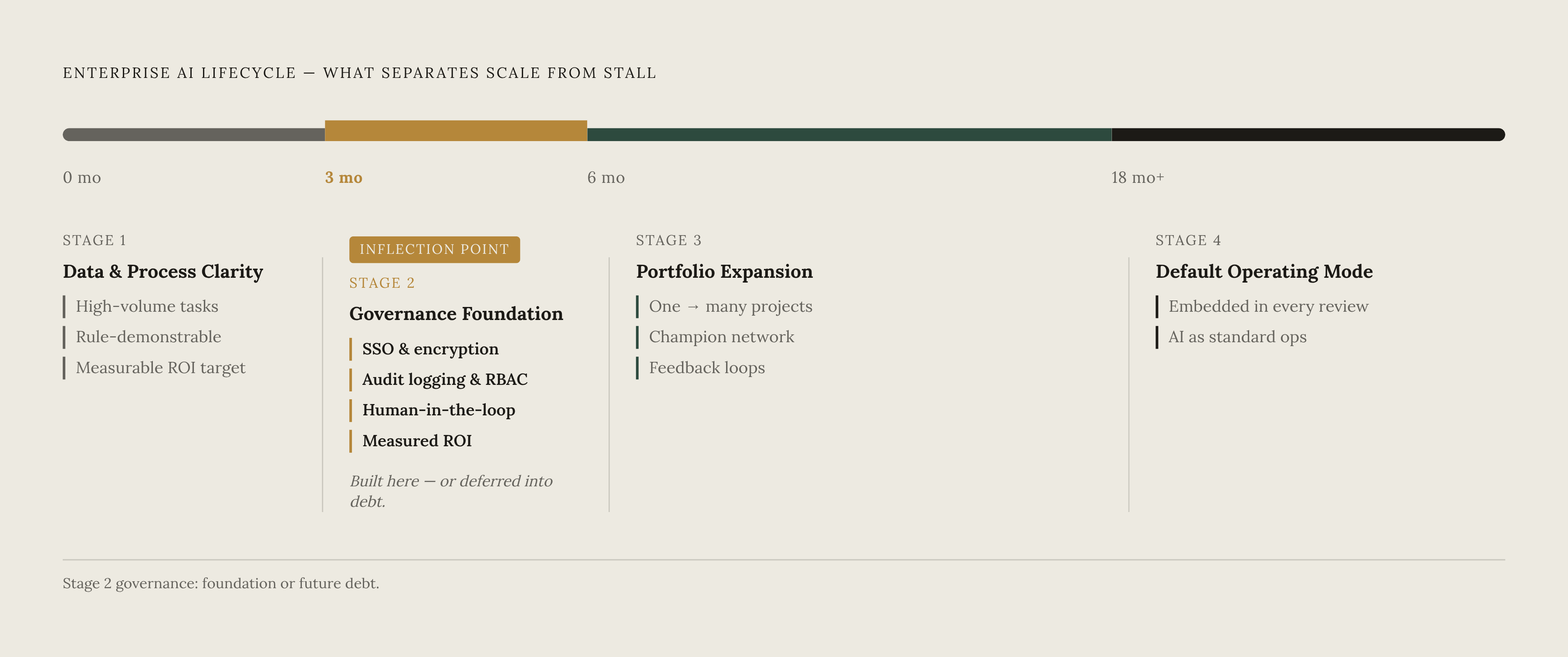
Enterprise AI programs that hold up over time move through a recognizable four-stage lifecycle, and skipping a stage does not save time. It creates problems that get more expensive to fix the further the program advances.
Stage one runs roughly through the first three months and is about data and process clarity. You have to find the actual bottleneck before you touch the tool, because if you add AI to a broken process, you just get the same poor results, sometimes worse. Experienced practitioners converge on the same selection criteria for a first use case: high volume, rule-demonstrable, and measurable. That is why customer support triage, invoice processing, IT service desk automation, and document classification consistently rank as the highest-ROI targets for a first wave.
Stage two, running from roughly month three through month six, is where the program moves from an experiment to one production system with measured ROI. Governance infrastructure has to get built into this stage, not scheduled for later. The work that belongs here includes SSO integration with enterprise identity providers, encryption configuration, audit logging activation, role-based access controls for AI agent configuration, and human-in-the-loop checkpoints for high-risk actions. None of this is optional scaffolding: without it, the system cannot be trusted once more people depend on it.
Stage three spans roughly month six through month eighteen, and this is where a single project turns into a portfolio program. Change management, cohort expansion, activation of an AI champion network, and systematic feedback loops take the place of ad-hoc rollout. Stage four starts around month eighteen, and by then AI has become the default operating mode, embedded into every operational review rather than treated as a special initiative. That stage, the transformation stage, only becomes reachable because the earlier three held.
The phase most organizations shortcut sits before stage one even begins: use-case identification, data readiness assessment, organizational readiness, and infrastructure planning. Skipping that groundwork creates problems that are exponentially more expensive to fix once AI systems are already running in production. Stage two is where the lifecycle turns. It is the point where a program either embeds governance into its foundation or defers it into a debt pile that keeps growing until something breaks.
Skills infrastructure at scale: curriculum design, champions, and cohort architecture
The training programs that actually scale are built on three principles: task selection over tool tours, a repeatable prompting framework, and human-in-the-loop verification. They get delivered through a champion-anchored cohort model rather than a single company-wide rollout.
Correlation One's playbook, built for a global asset manager managing more than $70 billion in assets with over 500 institutional investor relationships, shows what this looks like in practice. A curriculum built around judgment rather than button-clicking can be delivered identically whether the audience is a small pilot group or a global workforce. Tool-centric training fails at scale for three reasons: tools change faster than curricula can keep up with, a feature tour ignores the real variance in skill level between skeptics, dabblers, and power users, and knowing that a tool exists does not, by itself, change anyone's behavior.
One framing distinction does more work than almost anything else in a new-user curriculum: working with information already in hand, like summarizing, synthesizing, and drafting, is a separate skill from finding information buried in internal systems. The first task belongs to a generative AI assistant. You use an enterprise search tool grounded in approved sources for the second. Teaching that single distinction prevents the most common mistake new users make. Training also needs to be role-based, with each team learning how AI applies to the tasks they actually perform rather than sitting through a generic broadcast overview.
The champion model is the mechanism that lets this scale without flattening into a one-size-fits-all rollout. One champion per department gathers feedback, refines adoption, and runs activation playbooks with their own team, and what they observe firsthand tends to be more operationally useful than what a periodic company-wide survey picks up.
The AI Enablement Academy's Champions Program is one concrete version of this structure. It was developed using the model its founders used to scale social learning to tens of thousands of people at Meta and Uber, and to train a large cohort of Amazon Talent Acquisition staff worldwide. The program is built from a strategy blueprint, role definitions tied to success metrics, a Champion Bootcamp running four to six weeks, phased delivery across four to twelve months, change-management training, and activation playbooks that champions then run on their own.
This approach produces productivity gains when it optimizes everyday, multi-step workflows that span teams, but not when it chases isolated quick wins inside one department. Those cross-team gains are the ones that survive once the initial enthusiasm for a new tool wears off. Research from Accenture backs this structurally: organizations with mature AI Centers of Excellence achieve meaningfully higher revenue growth from their AI initiatives than organizations without one, and the investment in skills infrastructure is what separates the two groups. None of this works, though, without alignment at the top. Adoption stalls when leadership itself is not aligned on AI fluency or on how resources get allocated. The skills infrastructure built for the workforce needs a parallel intervention built for executives.
Why governance has to be built into phase 2
Governance added after a program is already running cannot catch up to the access and identity problems that got embedded in production while nobody was watching. The programs that scale build governance into the infrastructure phase from the start, rather than going back to retrofit it once something has already gone wrong.
The operational reality driving this is that AI agents in 2026 are not simple assistants. They are privileged identities with direct access to ERP, CRM, and financial systems, and the Cloud Security Alliance frames them accordingly: they need the same governance, monitoring, and least-privilege controls that organizations apply to admin accounts. Most organizations are not close to that standard. Among large-enterprise security leaders surveyed in 2026, a large majority lack full visibility into their own AI identities, most do not enforce access policies for those identities, and a significant share say AI systems have access to core business platforms, but only a small minority actually govern that access well. The cost of that gap is not theoretical. Nearly all large-revenue companies lost money tied to AI-related risks during 2025, and most surveyed organizations documented risky agent behaviors, including unauthorized system access and data exposure.
Decision rights have to be written down before deployment, not worked out afterward: which operations are AI-assisted, which run fully automated, and which require a human to sign off. Without that documentation, every error gets blamed on "the AI" and nobody is actually accountable for fixing it. Mature programs converge on a similar baseline for agent permissions. Every agent gets a unique identity that can be distinguished in the logs, because shared credentials make it impossible to trace who or what did what. Permissions get scoped to the minimum necessary for the task at hand, and those permissions are time-bounded, with scheduled reviews rather than standing access that never gets reexamined. You keep secrets in a secrets manager, never hardcoded into config files or environment variables. High-risk actions, like spending money, deleting data, or changing permissions, get a human-in-the-loop checkpoint scoped to that single action rather than a blanket standing approval. Automated drift detection catches it when behavior changes between one review and the next.
Multi-agent orchestration makes all of this harder. When one agent invokes another, trust cannot escalate automatically: an agent receiving a request from another agent should not inherit that agent's permissions unless someone explicitly authorized it. This has become the primary bottleneck organizations run into as they move agent systems from pilot into production. Some programs are now aligning to the ISO 56001 innovation management standard, with the earlier ISO 56000 providing foundational vocabulary, as a way of balancing AI experimentation against organizational risk. That standard is one data point among several showing that governance frameworks are becoming formal and institutional rather than ad hoc, not the centerpiece of how any one program should think about governance.
A KPMG survey of large-enterprise leaders found that a large majority of respondents see security, compliance, and auditability as the most critical requirements for deploying AI agents. Those same three elements are also the ones most commonly pushed to a later phase of the program. The things leaders say matter most turn out to be the things programs build last, and the underlying technical architecture makes that contradiction impossible to ignore any longer.
The MCP security threat surface that enterprise programs now have to govern
The Model Context Protocol has become enterprise infrastructure faster than the security governance around it has been able to keep pace, and the threat surface it has opened up is specific, documented, and already being exploited inside production environments. Where the previous section laid out the governance principles organizations say they want, this section covers the technical mechanisms that make ignoring those principles dangerous.
MCP standardizes how AI agents connect to external tools, data sources, and systems, and that is why it has spread so quickly through enterprise environments. The same standardization that makes it useful also makes it a single point of failure when authentication and authorization are not handled with care. An agent connected through MCP to a CRM, a financial system, or an internal database is a credentialed actor capable of reading, writing, and in many cases executing changes, and every permission it carries is a permission that can be exploited if the identity behind it is not managed the way the governance baseline described above requires.
The multi-agent orchestration risk carries directly into MCP deployments. When one agent calls another through an MCP server, the trust relationship between them is exactly the kind of transitive escalation that governance frameworks are built to prevent. An agent that should only be able to read customer records should not, through a chain of MCP calls, end up with the ability to modify financial data simply because it was invoked by another agent that happened to have that access. So organizations now have to design against this exact failure mode as they move MCP-connected agents out of sandbox environments and into systems that touch real customers, real money, and real regulatory exposure.
The organizations that handle this well are the ones that already built the governance baseline into their infrastructure phase: unique identities for every agent, permissions scoped tightly to task, time-bounded access with real review cycles, secrets held in a proper secrets manager, human checkpoints on high-risk actions, and drift detection watching for behavior that changes between one review and the next. None of that is specific to MCP. All of it becomes urgent because of MCP, because the protocol has made it trivially easy to wire an agent into systems that used to require a human with a login and a reason to be there.
The pattern connects directly back to where this piece started. The Deloitte case showed what happens when there is no review step and no person with the authority to catch a bad output before it reaches a client. If MCP-connected agents operate inside ERP, CRM, and financial systems without proper governance, you get the same failure, scaled up and automated. The technology works. Whether it works safely, and whether it scales past a pilot into something an enterprise can actually run on, depends on whether governance was built into the foundation from month three or bolted on after the damage was already done.