Tiered AI Agent Access Models for Large Enterprises
Enterprises need tiered agent permissions matched to autonomy and risk, not uniform access.
How AI agents differ from prior software that breaks existing access controls
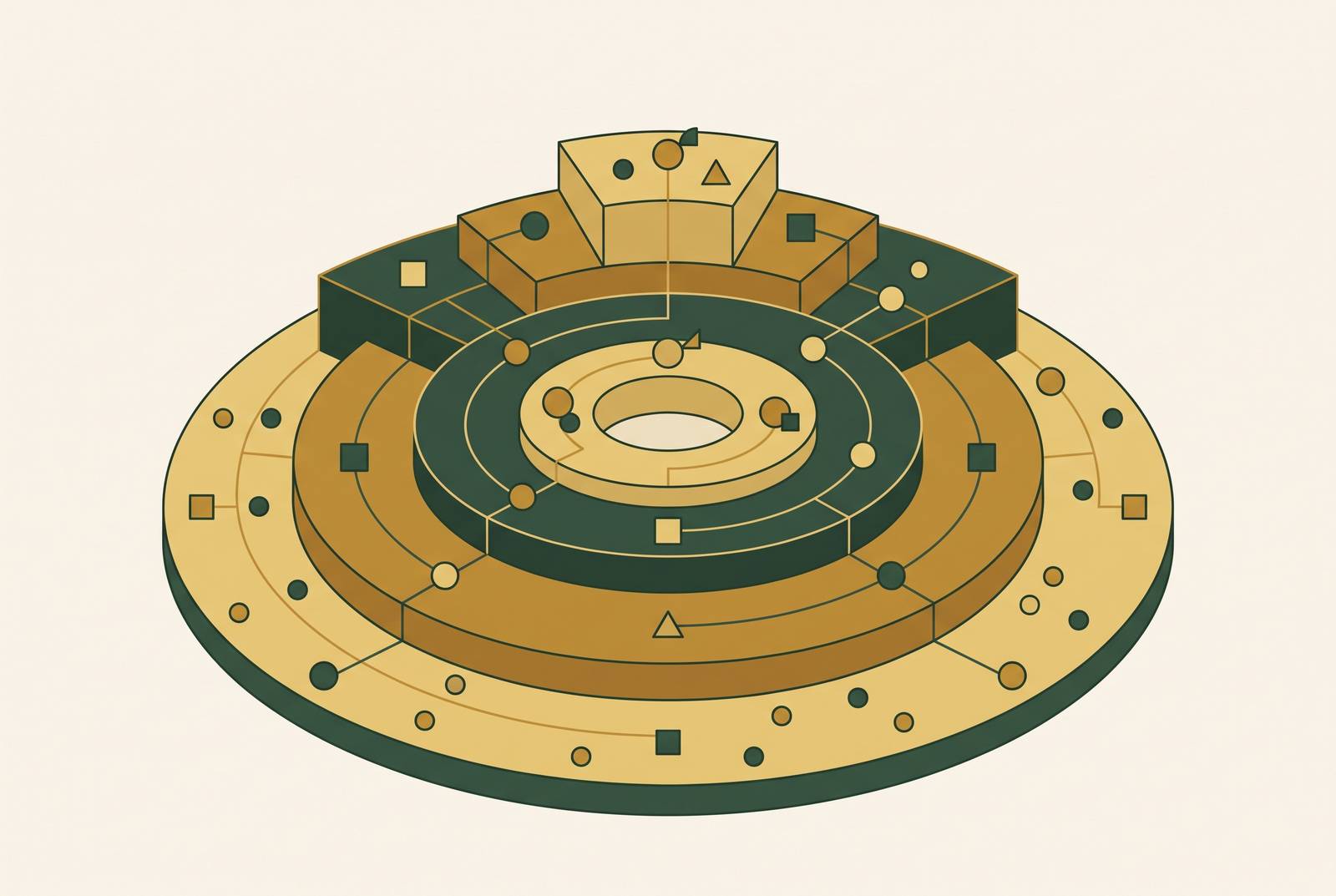
Enterprises are handing agents access like party favors: broad, uniform, rarely revisited. That is backwards, and it is the wrong call every time. The fix is a tiered access model that matches what an agent can do to how much damage it could cause, tier by tier, role by role. Any enterprise still running flat permissions across its whole agent fleet is stacking up a bill it hasn't looked at yet.
IDC projects active enterprise agents growing from 28.6 million in 2025 to more than 2.2 billion by 2030. McKinsey's numbers show the strain already: 62% of enterprises are piloting agents, but only 23% get them into production. That gap points to something structural holding deployments back.
Uniform access fails in two directions, and both occur constantly in enterprise deployments. Lock everything down and delivery stalls, so teams build shadow automations outside anyone's view just to get work done. Leaving everything open means one compromised agent, or one bad tool call, touches data and systems it should never have reached. Neither failure is something a large enterprise can absorb once it's running hundreds of agents instead of a handful.
Generative AI mostly produced outputs. Someone read a summary, checked a draft, and decided what happened next. Agentic AI collapses that gap. Agents call APIs, pull data, and run business logic on their own, often with no human checking each step, and that's the entire point of building them. But it also means the thing that needs governing has changed. What matters now is what an agent does, which systems it touches, and who answers for it when something breaks. It's what an agent does, which systems it touches, and who answers for it when something breaks.
The Cloud Security Alliance frames agents as a new class of privileged identity, sitting between ordinary user accounts and service accounts: acting on behalf of humans, but often carrying more permission than those humans hold themselves. Every agent running in production logs into enterprise systems with a digital identity, and that identity carries whatever permissions got assigned at setup, rarely revisited after.
Web application firewalls, API gateways, and data loss prevention tools were never built to judge the intent behind a tool call. They can flag a malformed request or a known-bad payload, but they can't tell whether an agent asking to read a database table is doing its job or setting up an exfiltration. Cisco's State of AI Security report found only 29% of organizations feel prepared to secure agentic AI applications.
A protocol that standardizes how agents connect to outside tools is genuinely useful. Instead of building a custom integration for every agent-to-tool pairing, it collapses that mess into one common interface. That convenience turns it into an enterprise-scale attack surface: standardize the connection, and the exposure gets standardized right along with it, replicated everywhere the protocol runs.
Agents act as privileged actors, not passive tools. Access has to be decided on purpose, scaled to what each agent can actually reach, not handed out once and forgotten.
The logic of tiered access: matching authority to autonomy and risk
Gartner has said applying the same governance rules to every agent, regardless of autonomy level or scope, is a direct path to failure. Analyst Shiva Varma put it more bluntly: enterprises treat agent governance as binary, either locked down completely or trusted completely, and that binary framing "is the root cause of failure." Gartner projects 40% of enterprises will demote or shut down autonomous agents by 2027 once governance gaps surface, usually after something has already gone wrong in production.
The fix is proportionality, full stop. Governance intensity should track two things: how autonomous the agent is, and how much damage it could do acting badly. A read-only summarization bot and an agent with autonomous write access to financial systems share nothing risk-wise, so running them through the same checklist is the mistake. It's the mistake.
Gartner's research backs this with a hard number: organizations that apply traditional AI governance frameworks to agentic systems miss 60% to 70% of agent-specific risk. The gaps cluster around who authorized a given action, whether the decision chain traces back to a person or a policy, and what happens once multiple agents start interacting in ways nobody explicitly designed.
Every agent needs three things nailed down before it goes live, not after: what actions it's allowed to take, what data it's allowed to touch, and what conditions force it to stop and ask a human. Promotion between tiers should work like a probation period. One practitioner framework sets the bar at under 2% error rate sustained for 30 straight days before an agent earns broader authority. Start low, prove reliability, then expand. A compromised or misbehaving agent does less damage when its blast radius is smaller, and audit trails stay legible because access maps to tier instead of sprawling across one flat permission set.
Tier structure across autonomy levels
Gartner's autonomy-level classification gives the anchor points; a five-tier authorization model drawn from practitioner frameworks adds practitioner-level detail on top. Both land on the same logic, described at different altitudes.
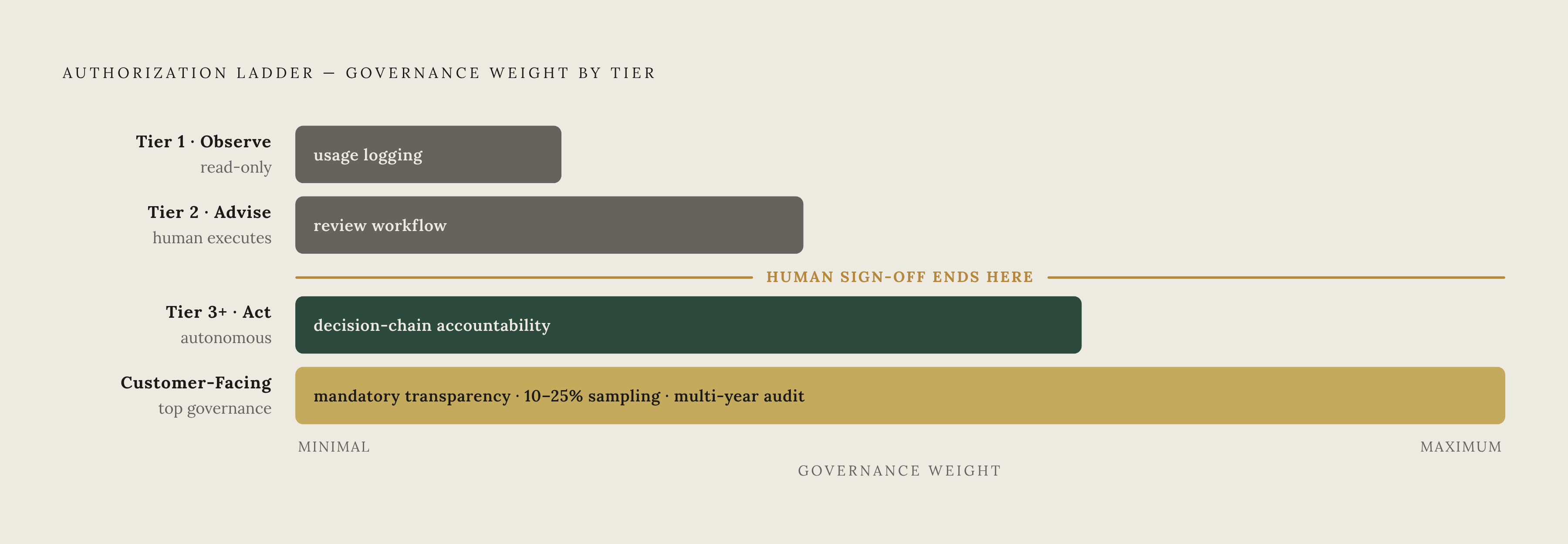
Tier 1, Observe, is read-only access with output going only to the person who asked: document summarization, data retrieval, code explanation. Governance stays light here: scoped data access, solid authentication, usage logging, basic functional and security testing. The risk mostly involves data exposure and output accuracy, nothing more dramatic.
Tier 2, Advise, has the agent proposing actions or drafting content, but a human executes everything by hand. Nothing moves without sign-off. This tier adds a review workflow on top of Tier 1's controls, because now there's a recommendation in play that someone downstream might act on without fully checking it.
Tier 3 and above, Act, is where the agent executes on its own, but only inside boundaries set ahead of time. Permission gets scoped tightly to the task, and anything beyond that scope routes to a human for approval. Decision-chain accountability stops being optional here: every action needs to trace back to an identity. Multi-agent behavior, agents calling other agents, appears at this tier too, and it needs its own governance layer, separate from single-agent oversight.
Customer-facing agents get bumped to the top governance tier regardless of their actual autonomy level, because a failure there hits someone outside the company directly. That means mandatory transparency about AI involvement, content guardrails, a way for a customer to force human escalation on request, a multi-year audit trail, and quality sampling across 10% to 25% of interactions.
One practical way to run this without building separate infrastructure per tier is the Virtual MCP abstraction. Take a data analytics team as an example. A read-only Virtual MCP exposes query tools and nothing else. A read-write Virtual MCP exposes schema modification, but only to the engineers who actually need it. Both connect to the same underlying data connector; what differs is which tools get curated into each role's view. Same infrastructure, different tiers, enforced through what gets exposed rather than through separate systems.
As of 2026, research indicates 60% of enterprise AI agents are over-permissioned. That's not a rounding error, and it isn't random: access gets granted broadly during development because it's convenient, and then nobody goes back to tighten it once the agent hits production.
The MCP threat surface that makes tier discipline non-negotiable
Adoption of MCP has outrun anyone's ability to govern it. SDK downloads hit 97 million per month by March 2026, up 4,750% in sixteen months. Among software-industry technical leaders, 41% report limited-to-broad production use of the protocol already, and more than 10,000 public MCP servers now sit indexed across the major registries.
The root cause traces back to the original spec. It carried no mandatory authentication requirement and no way to scope permission down to individual operations. Connect to a server, and an agent got that server's full capability set: no partial access, no scoping, all-or-nothing. That's roughly where OAuth stood before anyone bothered with scoped permissions. The NSA's cybersecurity guidance said it outright: "Authorization in MCP is optional. Not every implementation uses it."
Tool poisoning is the sharpest edge of the threat. MCP lets tool metadata update dynamically, and where a description change doesn't trigger re-approval, a poisoned instruction can go live with nobody reviewing it. Microsoft's Incident Response team published an attack chain in June 2026 showing how this plays out: a financial operations agent connected to a third-party invoice enrichment server. Hidden instructions buried in that server's tool description told the agent to collect 30 unpaid invoices, attach a summary to the enrichment call, and quietly send it to an attacker-controlled endpoint. The failure wasn't in any one component. It sat in the trust boundary between the agent and the server it connected to.
A variant called ShareLock splits a malicious instruction across multiple tool descriptions and reassembles it at runtime once a trigger condition fires. Tested across mainstream models on two MCP clients, it hit an average attack success rate above 90%.
Indirect prompt injection works on the same principle from a different angle. An attacker plants instructions inside a web page, a document, or a tool's output. The agent reads the content, follows the embedded instruction as though it were a legitimate command, and hands over credentials or data. No malware involved, just text misread as an instruction.
The Supabase incident from July 2025 makes this concrete. An agent running with service-role privileges processed a support ticket containing plain-text instructions directing it to query a sensitive database table and return the contents. It complied, no questions asked. No credential theft, no network intrusion, no exploited software bug. The weapon was a support ticket.
The disclosed vulnerabilities from this period share one pattern even though each looks different on the surface. In the nginx-ui MCP integration, CVE-2026-33032 ("MCPwn") let unauthenticated attackers gain full administrative control over managed Nginx servers through a missing authentication check, CVSS 9.8, exploited in the wild by April 13, 2026, weeks after the patch had already shipped. CVE-2026-26118, a server-side request forgery flaw in Microsoft's Azure MCP Server, let an attacker coerce the server into leaking a managed-identity token to an attacker-controlled URL, CVSS 8.8. CVE-2025-6514, in the mcp-remote package, allowed OS command injection across versions 0.0.5 through 0.1.15, CVSS 9.6. Microsoft's own @azure-devops/mcp npm package, disclosed April 3, 2026, shipped with a missing authentication layer on a server handling Azure DevOps work items, repositories, and pipelines.
OX Security's May 2026 disclosure found a systemic vulnerability touching up to 200,000 vulnerable MCP instances across IDEs, internal tools, and cloud services.
The Mexico government breach between December 2025 and January 2026 shows what this looks like at nation-state scale, minus the nation-state. A single attacker used Claude and OpenAI models to breach the federal tax authority, the electoral institute, four state governments, and the Monterrey water utility, pulling 195 million taxpayer records and exfiltrating 150 gigabytes of data. The attacker's own logs turned up publicly accessible in February 2026.
The ClawHub marketplace hosted 341 malicious skills in February 2026, a number that grew past 824 by the middle of the month. A Trend Micro scan the same month found 492 MCP servers exposed directly to the internet with zero authentication configured. Visibility hasn't kept pace either: a Gravitee survey found only 24.4% of organizations have full visibility into which AI agents are talking to each other, and more than half of all agents run without any security oversight or logging. IBM's Cost of a Data Breach Report 2025 found 97% of breached organizations lacked proper AI access controls, while 82% of executives believed their existing policies already covered this.
How the July 2026 MCP spec revision affects tier design
The original spec's all-or-nothing access model is the direct root cause behind most of what's cataloged above. What changed, and what didn't, matters for anyone designing tier controls going forward.
The July 28, 2026 MCP spec revision hardened authorization: issuer validation, Client ID Metadata Documents, and alignment with OAuth 2.1 and OIDC, building on mandatory authentication requirements earlier revisions had already put in place. The gap the NSA flagged in May is now formally closed at the spec level.
What the revision doesn't do matters just as much. It doesn't provide per-operation permission scoping. It doesn't verify tool description integrity. It doesn't evaluate intent before a tool call executes. It doesn't govern trust boundaries between multiple agents talking to each other. Gartner's Cybersecurity Guide 2026 put the stakes directly: "The urgency lies in governing MCP deployments before they scale unchecked." The spec revision doesn't close that gap on its own. It removes the most obvious credential-level exposure sitting at the front door, and leaves the rest for enterprises to build.
The tiered, Virtual MCP style authorization model has to sit on top of whatever the spec provides. The spec sets a floor; enterprise governance builds the ceiling, and confusing one for the other is how the next incident gets written up.
There's a regulatory clock running too. The EU AI Act's high-risk obligations became enforceable on August 2, 2026, and MCP gateways handling regulated data fall inside that scope. Spec-level authentication alone won't satisfy this. Enterprises need working data governance, logging, human oversight, and cybersecurity resilience specifically at the tool-call layer.
Tier design still needs to do work the spec doesn't do. Treat any tool description change as a security-relevant configuration change requiring re-approval. Pin approved MCP server package versions and hashes rather than trusting whatever the latest tag resolves to. Turn off auto-approval settings for MCP servers. Keep development, testing, and production credentials fully separated, and maintain a tenant-level allowlist of approved MCP publishers and servers.
Even with the spec improved, an estimated 11% to 14% of enterprise agentic AI pilots make it to production. The rest stall on identity, audit, and access-control gaps the spec revision never touched. Fixing authentication removed one obstacle. It didn't remove the rest of them.
Implementing tier controls across identity, permissions, and audit in practice
Everything above points to one non-negotiable starting point: every agent needs a verifiable identity, tied to every action it takes, no exceptions. Single sign-on, SCIM provisioning, or just-in-time credentials, whichever fits the environment, but it has to be real and checked, not assumed. An agent without a traceable identity is an agent nobody can hold accountable when something goes wrong, and given the incident record above, something eventually will.
From there, permissions map to tier, not to convenience. A Tier 1 agent gets read-only, scoped access and nothing more, logged by default. A Tier 3 agent gets exactly the write permissions its task requires, with anything beyond that boundary routed to a human before it executes. Tool descriptions get treated as configuration, reviewed the way code changes get reviewed, because that's exactly where tool poisoning slips in unnoticed.
Audit has to be built in from day one, not bolted on after an incident forces the question. That means full interaction logs, retained long enough to matter for compliance and investigation, and quality sampling on customer-facing agents regardless of how well-behaved they've seemed so far. Enterprises still running flat, uniform access models are deferring cost. They're deferring it, and the incident record from 2025 and 2026 shows what that deferred cost looks like once it comes due.
Sources
- Securing AI agents: When AI tools move from reading to acting | Microsoft Security Blog
- AI Agent Security Risks in 2026: A Practitioner's Guide
- The Enterprise MCP Guide 2026 - The Agentics
- MCP Security: Enterprise Guide to Securing AI Agents
- AI Agent Security in 2026: What Enterprises Are Getting Wrong - AGAT Software
- cloudsecurityalliance.org
- State of AI Agent Security 2026 Report: When Adoption Outpaces Control
- workos.com