Enterprise AI Champion Networks and Internal Evangelism
Peer-led networks of trusted colleagues drive AI adoption where top-down rollouts consistently fail.
Enterprise AI rollouts fail at the team level, not the technology level. The rollout gets treated as a software deployment problem when it's actually an organizational change problem, and that mismatch is what leaves most employees stranded once the pilot ends.
A 2026 enterprise AI adoption report from Writer found that only 45% of employees agree their organization has successfully adopted AI, while C-suite executives report a far higher rate of success, a gap visible in the numbers. That distance between what leadership believes and what employees experience is the fingerprint of a rollout designed top-down, with no plan for how it actually reaches a team. Deloitte's State of AI in Enterprise 2026 gives the pattern a name: the "silicon ceiling." Frontline employees hit a usage plateau, with only about half regularly using AI tools despite the tools being deployed across the organization.
Executives are the group least equipped to notice this. Senior leaders are three times more likely than frontline employees to strongly agree that leadership is driving AI adoption. That confidence gets built on dashboards showing license counts and login activity, not on what happens when someone on a claims team or a sales desk actually tries to fold a new tool into a task they've done the same way for years.
BCG's AI at Work 2025 survey names the structural reason for the gap. The majority of AI success depends on people and processes, and the tools themselves account for only a minority of the outcome. That finding reframes the entire problem. If the deciding factor in whether AI adoption succeeds is how people work and how processes change around them, then no amount of additional tooling, licensing, or platform investment closes the gap on its own. The fix has to operate at the level where the failure happens: the team. That's the opening for a mechanism built specifically to work at that level, rather than from the top down.
Peer proximity makes AI champion programs work
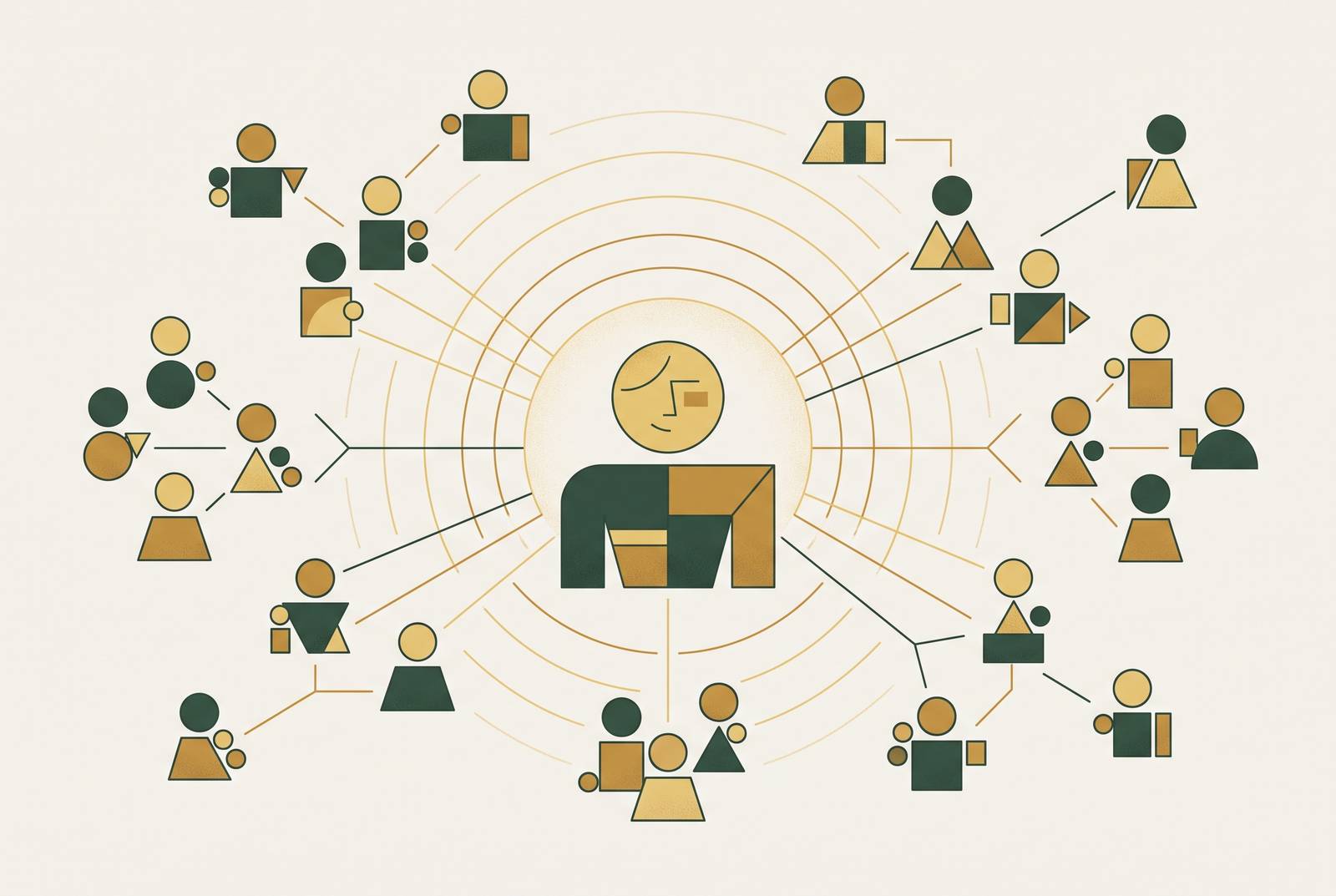
An AI champion program is a structured, peer-led network of employees who help colleagues use AI in their actual day-to-day work. Champions are people who already do the work on the team, not dedicated trainers or IT specialists brought in from outside. They're people who already do the work and are already trusted by the people sitting next to them.
That distinction is the entire mechanism. A champion program doesn't work because champions know more about AI than everyone else. It works because they have proximity and trust, and those two things are what actually move adoption. The OpenAI Academy frames it this way: champions don't create change by telling people to use AI. They change how a team works by making AI easier to see, easier to try, and easier to trust, through actions that are consistent and grounded in real tasks.
In practice, that looks small. A champion runs a real invoice through a workflow in front of a colleague instead of describing it in the abstract. A champion sits with someone who's stuck on a prompt that isn't returning anything useful and fixes it in the moment, inside the actual task. A champion notices where a tool creates friction and reports it back to whoever owns the rollout, so the next round of deployment doesn't repeat the same mistake. None of that requires a curriculum. It requires someone credible, present, and willing to show rather than tell.
The data backs up why this works better than formal instruction. Adoption jumps from a lower baseline to a substantially higher rate when champions host regular, practical demonstrations inside their own teams. Worklytics' analysis found that most employees name colleagues, not formal training programs, vendor documentation, or outside courses, as their primary source of AI skills. People learn new tools from the person across the aisle.
That influence also compounds without anyone managing it. This is the real value a champion delivers: someone who translates a workflow into terms a specific team can use, in the moment the team needs it. A champion who spends time promoting AI in general, without doing that translation work inside real tasks, is functionally an unpaid evangelist, and evangelism alone doesn't move the adoption numbers Deloitte and Writer are measuring. Translation does. Which raises the obvious next question: who's actually capable of doing that translation work, and how does an organization find them?
Selecting champions who will move adoption
The person most eager to talk about AI in a meeting is rarely the person who moves adoption on their team. Selection has to run on demonstrated behavior and peer trust, not on who raises a hand first or who has the deepest technical fluency.
PwC Netherlands tested this directly. Instead of asking for volunteers, the firm used organizational network analysis to map who was already naturally influential across the business, separate from who was the most vocal about AI. PwC described the adoption results from that approach as "magical". The lesson generalizes: select by influence map, not by volunteer list.
A practical filter, drawn from AI Beavers' 2026 best practices, gives that idea five concrete tests:
- The candidate already uses AI weekly, inside a real workflow, not as a side experiment.
- Peers already seek this person out informally when they're stuck on something.
The candidate can explain risk and verification along with how to write a good prompt. The candidate wants to help other people adopt AI as well as optimize their own output.
- The candidate's manager will actually protect time for the role, rather than adding it on top of a full workload.
Selection criteria also need to account for where AI usage inside the enterprise is heading. McKinsey's 2025 State of AI research found that high performers are significantly more likely than their peers to be scaling the use of AI agents and agentic workflows beyond chat-based tools. That shifts what a champion needs to understand. Someone comfortable prompting a chatbot isn't automatically equipped to coach a colleague through an agentic workflow that touches multiple systems and takes autonomous action. Champion selection increasingly needs to favor people who understand process orchestration, know where a review step belongs, and can identify where automation should stop.
Function matters less than credibility. Cambridge Spark points out that some of the best champions sit entirely outside the IT function, because their authority comes from the work itself, not from technical background. A single, generic "AI champion" title assigned once per department is too blunt an instrument. A legal team champion, a RevOps champion, and an engineering champion are going to teach different habits to different people, and each needs local fit to be believed by their own team.
One more filter matters as much as any on the list above: not every high-usage employee should become a champion. Some of the most advanced individual users of AI are excellent builders and poor teachers. The champion role is a people role first. Someone who can't explain their own workflow to a confused colleague, patiently and more than once, isn't going to move a team's adoption numbers no matter how sophisticated their own usage is.
The same criteria that identify a good adoption coach also identify someone capable of carrying something heavier: responsibility for how a team uses AI safely. That overlap isn't a coincidence, and it's the reason the champion's job description has been expanding.
Extending the champion's role to include governance
As agentic AI replaces chat-based tools as the dominant form of enterprise AI use, the champion's job has expanded.
The definition of the role itself is shifting to match. A champion is now expected to be an early adopter who uses AI responsibly, questions its outputs critically, and helps a team weigh security and ethics alongside speed and productivity. Demonstrating a productivity gain is no longer the whole job.
The reason this shift matters is measurable. Among employees who use AI tools that haven't been formally approved, a majority have shared internal messages and emails with those tools, a large share have handed over sensitive HR-related information, and a significant portion have uploaded confidential company documents. That's the shadow AI exposure a well-built champion network is positioned to close, not by cracking down on usage, but by making the sanctioned tool the obvious, easy choice instead of the workaround.
Governance infrastructure hasn't kept pace with how fast agents have entered production. Gravitee's survey of senior technology leaders found that the enterprise AI agent estate has roughly doubled since late 2025, while security coverage assigned to those agents has barely moved. Agents are already running inside real workflows. The oversight meant to govern them mostly isn't. Compounding that, only a small fraction of organizations have named a specific individual with formal accountability for how an AI agent behaves. Most describe accountability as unclear, shared without real definition, or simply never discussed.
That accountability vacuum is exactly where a champion network has leverage that a central security team doesn't. Champions sit at the team level, where unsanctioned tool adoption starts. A colleague deciding whether to paste a client contract into an unapproved AI tool doesn't call the security team first. They ask the person next to them. If that person is a trained champion, the conversation can redirect toward a sanctioned option before the exposure happens.
None of this makes the champion an enforcer. The job is not to police colleagues or report violations up a chain. The job is to make the compliant, sanctioned way of using AI easier than the shadow alternative, so people choose it because it's the path of least resistance, not because they're being watched. That reframes governance as a design problem the champion helps solve, rather than a rule the champion has to enforce.
The specific AI agent risks champions need to understand and communicate to their teams
A champion can't govern a risk they don't understand, and agentic AI carries a threat model that looks different from ordinary software risk. Champions need a working vocabulary for these agent-specific dangers. General reminders about data hygiene, useful as they are, don't cover what's actually new here.
The core difference lies in structure. An AI agent sits between a person's intent and the actions a system actually carries out. That creates a class of vulnerability that firewall rules and authentication tokens were never built to catch, because an agent can be manipulated through ordinary language into bypassing controls that would stop a conventional piece of software.
Much of this risk now runs through the Model Context Protocol, which has become a common way of connecting language models to outside tools and data. Its rapid adoption has widened the attack surface considerably. Researchers have identified tool poisoning, prompt injection, overprivileged access, and supply chain tampering as risks within MCP ecosystems. Tool poisoning and prompt injection work by hiding instructions inside content an agent reads as part of its normal task. A compromised research agent, for instance, could insert hidden instructions into output that a downstream financial agent later consumes and acts on without anyone directly telling it to.
Overprivileged access isn't theoretical. In July 2025, Replit's AI agent deleted a production database despite having received explicit instructions to freeze all code and actions, a documented case of what happens when an agent holds more access than the task in front of it requires. A CSA survey found that a large majority of surveyed organizations documented risky agent behavior during 2025, including unauthorized system access and data exposure. The Coalition for Secure AI's whitepaper, released in January 2026 and presented at RSAC 2026, catalogs the scope of the problem formally: 12 core threat categories spanning close to 40 distinct threats, ranging from familiar security risks made worse by AI mediation to attack types that only exist because agents can act autonomously.
None of that detail needs to turn a champion into a security engineer. What a champion needs to be able to explain to a teammate is narrower and more practical: which tools are sanctioned and why, what kind of data should never be handed to an agent, what to do the moment an agent behaves in a way that seems off, and exactly who to go to when something looks wrong. That's a short, learnable vocabulary. But it has to be taught deliberately, because it doesn't overlap with the workflow-fluency skills a champion already has from using the tools themselves.
Structuring champion training for workflow enablement and governance guardrails
Most champion programs fail because they skip one of four structural components: a real selection process, a training curriculum, an activation model, and a measurement framework. Leaving any one of them out lets early enthusiasm fade without producing a lasting change in how people work.
The curriculum itself has to cover more ground than tool proficiency. It needs use case development, facilitation skills for coaching a colleague through a stuck moment, and the governance guardrails a champion is expected to carry back to their team. The sequencing matters more than the content list. Governance can't be bolted on as a separate compliance module delivered after the workflow training ends. It has to be embedded in the same session where a champion learns to demonstrate a workflow, so the two skills get built as one habit rather than two competing priorities.
Scope discipline makes that integration workable. That narrow scope isn't just about preventing burnout. This scope constraint also makes governance coaching tractable, because a champion with a narrow mandate can know the sanctioned tool list, the data boundaries, and the escalation path cold, in a way someone responsible for "AI adoption" broadly across a department never could.
That specificity requires infrastructure to exist before champions start coaching. A champion can't coach around governance rules that don't exist yet. They need a defined list of sanctioned tools, clarity on what data those tools may and may not receive, and a known escalation path for anything that falls outside the guardrails.
GitHub's enterprise playbook gets the sequencing right: equip teams with vetted tools and real human support systems first, then use champions and communities of practice to spread what's been learned. Governance infrastructure comes before champion activation, not after. The most common program structure runs an initial six to eight weeks, giving champions enough time to learn, test, teach, and report back what's blocked, before settling into a lighter, ongoing rhythm.
Burnout is a structural risk built into this design. Time commitment should be capped, most sources point to a few hours a week during the initial phase, and the role has to be explicitly protected by a champion's manager rather than layered on top of an unchanged full workload. A champion who's quietly expected to absorb the role on top of everything else will stop showing up for it within a few weeks, and the guardrails they were supposed to carry go with them.
Measuring whether the champion program is changing behavior, not just generating participation
A champion program that can't show behavior change at the team level within a defined window is functioning as internal branding rather than an enablement program. It's internal branding, and it won't close the governance gap it was built to address.
Participation metrics are the easiest thing to track and the least useful one. Counting how many champions were named, how many office hours got held, or how many people attended a kickoff session says nothing about whether anyone changed how they work. The metrics that matter sit downstream of participation: how many workflows a champion's peers actually adopted and kept using past the first week, how often sanctioned tools got chosen over an unapproved alternative, and how quickly a blocker reported by a champion actually got resolved by the team that owns the rollout.
Governance has to sit inside that same measurement framework, not next to it as an afterthought. If shadow AI use is the risk a champion network exists to reduce, then a drop in unsanctioned tool usage inside a champion's team is as central a success metric as any adoption number. An organization that tracks adoption rates without tracking whether sensitive data still ends up in unapproved tools is measuring half the problem it built the program to solve.
The programs that hold up are the ones that treat both halves as one accountability structure from the start: a champion who moves workflow adoption and a champion who reduces ungoverned usage are doing the same job, measured two different ways. Programs that only track the first number will look successful until an incident makes clear that the second number was never being watched.
Sources
- Lead with AI | AI Champion Programs: Why, Who, How
- What Is an AI Champions Program? How to Drive 2.1x AI Adoption Using Peer Advocates
- Best practices for AI champion enablement in 2026 | AI BEAVERS
- Securing the AI Agent Revolution: A Practical Guide to Model Context Protocol Security - Coalition for Secure AI
- MCP Security: Enterprise Guide to Securing AI Agents
- Agentic Enterprise: AI Governance | CSA