Measuring AI Agent Adoption Beyond Seat Counts
Agents act autonomously, making seat counts and login metrics obsolete measures of real impact.
Seat counts measure access, not adoption, and that gap has been costing enterprises money for years. With AI agents now acting on their own, even the login-based metrics that limped along for traditional software stop working entirely. What replaces them is a layered measurement framework built around workflow depth, task completion, autonomous action volume, and business outcomes, because that's the only way to know whether agents are actually changing how work gets done.
Why seat counts became the default AI adoption metric and no longer work
Seats and logins came from SaaS licensing, where they made a certain kind of sense. A seat measured access provisioned, and when software value stayed roughly uniform across users, access was a decent enough stand-in for value.
AI doesn't work that way, and 2026 made that obvious. Deloitte's State of AI report found worker access to AI rose 50% in 2025, yet only 34% of organizations say they're truly reimagining how work gets done. Access and transformation turned out to be two separate variables that just happened to move together when the underlying tool was simpler.
Avantiico's 2026 analysis puts a number on the gap directly: only 35% of employees actively use Microsoft 365 Copilot after rollout, despite the seats being fully paid for and provisioned. That's not a rounding error.
The consequences appear at the board level. PwC's 2026 CEO Survey found only 12% of CEOs report AI delivering both revenue gains and cost reductions. Organizations tracking access instead of outcomes aren't catching the problem early enough to do anything about it. Writer's 2026 survey, covering 1,200 C-suite executives and 1,200 non-technical employees actively using AI at work, found 79% of organizations face adoption challenges, a double-digit jump from 2025 Writer 2026 survey. That makes struggling adoption the default outcome, not the exception.
Access metrics answer "can employees use AI?" Adoption metrics have to answer a harder question, "are employees using AI in ways that change what work actually produces?" Those are different questions with different answers, and most enterprises are still only asking the first one. Measuring AI agent adoption requires looking beyond simple seat counts to capture actual usage.
AI agent adoption in 2026 and the measurement gap the data reveals
The spread that defines the moment is stark. Gartner found 80% of enterprise applications shipped or updated in the first quarter of 2026 embed at least one AI agent, up from 33% in 2024. Meanwhile, S&P Global Market Intelligence and McKinsey found only 31% of enterprises have an agent actually running in production. That's a 49-point gap between "we shipped something with an agent in it" and "an agent is doing real work," and it's where most enterprise AI budgets are quietly disappearing.
The gap isn't evenly distributed. Banking and insurance lead production deployment at 47%, healthcare trails at 18%, and government sits at 14%. Those differences track digital workflow maturity and compliance overhead, not how many pilots got kicked off in each sector. A bank isn't smarter about agents than a hospital system. It just has cleaner data pipelines and fewer regulatory tripwires standing between a pilot and production.
McKinsey's broader 2026 numbers back this up from another angle: 62% of organizations are at least experimenting with agents, but only 23% are scaling one in even a single business function. Experimentation and scaling are not the same motion, and they don't respond to the same metrics.
Most pilots simply don't survive the trip. Forrester and Anaconda data from 2026 puts pilot mortality at 88%, meaning 88% of agent pilots never reach production. The top blockers cited by leaders are evaluation gaps (64%), governance friction (57%), and model reliability (51%). Those aren't technical failures so much as scoping and ownership failures dressed up as technical ones.
Layer onto this a newer complication: multi-agent orchestration. 22% of production deployments now coordinate three or more agents working together, and that creates attribution problems seat counts were never built to approximate, let alone solve. An organization can report, honestly, that 80% of its apps embed an agent, while running essentially nothing in production. Embedding counts turn out to be just as misleading as seat counts, only newer and shinier.
Agentic AI's break with metrics inherited from the human-software interaction model
Traditional AI tools like Copilot or ChatGPT produce an output, and a human decides what to do with it. Agents skip that step. They act autonomously, making API calls, running multi-step workflows, and completing tasks without a human kicking off each individual action. That single shift breaks nearly every metric built for the human-in-the-loop world.
Start with cost. Agents run on consumption-based billing, chewing through tokens and API calls around the clock. A per-seat number describes neither what that costs nor what it's worth. Then there's attribution: in a workflow where several agents hand tasks off to each other, who gets credit for a completed task? The orchestrating agent? The sub-agent making the tool call? The human who configured the workflow a week earlier and hasn't touched it since?
Engagement depth, a concept that worked fine for distinguishing a power user from a dabbler, collapses too. It depended on signals like session length and multi-turn interaction, all of which assume a human sitting at the keyboard. An agent running overnight doesn't have a session in any sense a human-usage dashboard would recognize.
Shadow usage compounds the blindness. Larridin's 2026 enterprise guide found employees typically use three to five times more AI tools than IT ever estimates. With agents, that same invisibility extends to autonomous actions IT never sees happen at all. Larridin's 2026 research found only 6% of CIOs report that accountability for AI governance and outcomes is clearly established. Agent autonomy doesn't ease that problem. It makes it worse, because there's no human login trail left behind to audit.
A layered measurement framework: from activation through autonomous action volume to business outcomes
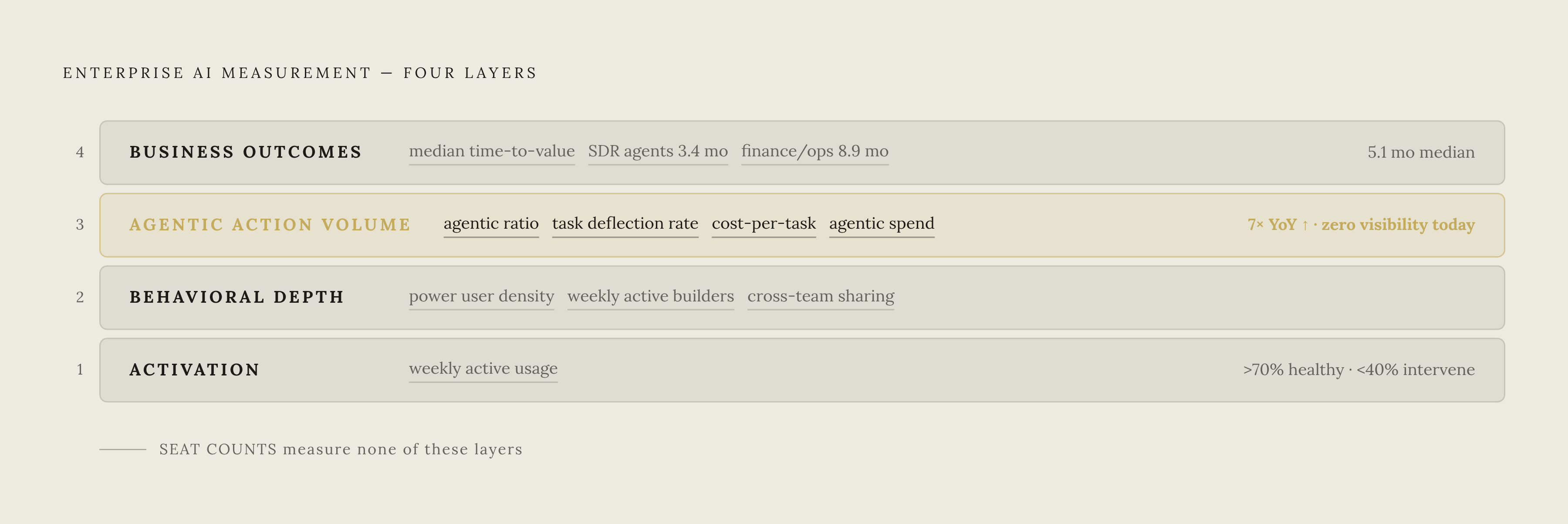
If the old metrics don't map to how agents create value, the fix is a framework with layers, each one answering a question the last one couldn't.
Layer one is activation, the floor, not the ceiling. It's weekly active usage across the entire AI ecosystem an organization actually has, not just the primary licensed platform, and it needs to capture sanctioned, tolerated, and shadow usage alike. Above 70% signals genuine access; below 40% is an intervention signal.
Layer two is behavioral depth, which separates activity from productivity. Power user density is the leading indicator here: there's a real productivity gap between AI power users and average employees, and growing that percentage week over week, department by department, is arguably the CIO's actual job. Weekly active builders matter too, people creating workflows or agents that others go on to use, since that's multiplicative value rather than personal productivity. Agents or workflows shared across teams signal something has become institutional rather than someone's personal trick.
Layer three is agentic action volume, the layer seat counts were never built to see. The agentic ratio tracks the share of AI activity that's autonomous versus human-initiated; a rising ratio means the organization is extracting value specifically from agents, not just from AI generally. The agentic spend ratio matters because consumption-based billing can grow 7x year over year even while seat counts stay flat, which is roughly the pace at which median enterprise monthly LLM spend was growing entering Q1 2026. Task deflection rate quantifies how much work agents completed that would have needed a human otherwise. Cost-per-task is the consumption-based heir to cost-per-seat, and it's become its own CIO-level KPI.
Layer four is business outcomes, the only layer boards actually care about. Median time-to-value across agent deployments is 5.1 months, with SDR agents paying back in 3.4 months and finance or ops agents taking 8.9 monthsc29. Outcome is defined as the operational state of the workflow after AI touches it, faster, cheaper, more accurate, higher quality, measured against a defensible baseline.
Novo Nordisk offers a working example of outcome-anchored measurement done right. The company scaled a self-service generative AI platform to more than 25,000 employees, who built over 2,500 chatbot use cases between them, and separately cut clinical study report production from more than 10 weeks down to 10 minutes using Claude Code. Those are figures tied to time, cost, and quality, not login counts. The 30-day repeat usage rate and time-to-first-value for new users are leading indicators worth tracking, since both predict whether a deployment will reach the outcome layer rather than just confirm it after the fact The Agent Report 2026.
Prosci's research found that 38% of AI adoption challenges stem from user proficiency issues, more than double the 16% attributed to technical integration problems, meaning behavioral depth metrics catch the largest failure category before it becomes an ROI problem.
Root causes revealed by the 22% of agent deployments reporting negative ROI at 12 months
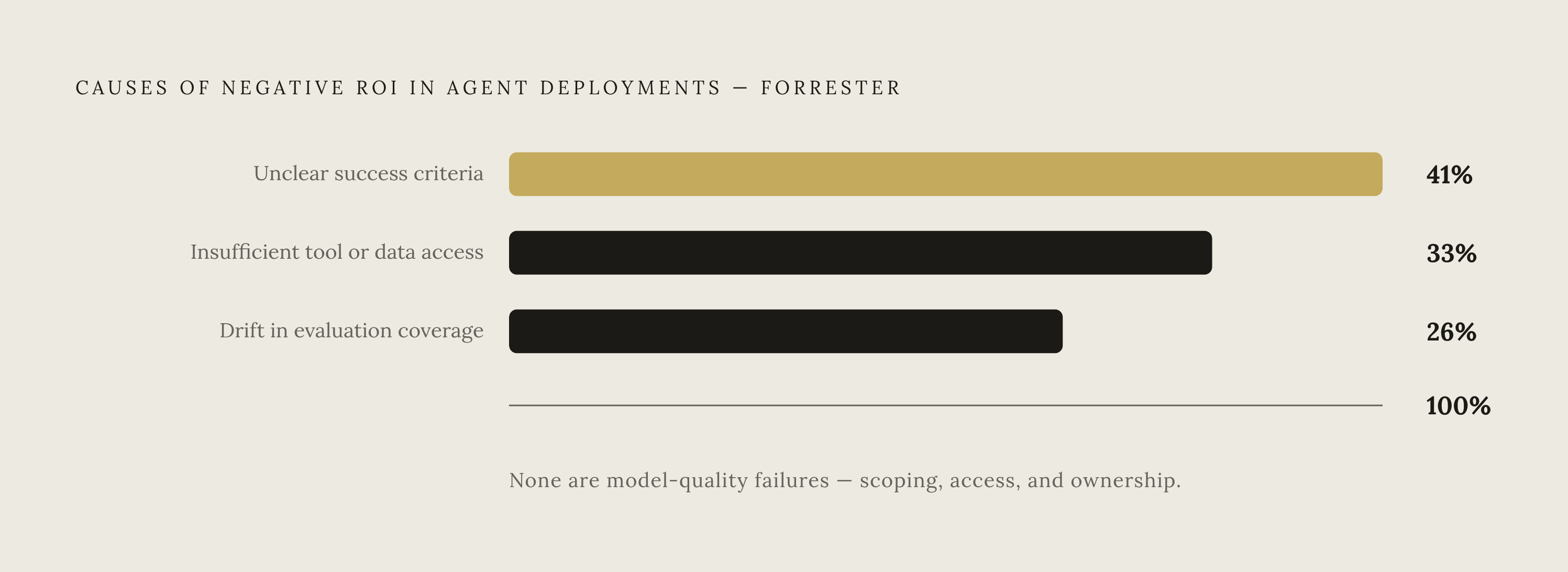
22% of agent deployments report negative ROI at 12 months. Forrester's root-cause work on that figure attributes 41% of the failures to unclear success criteria, 33% to insufficient tool or data access, and 26% to drift in evaluation coverage.
None of those three are model-quality problems. They're scoping, access, and ownership failures, the kind a decent measurement framework would have revealed months before the ROI report came in negative. Unclear success criteria traces straight back to skipping outcome definition at layer four: when nobody agreed on what "better" looked like before launch, there's no baseline to measure drift against and no early warning that something's off. Insufficient tool or data access, affecting 33%, appears as agents that can't reach the systems they need, completing tasks partially or incorrectly; the agentic action volume layer, through task deflection rate and cost-per-task, would reveal this as anomalously low task completion at rising cost. Drift in evaluation coverage happens because agents change behavior as models update and tool descriptions shift underneath them, and without continuous behavioral monitoring, that drift stays invisible until the number is already negative.
This lines up with the pilot mortality picture from earlier: evaluation gaps, governance friction, and model reliability are the top reasons pilots never reach production in the first place. Many of the same root causes appear earlier in the lifecycle, wearing a different name.
Ownership is the variable that seems to actually move the needle. 56% of enterprises now name a dedicated AI agent owner or "agentic ops" lead in 2026, up sharply from 11% in 2024. Ownership maturity correlates strongly with the small subset of organizations that actually cross the production threshold. Measurement isn't a report generated after deployment; the implication runs through everything above it. It's an operational feedback loop that runs during deployment and catches the failure modes before they turn into a negative ROI headline.
Agent access control and tool-call visibility as measurement infrastructure, not just security controls
An agent calling 40 tools across three services inside a single workflow doesn't produce a "session" in any sense a traditional dashboard recognizes. Measuring at the agentic action layer means tying identity to every individual tool call, not just to the agent's initial login.
The Model Context Protocol has become the rails this runs on, with adoption crossing more than 10,000 public servers. That's also exactly where the measurement surface lives, for better or worse. Right now, it's mostly for worse: only 8.5% of MCP servers use OAuth, per Astrix, which means most agent tool calls happen without the identity binding that would make them attributable, auditable, or measurable in the first place. Research published in early 2026 found more than 1,800 active MCP servers on the public internet running with no authentication at all. Agents connecting to those leave no audit trail and generate zero data for the agentic action layer. They're not just a security hole. They're a hole in the measurement itself.
Proper identity infrastructure fixes both problems at once. It ties every tool call to a specific agent identity and, through a delegation chain, back to the human who authorized it. It lets task completion rates and cost-per-task get computed from actual tool-call logs instead of self-reported vendor dashboards. It catches behavioral drift the moment an agent's tool-call pattern diverges from its authorized scope, which is precisely the drift-in-evaluation-coverage failure mode Forrester ties to 26% of negative ROI outcomes. And it produces full OTEL tracing with tamper-proof audit logs that satisfy governance requirements and give the measurement program a defensible baseline at the same time.
The protocol itself is moving in this direction. The MCP update released July 28, 2026 brought authorization hardening and a stateless core, which points toward the identity binding measurement depends on. Cisco's State of AI Security 2026 found only 29% of organizations feel prepared to secure agentic AI deployments. That same readiness gap creates measurement blindness right alongside the security exposure, because an organization can't measure what it can't see. The enterprises measuring agentic action volume reliably are, unsurprisingly, the ones that routed agent tool calls through a control plane with identity enforcement built in from the start.
Building a measurement program that scales as agent autonomy grows
Measurement design has to come before deployment, not after. Forrester's finding that 41% of negative ROI cases trace to unclear success criteria means the baseline and the definition of "better" both need to exist before the agent goes live.
The metric stack should stage itself against deployment maturity. Early on, activation is what matters: weekly active usage across all tools, time-to-first-value, and the 30-day repeat usage rate The Agent Report 2026. As a deployment grows, the focus shifts to depth: engagement distribution, power user density trends, agents shared across teams. Once it's scaling, agentic metrics take over: the agentic ratio, task deflection rate, cost-per-task, and agentic spend as a share of total AI spend. At maturity, it's workflow-level before-and-after comparisons against the original baseline, with ROI benchmarked against the 5.1-month median payback and the function-specific targets underneath it, 3.4 months for SDR, 8.9 months for finance and ops.
The shadow AI rate deserves a second look, too, not just as a security line item but as a measurement health check. If employees are routing real work through unsanctioned agents, the sanctioned measurement program is only capturing a slice of what's actually happening. That gap is itself a signal, usually that the approved path isn't easy enough to bother using.
Confidence is not visibility. Larridin's 2026 enterprise guide found 92.4% of executives believed they had solid visibility into AI usage, while real visibility gaps appeared at every level below them. A measurement program built on executive confidence instead of actual telemetry is measuring how executives feel, not what's happening.
Ownership is the last piece, and maybe the one that ties everything else together. Organizations that named a dedicated AI agent owner show the strongest correlation with crossing the production threshold. The measurement program itself needs that same kind of fixed accountability, not a task that rotates between quarterly reporting cycles. Enterprises that route agent traffic through a single control plane, with SSO, SCIM, just-in-time credentials, and policy enforcement down at the tool-call level, get the telemetry all four layers need without building separate instrumentation for each one. Governing agents well and measuring them well turn out to be the same job, built once and run continuously.
Sources
- AI Adoption: The Complete Enterprise Guide 2026
- Enterprise AI adoption in 2026: Why 79% face challenges despite high investment - WRITER
- Microsoft 365 Copilot adoption 2026: measuring seats vs. usage - Userlane
- Beyond AI Licenses: How to Measure Whether Your AI Is Actually Working | California Management Review