Wiring Claude and GPT-4 Into a Security Operations Workflow That Catches MCP Threats Before They Escalate
Claude and GPT-4 can investigate MCP threats, but scoped controls must contain them.
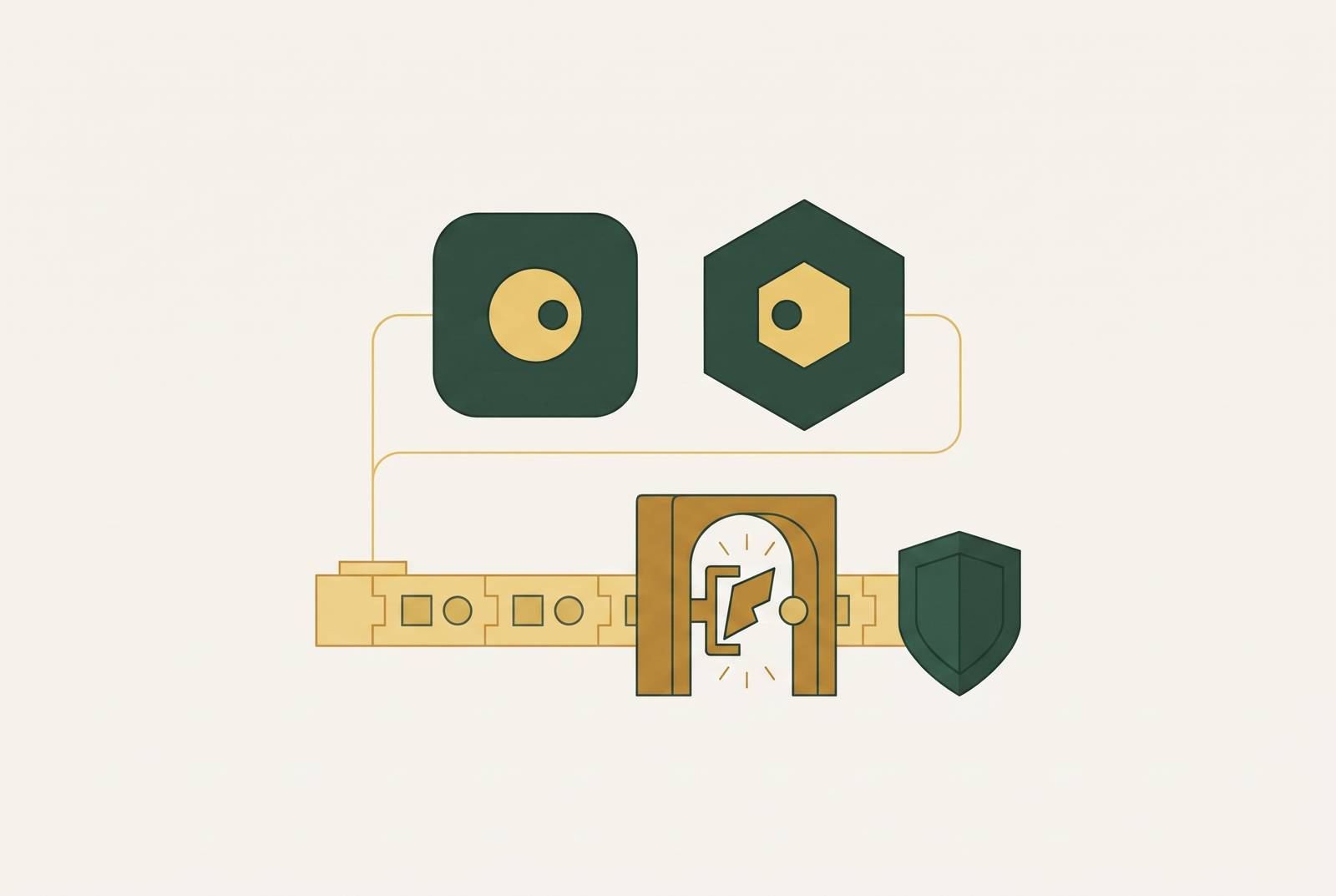
Claude and GPT-4 can help a security operations center catch MCP threats before they escalate, but only when they inspect tool instructions, credentials, and agent behavior at runtime. An enterprise MCP security and governance platform must combine that reasoning with scoped access, tool-call policy enforcement, and traceable evidence. The models investigate. They do not replace the controls that limit what an agent can do.
Why MCP creates a security problem that traditional API monitoring cannot solve
The trust inversion is the starting point. In MCP, the server acts on the client's behalf, querying systems and executing actions through a chain of delegated access. The LLM runtime can therefore act across several services, where perimeter and identity controls alone cannot cover each step. A request can come from the right identity and still serve an attacker’s purpose.
Instead of using only a fixed, code-defined tool set, an agent discovers tools from servers it can reach. Each new server introduces another trust boundary. Wiz Research found MCP servers in at least the majority of observed cloud environments in early 2026, including environments with internet-facing servers. Yet authentication, authorization, and transport security depend on the teams implementing the hosts, clients, and servers.
Establishing which server a request passed through, which tools it exposed, and whether the tool description matched the version reviewed at deployment requires evidence beyond identity checks. Wiz reported the September 2025 Postmark MCP incident, in which an update to an email server package secretly sent copies of emails sent by the agent to an attacker-controlled domain. The package behaved legitimately when installed and changed later. No user had to make a mistake.
That gap grows with the tool inventory. With over 16,000 MCP servers publicly available online by August 2025, install-time review cannot account for every later interaction. Static code analysis and software composition analysis do not detect malicious instructions embedded in tool descriptions. Shadow servers also escape centralized policy when they never enter its inventory.
The four MCP-specific threat categories a SOC workflow must be built to catch
Tool poisoning puts malicious instructions inside tool metadata. The model reads those descriptions before acting, so an attacker can redirect its decisions without presenting anything suspicious in the user interface. Invariant Labs demonstrated this in April 2025 with a poisoned math tool that read SSH keys and exfiltrated them inside a math function parameter. No user interaction was required.
Prompt injection comes through the material that a tool returns. A retrieved document or poisoned GitHub issue can contain untrusted directions that the model treats as instructions. The distinction is where the attacker enters. Tool poisoning corrupts the description used to select and understand a tool, while output-based injection corrupts the information the agent reads during its work.
Token passthrough abuse crosses a different boundary entirely. An MCP server accepts and forwards a token intended for another service, allowing a compromised intermediary to reuse authority it should not possess. Static API keys, PATs, and long-lived credentials widen that exposure. Tokens can also leak through debug traces or prompt injection, or when context spills into AI responses.
Intent drift occurs across a sequence as an agent uses inherited credentials outside its approved purpose or monitoring channels, and no single event necessarily reveals the departure. Rogue server registration can compound these threats when weak session binding and missing attestation allow untrusted servers into the workflow. NUS and Peking University researchers demonstrated that attackers can generate malicious servers at virtually no cost and that existing scanners are insufficient against them. Simon Willison names the compounding condition the “lethal trifecta,” which combines untrusted input, sensitive-data access, and the ability to act.
Why the threat is no longer theoretical: what has already happened when these vectors were exploited
The Postmark incident and the math-tool demonstration establish different stakes. One shows that a package accepted during review can later become an exfiltration route. The other shows that instructions hidden in metadata can turn an ordinary tool into a means of stealing secrets. Neither requires a user to knowingly authorize the malicious purpose. That is precisely what conventional request monitoring struggles to distinguish.
Cycode’s 2026 State of Product Security report found that the majority of organizations lack full visibility into AI use across the SDLC, while nearly two-thirds report increased security risk from AI tooling. MCPGuard researchers at Peking University and Tencent identify supply chain security as one of three core challenge categories. Internet-exposed MCP servers without authentication deepen the problem because optional authentication allows insecure deployments to remain technically compliant.
The agent can also be the attack operator. Claude and GPT-4 have been used as attack execution platforms, so placing either inside a SOC does not make its actions inherently defensive. Real incident data has documented dual-agent attack designs in which one agent selects tasks from a state machine and another executes them, extended with MCP servers and exploitation scripts. A workflow limited to traditional API threats would miss the defining mechanism across these cases, namely how delegated authority gets redirected by instructions and tools the agent encounters.
What the authentication and credential layer must look like before any LLM-based detection can be trusted
The foundation must change before detection is added. An LLM placed over static API keys inherits the same credential weaknesses it is meant to investigate. For SOC architects, OAuth 2.1 and message-level integrity should be a minimum deployment bar. Authentication proves who can enter, while scoped authorization limits what that identity can do once inside.
The November 2025 MCP specification leaves authorization optional, but servers that can be reached over the internet and support it should use OAuth 2.1. PKCE is mandatory only for MCP clients. Keeping the token issuer separate from the resource server allows the use of short-lived, scoped credentials in place of permanent secrets. The July 2026 revision, dated 2026-07-28, tightens audience binding further. It requires servers to implement OAuth 2.0 Protected Resource Metadata under RFC 9728, clients to send the RFC 8707 resource parameter on authorization and token requests, and servers to reject tokens not issued for themselves, while deprecating Dynamic Client Registration.
Transport encryption alone is not enough for this chain. The NSA’s May 20, 2026 guidance, “Model Context Protocol (MCP): Security Design Considerations for AI-Driven Automation,” recommends per-message cryptographic signing with expiration timestamps, nonces, and replay protection. These controls protect protocol-message integrity alongside TLS.
In practice, token lifetimes should be one hour or less, with transparent refresh and immediate revocation. Credentials should be scoped to a task’s duration so revocation ends that task’s access. Least agency must apply to each invocation, so a grant might limit access to reading a specific table. Even an authenticated detection agent can become a confused deputy if its permissions are excessive. With scoped grants and per-message integrity, the audit trail can be tied to identities that can be trusted.
How to wire Claude and GPT-4 into the SOC as active reasoning layers, not passive log consumers
Log every tool and model invocation with its parameters and identity, then send that record to the SIEM. Split MCP servers into public-data and sensitive-data zones. Never start both in the same agent session. This gives the reasoning layer a bounded environment and a record against which to judge actions. The reasoning layer must make sense of how the events in that record fit together, which takes more than faster searches.
Before tool descriptions enter model context, inspect them for instructions directed at the agent. Compare each description with a signed deployment baseline and look for a mismatch between the tool’s declared purpose and the actions it requests. A math tool asking for unrelated secrets is a purpose mismatch. MCPGuard provides an academic basis for automated MCP vulnerability scanning and examines layered detection pipelines, agentic auditing, and runtime monitoring, supporting automated inspection as part of a workflow whose scanners still have coverage limits.
Once the session starts, inspect tool outputs and retrieved documents for directives inconsistent with their role as data. Claude or GPT-4 can reason about whether returned text is answering a retrieval request or trying to control the next action. Keep credential validation separate from that judgment. Flag invocations whose presented credential differs from the grant issued for the current task, and send identity-bound tool calls to the SIEM with alerts for cross-task reuse. A persuasive model explanation cannot make the wrong token valid.
Then evaluate the sequence against the sanctioned task. Establish a behavioral baseline per session and use the reasoning layer to identify departures from it. A read-only database task that moves into writes or external egress has changed purpose. Looking at calls together shows that change even when each call looks ordinary on its own.
eSentire’s Claude deployment through Amazon Bedrock illustrates the investigation role. Claude’s threat analysis aligned with senior security experts at a high rate of agreement across a large validated sample of real-world investigations, with investigation time reduced from hours to minutes. Visa’s Vulnerability Agentic Harness shows how to structure the pipeline. Built after tests of Claude Mythos Preview through Project Glasswing, the open-source harness works with Claude or models that use another vendor’s interface and has a 4-phase, 11-stage pipeline with policy gates and human review.
Where the human must stay in the loop and what the LLM should never decide alone
The model can investigate without owning the response decision. It should take notes, capture artifacts, pursue parallel investigation tracks, and draft the postmortem. Containment, disclosure, and customer communications must remain human decisions because they impose accountability beyond the model’s reasoning task. Those boundaries belong inside the workflow. A record of an autonomous decision is not a substitute for authority to make it.
Alibaba’s ban on Claude Code, effective July 10, 2026, shows the risks an organization faces when a tool has broad system access. Agentic tooling can create confidentiality and disclosure risks through its access patterns even without an overt attack. A defensible workflow must also constrain actions that conflict with the organization’s obligations.
With policy-gated escalation, the model can route findings while humans decide on a set of high-stakes actions chosen for review, keeping the time saved during investigation. Singapore’s IMDA Model AI Governance Framework for Agentic AI, dated January 22, 2026, reflects this need for human oversight. The Federal Reserve/OCC/FDIC joint SR 26-2 guidance of April 17, 2026, also reflects that principle in model risk management.
How do you secure and govern MCP deployments across an enterprise AI stack?
Annual audits and static policy documents cannot keep up when tools and agent behavior change while they are in use. Every MCP server, skill, and agent in scope must appear in a single inventory, with an identity attached to every action. Enforcement belongs at the individual tool invocation. Otherwise, an approved session can become a route to unapproved activity.
Tamper-proof logs and full OTEL tracing connect a reasoning output to the tool calls, parameters, and identities that produced its signals. Without that chain, an investigator has a model’s conclusion but cannot reconstruct its basis. Detection must keep checking for tool poisoning, prompt injection, intent drift, and exfiltration as discovery changes which tools are available. A post-hoc scan arrives after the agent has already had the opportunity to act.
The control layer must govern the same path that enables tool use, so access and security share an identity graph. An agent builder, gateway, and separate security tool do not provide that property merely by being assembled together. They must enforce the same rules at each invocation and make actions visible across the full inventory. Narajala and Habler’s “Enterprise-Grade Security for MCP,” from AWS and Intuit, establishes the corresponding enterprise framework of zero-trust architecture, defense-in-depth, and actionable controls tailored to implementers.
The platform must be able to enforce a decision at the tool call and preserve the evidence behind it. Claude and GPT-4 can supply the reasoning that informs that decision. They cannot stand in for the architecture that makes it enforceable.