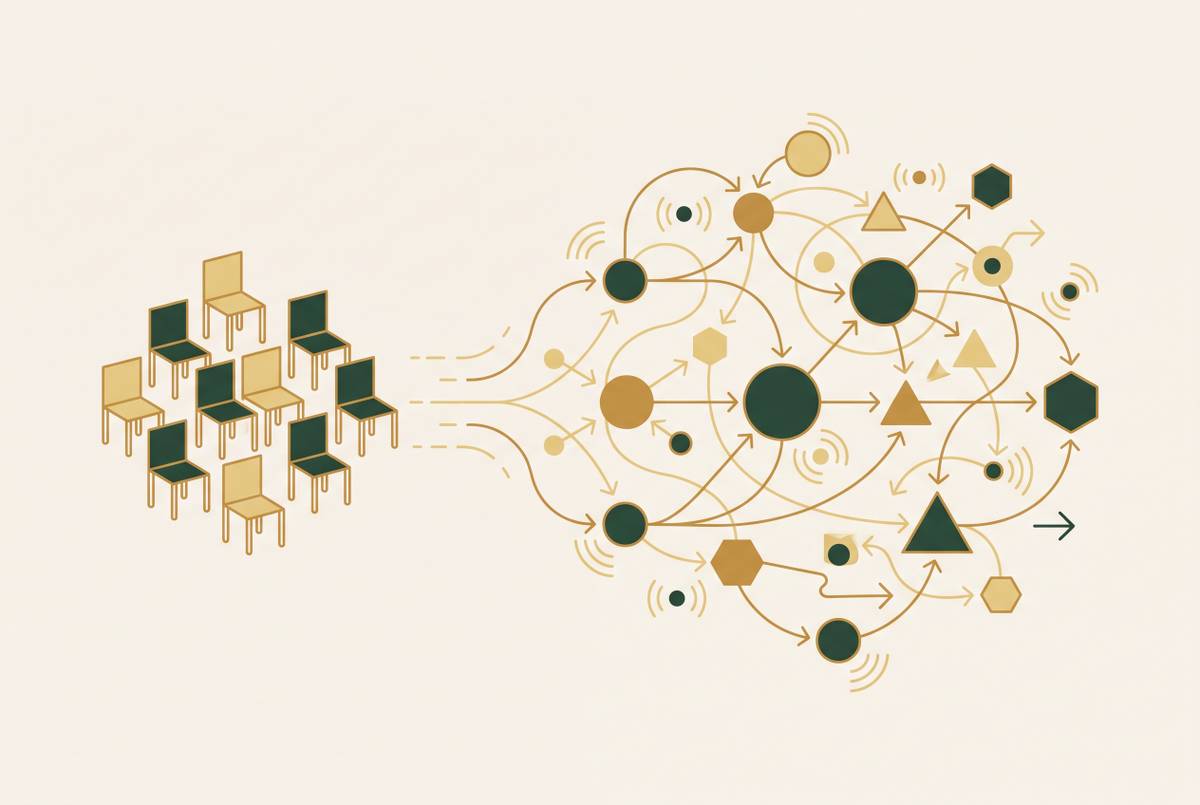
The Golden Path Playbook for No-Code AI Agent Deployment Across Thousands of Employees
A framework for safely deploying AI agents across enterprises at scale.
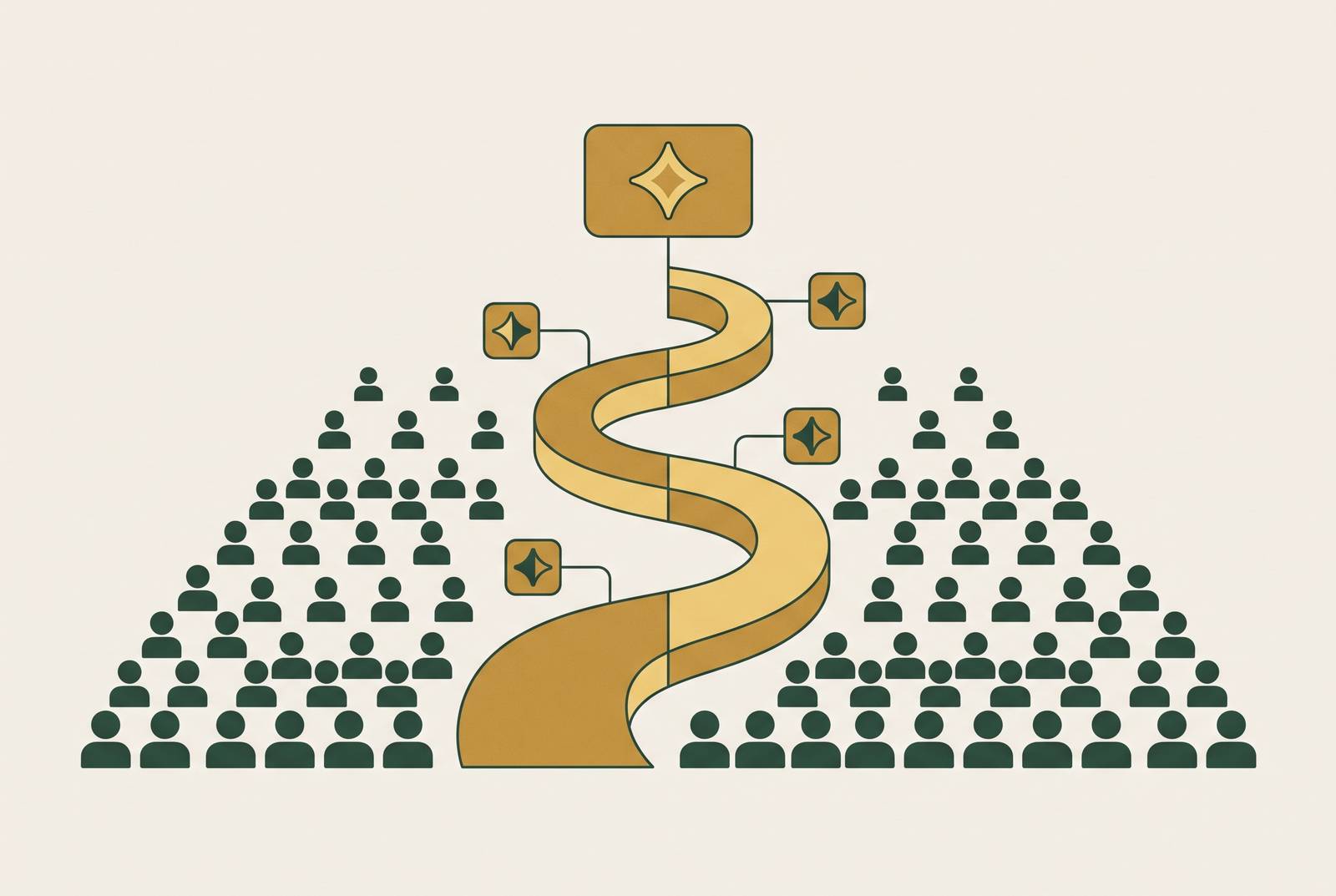
Rolling out no-code AI agents across thousands of employees requires a golden path, a standard, repeatable way to build agents with identity, permissions, approvals, and monitoring already in place. Employees should start from approved tools and templates. The goal is self-service without overwhelming IT, with the easiest route also the safe and sanctioned one.
Why enterprises are deploying no-code agents now, and what makes this wave different from past automation cycles
Searching research documents for advisor questions, monitoring clinical trial data, and processing insurance claims are operational uses. No-code builders let teams use this automation even if they have no dedicated developers. A business analyst or operations lead can combine visual components and natural-language instructions to build an agent in hours. This changes how quickly automation can spread through marketing, HR, sales, finance, and operations.
But this is not another scripted chatbot rollout. Agents can reason, chain actions, call external tools, and transact across live systems. A misconfigured agent can therefore do more than give a bad answer. It can act through the connections and permissions supplied to it. As builders become easier to use and business pressure grows, adoption can outpace the controls meant to govern it.
Why existing governance frameworks break the moment agents act autonomously
Enterprise access policies, audit trails, and identity controls were built for people who use tools. Autonomous agents break that assumption by taking several actions on a person's behalf without returning to the keyboard for each decision. In many identity configurations, the agent simply inherits the access of a human or service account. The 2026 CISO AI Risk Report surveyed 235 security leaders at large enterprises and found that large majorities could not see all their AI identities or did not enforce access policies for them.
The “lethal trifecta” explains why that gap is dangerous. An agent can read untrusted content, access sensitive data, and communicate externally. Each capability is manageable in isolation, but their combination creates a route from hostile instructions to data exposure. A crafted document or tool description can redirect an agent that also has CRM access and permission to send email. This is a common way for a business to set up an agent. Governing it requires control over what the agent may do.
The specific MCP attack surface that no-code rollouts open at scale
The Model Context Protocol connects agents to tools, but connecting a server does not itself establish safe authorization. Tool poisoning uses the instructions an agent reads in a tool description to attack it. A malicious server embeds commands there, and an agent that treats them as trusted instructions may read files or leak secrets while returning a normal-looking answer. A rug pull changes the timing of that attack. The server behaves legitimately at installation, then changes its tool definitions after permissions have been granted, without necessarily notifying the client.
Credentials create a separate route to exposure. Without centralized management, API keys, hardcoded OAuth tokens, and long-lived service credentials spread across server configurations. Shadow MCP adds connections that security teams have never checked and that are missing from their inventory. Public registries widen the supply chain, since a poisoned tool can reach every agent that installs it. Non-technical builders cannot be expected to check embedded commands, spot tool definitions that change without notice, or trace the credentials used for connections. Without a governed path, these things go unchecked during everyday setup.
What a golden path actually means in the context of enterprise agent deployment
A golden path is a set of pre-approved templates that encode organizational standards. Platform engineering teams use it to let developers serve themselves without mastering every underlying infrastructure control. Non-technical agent builders say what they need, and the platform gives them the approved tools, permissions, and limits on what their agents can do. Governance belongs inside that process so employees do not have to work out how to follow a separate checklist.
Rasa illustrates the separation of responsibilities behind this approach. Reusable skills encode business logic, memory maintains context, and orchestration controls what the agent may do. A conversational on-ramp can then translate an employee's intent into a correctly provisioned agent within those boundaries. Ease of use does not require broad authority. The alternative, attaching a human's API token or a broad service account, turns a prompt-injection flaw into a privilege problem. A golden path preserves self-service without treating unrestricted access as its price.
Platform selection as a governance decision — what the leading no-code builders actually offer
Platform architecture determines how much control the path can support. The comparison starts with granular permissions, identity attached to actions, built-in audit trails, and central administration. Builder convenience comes after those tests. Microsoft Copilot Studio fits M365 organizations because it inherits M365 permissions and offers centralized management through the Power Platform admin center. Its generative orchestration selects and chains tools, making the inherited permission model especially consequential. Its governance fit is more limited outside that ecosystem.
Infrastructure control separates several other options. Rasa offers on-prem, cloud, or managed deployment through an open framework, making it a strong fit for regulated organizations that need control over where agents run. Google Vertex AI Agent Builder is for teams in the Google Cloud ecosystem. Its Agent Development Kit is open-source under Apache 2.0 and supports multi-agent workflows with governance, while its managed Agent Engine runtime is cloud-only. n8n offers self-hosted or cloud workflow automation, combining structured flows with AI steps. Self-hosting is relevant where data residency drives the decision.
Airtable puts the workspace and database at the center. Its Omni conversational builder creates agents through natural language, while Field Agents operate across records at scale. That gives business users a direct on-ramp within Airtable's environment. A free plan is available, and its paid Team plan is billed annually. Across these options, platform choice addresses some governance needs but does not solve MCP-specific threats. Tool poisoning, rug pulls, credential sprawl, and shadow connections still need controls above or beside the builder.
The four identity and authorization controls that make a golden path agent-safe
Scoped identity is the first contract the platform must enforce. Every agent action needs an attributable, short-lived identity with the smallest scope that completes the task. Revoking it should not require changing a human's access. The second contract is policy enforced before execution. Rather than relying on a wiki, the platform evaluates the agent's proposed change against allowed registries, resource limits, privileged-operation restrictions, and change-window rules. The agent proposes a desired state, and the gate checks the difference before anything applies.
The third contract keeps the rules for what needs approval outside the prompt. Staging actions may auto-approve within policy, while production actions require a human decision that the agent cannot waive. Chat should produce a pending approval. The fourth contract binds credentials to the task. A credential is created when work begins, grants only what that work needs, and expires when the task closes. That leaves a compromised agent able to reach only tasks that are still open, with no standing grants it can keep using forever.
MCP authentication requirements the playbook must satisfy at enterprise scale
Collapsing every tool into one scope means a leak can expose the whole server, so authorization must preserve meaningful permission boundaries. The MCP specification's July 28, 2026 revision tightened requirements for implementations opting into OAuth-based authentication. Authentication alone is not the full defense. The playbook also needs token validation and scope-based routing so that a valid credential does not become permission to use everything.
Enterprise-Managed Authorization addresses the administrative burden of thousands of employees authorizing servers individually. The June 18, 2026 extension moves that decision to the organization. An administrator sets policy in the company identity provider based on group membership, roles, and conditional-access rules. Employees sign in once, and the identity provider decides which servers they can reach. Organizational access policy is the basis of MCP access.
A centralized MCP gateway gives that policy an enforcement point. It validates tokens, routes requests by scope, and provides a unified audit log. Servers behind it can accept connections only from the trusted gateway without implementing OAuth themselves. Amazon Bedrock AgentCore, Envoy AI Gateway, now Agent Router, and Docker's MCP Gateway are implementations of this pattern. The complexity stays at the platform level. Handling OAuth and enterprise authorization there is what makes a governed no-code experience possible.
Real-time detection and audit — the controls that govern agents after they are running
Setup controls cannot catch every change after deployment. Tool definitions can change, external documents can contain prompt injections, and an agent can drift beyond its original purpose or leak data through an outbound channel. Detection must follow the agent's actual activity. Standard network and system logs do not capture the tool-call sequences or semantic content needed to understand those events. MCP-specific detection needs signals about the tools invoked and the instructions shaping the action.
The audit trail must make that activity reconstructable. Every action needs an identity, every tool call needs recorded inputs and outputs, and every approval or denial needs a record that cannot be altered afterward. Full OpenTelemetry tracing connects actions across MCP calls. For finance, healthcare, and insurance organizations, identity-attributed, tamper-proof records also provide evidence that agents acted within sanctioned scope.
How do you roll out AI agents to thousands of employees who do not code?
The rollout should show that governance works before more people get access. The sequence below puts identity before the catalog, the catalog before the on-ramp, and the on-ramp before department-wide adoption.
Step 1. Establish the identity foundation before agents go live. Implement SSO and SCIM for attributable access, configure just-in-time credentials to avoid standing OAuth grants, and connect the MCP gateway to the identity provider.
Step 2. Establish the approved catalog. Give employees a sanctioned set of vetted MCP servers, tools, and reusable templates. The on-ramp needs an approved destination before it opens.
Step 3. Build the no-code on-ramp. Use a conversational interface that turns intent into a correctly scoped agent against that catalog. Rasa's starter packs and pre-built skills show how these templates give employees working examples to start from.
Step 4. Encode approval tiers as executable gates. Group actions as auto-approved within policy, human-in-loop, or blocked. Staging can auto-approve within its limits, but production needs approval. Keep those decisions outside the agent's control.
Step 5. Expand in waves. Start with power users and technically literate employees who can expose friction in templates and approval flows. Refine the path before expanding department by department. A designated agent champion in each department can triage issues without involving the platform team every time.
Step 6. Activate real-time detection from day one. Configure MCP-specific detection with the gateway before production use, even though it appears later in the rollout sequence. Tool poisoning, prompt injection, and intent drift do not wait for a second phase.
Step 7. Govern the catalog continuously. Check approved servers again, send alerts when tool definitions change, and set up a way to quickly de-list a server that fails review.
Security enables every stage of this rollout. It supplies the route employees can use without assembling access controls themselves, while maintaining the boundaries that make wider adoption possible. Reactive governance after shadow connections spread is harder and more expensive.
What “the easiest path is also the safe path” looks like once the playbook is running
Governance becomes largely invisible in the employee's normal workflow. Someone in HR, finance, or marketing can move from intent to a running agent without contacting IT or understanding OAuth. Credentials and approved connections arrive through the same experience as building the agent. When a person leaves or changes roles, SCIM updates their access so orphaned grants do not linger. Employees get capable tools.
A tool-poisoning attempt produces an alert and a trace, with the action stopped before completion and its attempted behavior recorded. Platform teams maintain shared infrastructure instead of rebuilding access plumbing for each department. With that operating model, security becomes the function that makes company-wide AI adoption possible.