Standardizing AI Agent Toolchains Across Engineering Teams
Shared MCP protocols need standardized governance to move agents into production securely.
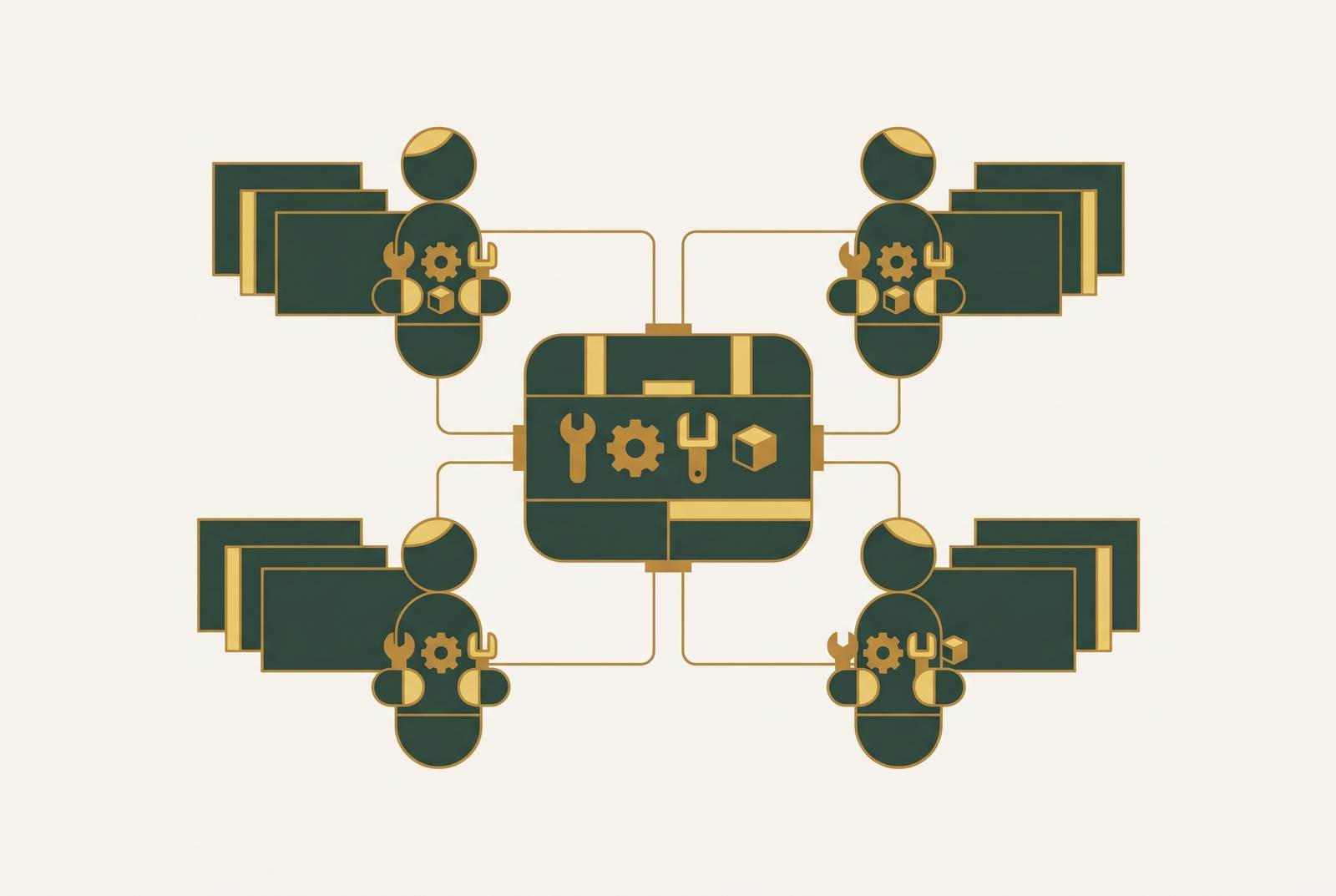
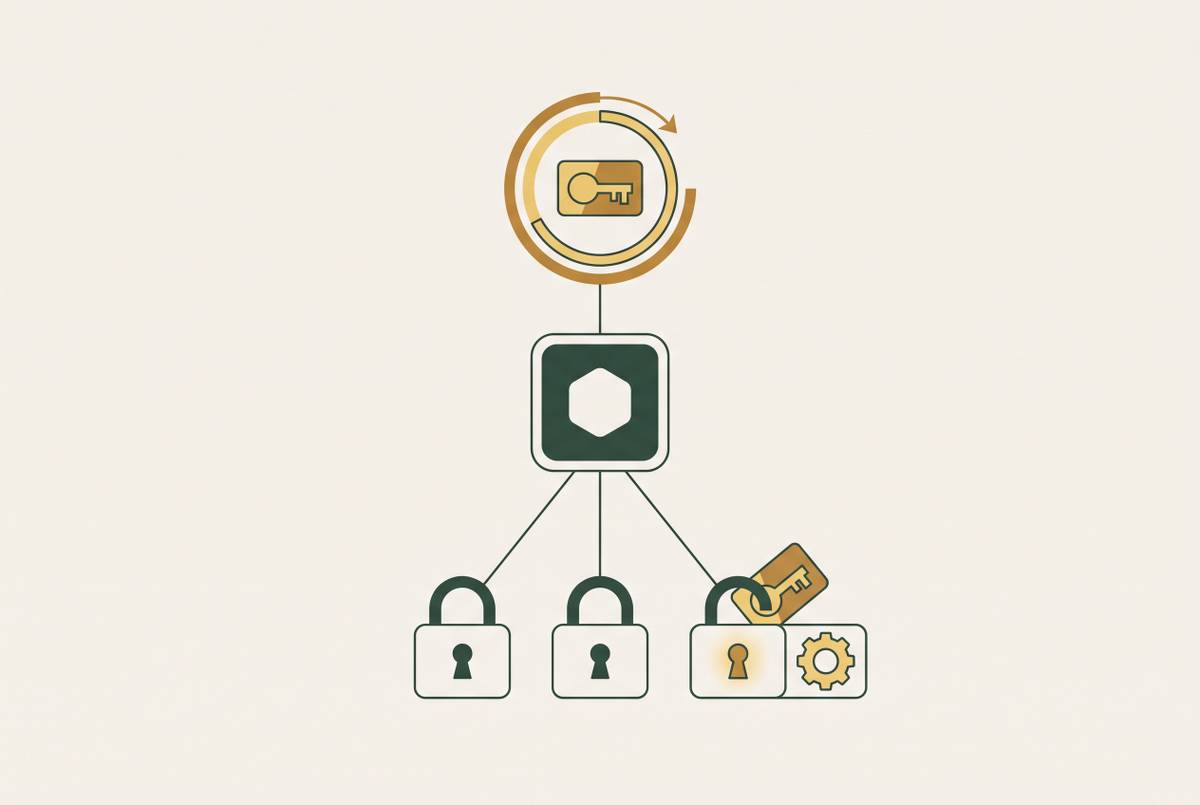
Standardizing AI agent toolchains is how enterprises make security, governance, and auditability travel with every deployment. To secure MCP OAuth credentials, a shared toolchain must tie each tool call to a scoped user identity, issue short-lived credentials for the task, and enforce access policy before the call runs. MCP standardizes the connection. The toolchain must govern what happens through it.
Why engineering teams standardizing on MCP still end up with ungoverned agents
For developers, MCP removes a real integration burden. Instead of building an N×M matrix of connections between agents and tools, teams can work through one protocol. OpenAI, Google, Microsoft, and AWS adopted it within roughly thirteen months of its launch. It now underpins agent integrations across CRM, developer tooling, and enterprise SaaS, making it a practical foundation.
But a common protocol does not produce common controls. Teams still choose their own authentication settings, provide the credentials, and decide whether to wire up audit trails. Those decisions govern access to databases, APIs, code repositories, email systems, and internal tools. When each team configures that access separately, the shared connection surface compounds the exposure.
The production gap reflects this unfinished work. Only an estimated 11–14% of enterprise agentic AI pilots reach production, with identity management gaps, auditability failures, and access-control debt among the consistent blockers. Connecting an agent and governing its actions are different engineering jobs.
What the MCP attack surface actually looks like when toolchains are assembled team by team
Tool poisoning targets the information an agent uses to decide what to do. Malicious instructions enter through tool descriptions, often invisible in host interfaces, and get treated as authoritative. The Cloud Security Alliance identifies this as a structural protocol risk. Indirect prompt injection gets into the same decision process through content from outside, including support tickets, GitHub Issues, and email. In the Supabase service-role and GitHub MCP incidents, the attack used the agent’s legitimate access rather than stolen credentials or a network intrusion.
Credential choices widen that opening across connected systems. A persistent shared key or inherited human session can give an agent excessive permissions while obscuring who authorized an action. Cross-server tool shadowing adds another route, allowing a malicious MCP server to weaponize adjacent trusted servers. The CSA research note also identifies unsanitized shell parameters in the official Python, TypeScript, Java, and Rust SDKs as a supply chain exposure. Reference implementations are not a substitute for deployment controls.
Researcher Yarden Porat published the January 2026 Git MCP chain combining arbitrary repository creation, argument injection, and path validation bypass in CVE-2025-68143, CVE-2025-68144, and CVE-2025-68145. Azure DevOps MCP’s April 2026 authentication bypass, CVE-2026-32211, had a CVSS score of 9.1 and an “authentication optional” default. These are distinct failures, but they converge at the tool-call boundary. Conventional WAFs, DLP tools, SIEMs, and API gateways do not evaluate an agent’s intent, so valid tool invocations over legitimate HTTPS can pass through without that scrutiny.
Why the MCP specification alone cannot enforce what enterprises need
The specification is maturing, but its scope remains limited. Its OAuth 2.1 authorization framework leaves authorization optional, while Anthropic has treated the STDIO behavior as intentional and placed remediation responsibility on downstream developers. Enterprises therefore cannot treat protocol compliance as proof that authentication and execution controls are in place.
The MCP 2026-07-28 specification, published July 28, 2026, tightens authorized HTTP transport. Servers using it must use OAuth 2.0 Protected Resource Metadata as required by RFC 9728, clients must send the resource parameter defined in RFC 8707, and servers must reject tokens that were not issued for them. These requirements strengthen token handling at the connection boundary. They do not make authorization mandatory across MCP implementations. STDIO transports SHOULD NOT follow the authorization specification and should instead retrieve credentials from the environment.
Centralized provisioning also stops short of action-level permission. The Enterprise-Managed Authorization extension, stable since June 18, 2026, enables access provisioning through an organization’s identity provider and has been adopted by Anthropic, Microsoft, and Okta. Its guidance explicitly says it is not runtime authorization for individual actions. Which agent may invoke a tool, with which scope, under which conditions, and subject to whose approval remains an organizational decision. That is the exact space the enterprise toolchain must fill.
How do enterprises enforce access policies on MCP tool calls consistently?
Put enforcement in the shared toolchain. Every agent needs a tool allowlist that is enforced and a scoped, user-derived identity for every call. Credentials should be issued just in time for a single task, with short expiry windows. The Non-Human Identity Management Group recommends task-bound OAuth tokens for agent-to-agent workflows because credentials with broad access that last a long time put the delegation chain at risk. The controls also need an immutable audit trail.
These requirements sound simple until each team has to put them in place. The broad allowlist left over from a hackathon remains convenient, the “temporary” service-role credential keeps the integration working, and the audit log waits behind delivery work. This is the predictable result of assigning a platform problem to teams whose immediate job is to ship an integration.
Delegation makes it harder to get the decisions each team makes to work together. When Agent A invokes Agent B, the permission model must cover both and let B inherit A’s permissions only when that is explicitly authorized. The audit record must connect the delegating user, acting agent, request, evaluated policy, issued scope, allow-or-deny decision, human approval, tool result, and changed downstream resource. Missing links undermine both investigation and compliance evidence. A shared enforcement path makes those links a deployment requirement.
How compliance obligations are landing at the tool-call layer, not just the model layer
Enterprise procurement now asks for more than model-level assurances. NIST AI RMF’s GenAI Profile is referenced by procurement, security, and legal teams, while ISO 42001 is becoming an expected part of vendor due diligence, particularly in regulated sectors, though neither framework is interchangeable with binding law. Their practical effect, however, is to make governance evidence part of the buying decision.
That evidence reaches into credential handling and tool execution. Compliance teams need to map agent identities and credential lifecycles into the access-management and audit-log programs they already have. Token scoping, revocation, and traceability are becoming governed controls. Demonstrating who approved a destructive action requires an enforced human control and a record of its use.
Fragmented implementations make this translation harder than it needs to be. PwC UK’s head of site reliability engineering, Daniel Murphy, has said that the language gap between policy teams and SRE organizations slows adoption more than a lack of capital does. A standardized toolchain gives both groups a way to agree on how the rules will work. Policy becomes a rule evaluated at execution, and oversight becomes evidence attached to the action as it happens.
The four-layer architecture that makes a governed toolchain buildable
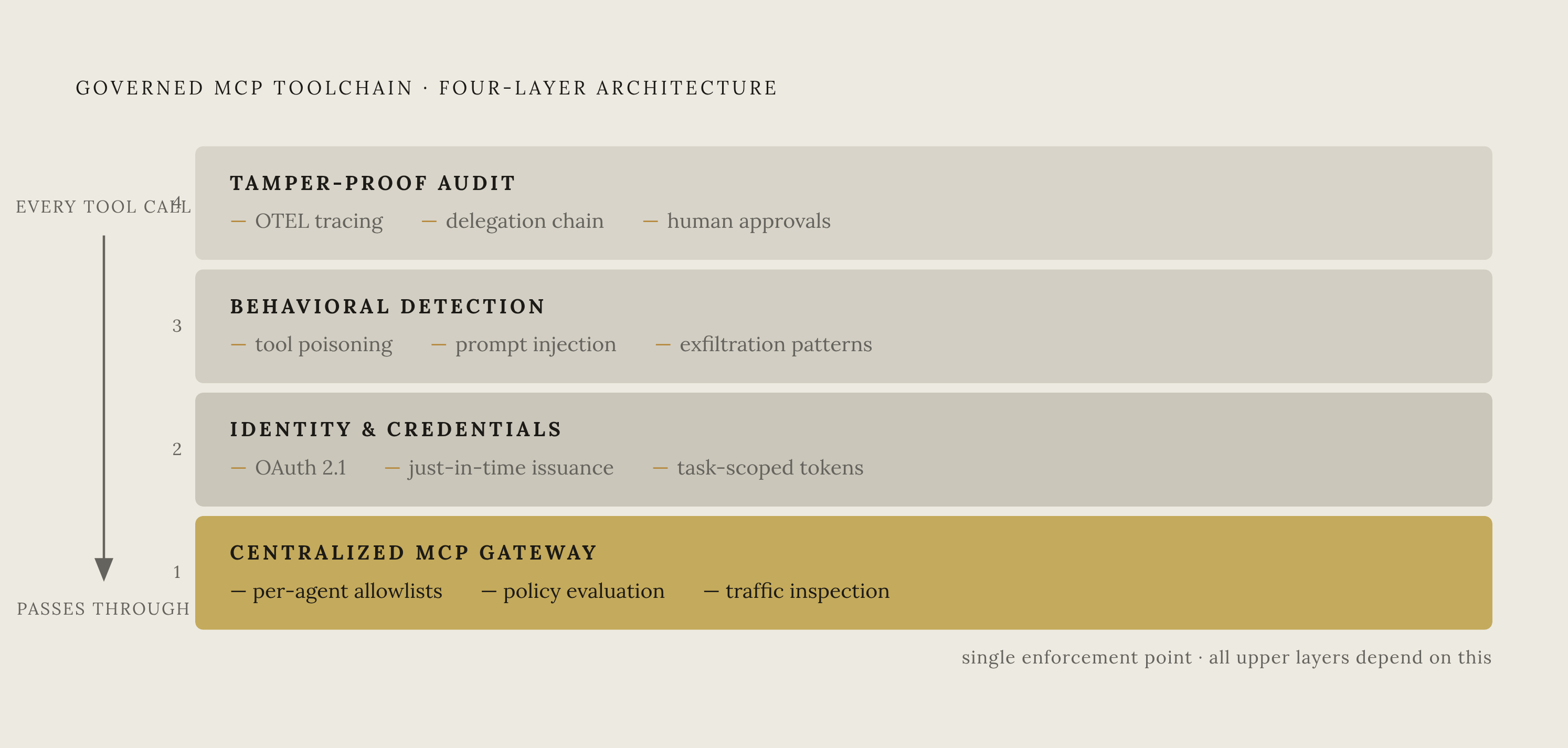
To implement these requirements, engineering and security teams can use a four-layer reference architecture. The first layer is a centralized MCP gateway through which all tool calls route. It provides the enforcement point for per-agent allowlists, policy evaluation, and traffic inspection. Direct connections outside that path defeat organization-wide enforcement. The gateway’s policy decisions also supply part of the evidence needed by the audit layer.
The second layer manages identity and credentials. OAuth 2.1-based identity binding gives agents scoped user permissions rather than standing credentials, while just-in-time issuance limits credentials to a task and a short lifetime. SSO and SCIM integration ties provisioning and de-provisioning to the organization’s identity lifecycle. For agent delegation, this layer and the gateway must jointly prevent transitive privilege escalation and make the issued scope traceable.
The third layer evaluates behavior as tool calls happen. It must address tool poisoning, prompt injection, intent drift, and exfiltration patterns. This is a separate job from connection security. Detection alerts provide evidence of suspicious behavior, while the gateway provides the point at which access policies are enforced. Conventional WAF and SIEM coverage cannot substitute for evaluating intent at tool-call depth.
The fourth layer preserves the record for later scrutiny. Tamper-proof audit logs with full OTEL tracing must connect delegation, identity, requests, policy evaluations, issued scopes, outcomes, and downstream changes. Human approval controls span the gateway and this audit layer. Destructive or irreversible actions pass through approval gates, and the resulting record shows whether a human approved them.
What the golden path looks like for teams adopting agents at different technical levels
This architecture works only if teams choose to use it. A governed toolchain that demands more effort than a workaround invites shadow AI on the same MCP surface. Most enterprise employees are not power users prepared to configure agents from scratch. The golden path must therefore work for people with different technical skills while keeping the same security standard for every group.
For non-technical staff, that means a curated catalog of pre-approved MCP servers and agent templates. Authentication and credential handling stay out of the setup process they have to understand. They should not need to learn OAuth flows or write configuration files. For engineers, a platform API and CLI provide a way to register servers and agents without rebuilding authentication plumbing.
Platform and security teams need organization-wide visibility in return. A single view of MCP servers, agents, and skills should connect tool-call policy enforcement with the existing identity provider, detection alerts, and complete audit records. EMA illustrates how centralized provisioning can reduce user effort, with connected servers available on first login without per-app OAuth. That convenience shows the right adoption pattern. Security can pre-approve the framework so teams deploy within it rather than negotiate the same controls for every integration.
How to evaluate whether a toolchain platform actually delivers governance at scale
The evaluation should test enforcement. A platform must enforce per-agent allowlists at the gateway. It must also bind identity to every tool call, integrate with SSO and SCIM, issue task-scoped credentials just in time, and revoke them on completion. OAuth support alone does not meet that test. The distinction is between establishing a connection and controlling the credentials used for each action.
Evaluate whether the platform detects MCP-specific threats in real time at the tool-call layer, including poisoning, injection, intent drift, and exfiltration. The audit record must be tamper-proof, include full OTEL tracing, and cover the whole delegation chain. A complete record cannot depend on which team remembered to instrument its agent.
A secure configuration that requires engineering work for every non-technical user recreates the adoption bottleneck. Separate agent builders, gateways, and security products also leave the integration work with the engineering team unless those controls function as one governed path. Buyers should therefore assess whether the platform enforces governance at tool-call depth for every agent, regardless of which team deployed it.