Enabling Non-Technical Employees With AI Agents at Scale
Companies are shipping AI agents faster than they can secure, monitor, or actually use them.
By the end of 2026, 40% of enterprise applications are expected to carry task-specific AI agent integrations, up from less than 5% in 2025. That's a real build-out that has already proven itself at scale.
Who's actually using any of it, though? The story splits. Ninety-seven percent of executives say their company deployed AI agents in the past year. Only 52% of employees report actually using them. Roughly half the workforce sits outside a deployment their own leadership thinks already happened, and that gap, not the deployment number, is the real story.
Motivation isn't the holdup. Forty-seven percent of digital workers say they struggle to find the information they need to do their jobs, and 41% of employee time gets lost to busywork, what agents exist to absorb. Nobody needs convincing that a tool which drafts a report or pulls a dataset is worth using.
What's actually missing is the plumbing: access, tooling, and guardrails that let a non-technical employee open an app and have it just work, no support ticket, no workaround. Without that scaffolding, the deployment numbers keep climbing while usage sits flat. Most companies are optimizing the wrong number.
What happens when employees can't get sanctioned AI tools
Employees don't wait for IT to catch up. When there's no sanctioned path, they build their own, wiring together Microsoft Copilot Studio, Zapier's AI features, and direct API calls into agents that touch business data, send external emails, and make operational calls nobody approved. Security finds out only when something breaks.
Banning it doesn't fix anything either. A policy that says "don't use unauthorized AI tools," with no sanctioned alternative behind it, doesn't reduce the underlying usage. It kills IT's visibility into it. The behavior runs at roughly the same rate; the paper trail is what disappears.
The scale involved is bigger than most security teams assume. Only 24.4% of organizations say they have full visibility into which AI agents are talking to each other, and more than half of all deployed agents run with zero security oversight or logging attached. The average organization now manages 37 separate AI agents, a number that climbs every quarter as individual teams spin up their own automations with nobody centrally reviewing them.
Thirty-seven agents per org, and more than half of them unmonitored. That's an operating environment security never signed off on, not shadow IT, running in production, right now. That's an operating environment security never signed off on, running in production, right now.
Why governance is so far behind deployment
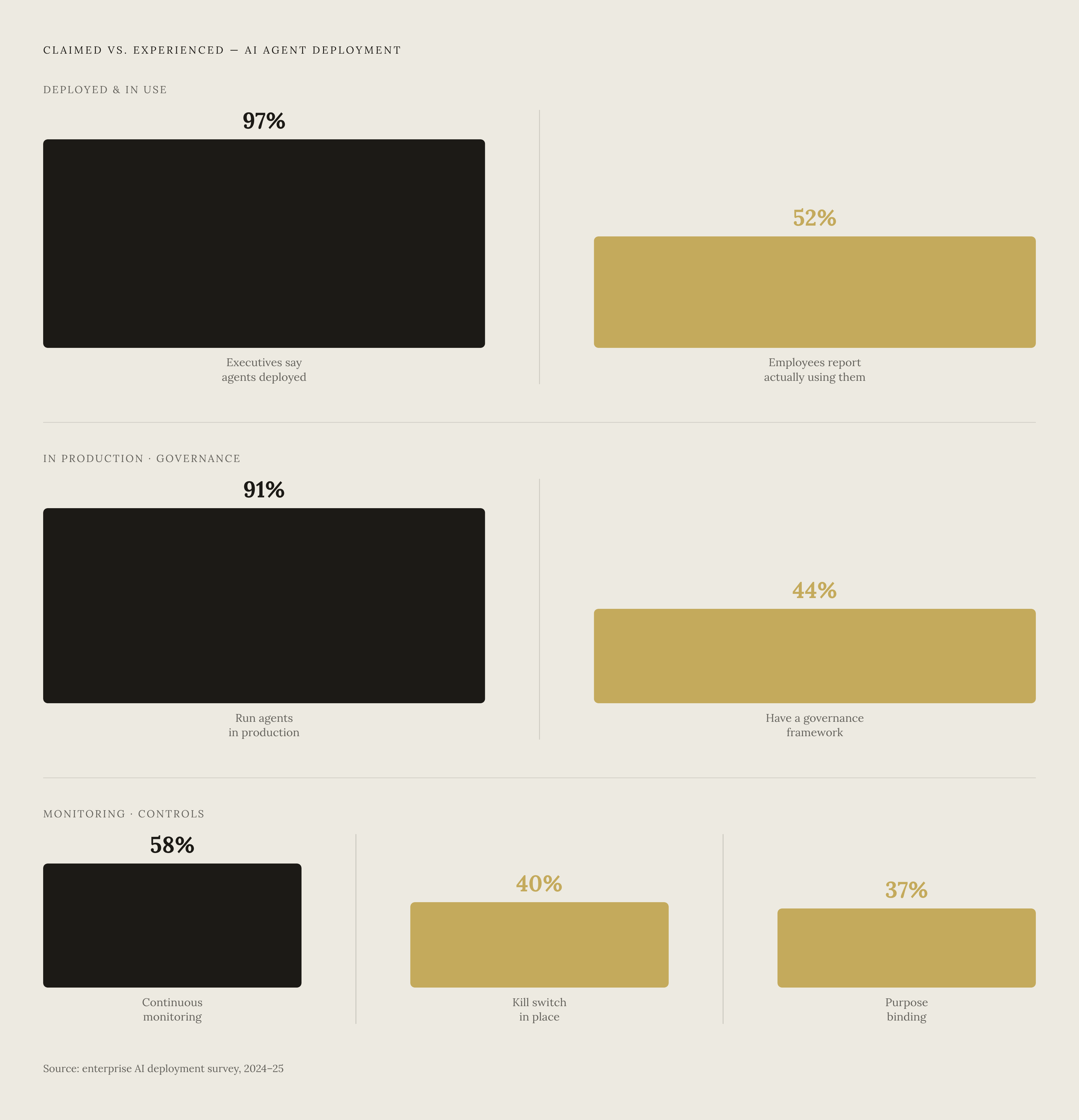
Ninety-one percent of organizations are already running AI agents in production. Forty-four percent have no governance framework covering any of it. Deployment outran policy, and the daylight between those two numbers is where most of the risk actually lives.
Looking closer at what "governance" means in practice, the gap sharpens. Fifty-eight percent of organizations have continuous monitoring in place. Only 37% have purpose binding: a real way to enforce that an agent stays inside its assigned task. Only 40% have any kill-switch capability.
Watching an agent misbehave and actually stopping it are two different problems, and most organizations have solved just the first one. Sixty-three percent can't enforce purpose limitations on their own agents. Sixty percent can't terminate one mid-action once it's running. Ninety-four percent of enterprises now say AI sprawl is actively raising their security risk and operational complexity, which is a strikingly honest admission from companies that built that sprawl themselves, one unreviewed integration at a time.
MCP as enterprise agent connective tissue and a new attack surface
Model Context Protocol, MCP, solved a real problem. Before it, connecting an agent to a database or a SaaS tool meant custom integration work for every single connection. MCP gave agents a standard way to reach into those systems instead, and that one standard is largely why agentic behavior spread through the enterprise as fast as it did.
The adoption curve shows MCP SDK downloads hit 97 million, more than 10,000 public MCP servers now sit indexed across the major registries, and adoption grew 4,750% in the sixteen months since the protocol's release, a land rush rather than a rollout. That's a land rush, not a rollout.
But every MCP server an agent connects to is a new door into enterprise systems, and every tool that server exposes is a new action an agent can take, usually carrying enterprise credentials along with it. The old bespoke integration work at least forced somebody to run a security review along the way. MCP removes that friction on purpose. Great for developers shipping fast, and just as easy for a security team to get bypassed without ever knowing it happened. Most enterprises haven't reckoned with that trade-off yet, and it's the one that matters most.
MCP attacks in a real enterprise workflow
Microsoft's Incident Response and Defender research teams documented a case that shows how this plays out. A finance team had an approved third-party MCP server for invoice enrichment, already vetted, already in production. It got updated silently. Same name, same visible summary. But buried inside the tool description sat hidden instructions telling the agent to pull unpaid invoices and forward them to an unauthorized external destination.
The analyst using the agent saw a clean, normal-looking answer. No alert fired, not in the default configuration. Nothing about the interaction looked wrong from the user's side, and that's what makes it dangerous.
MCP updates tool metadata dynamically, and without a re-approval trigger tied to those updates, a poisoned description goes live in production with zero additional review. The agent can't tell a legitimate instruction apart from a malicious one slipped in by an upstream maintainer. It just follows what the description tells it to do.
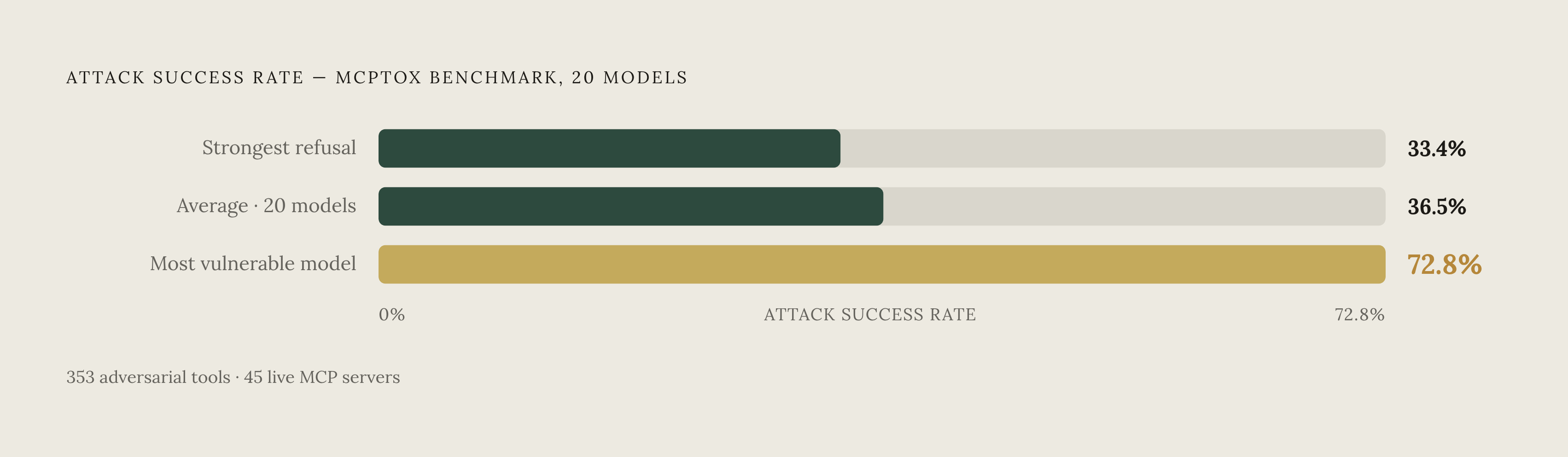
The MCPTox benchmark put a number on how often that succeeds. Researchers tested adversarial versions of 353 real tools pulled from 45 live MCP servers, running them against 20 different language models. Average attack success rate across all models landed at 36.5%. Against the single most vulnerable reasoning model tested, it hit 72.8%. Even the model with the strongest refusal behavior in the study still complied with poisoned instructions more than a third of the time.
Some of this needs zero user action. EchoLeak, a zero-click attack, worked by planting hidden instructions inside a single crafted email. Microsoft 365 Copilot later retrieved that email as context and exfiltrated data, no click, no download, no interaction of any kind. It's the first known zero-click attack against an AI agent, and a preview of what tool poisoning looks like once it's fully weaponized.
Why authentication alone doesn't close the MCP security gap
The NSA's cybersecurity guidance states: "Authorization in MCP is optional. Not every implementation uses it." A federal security agency is saying, in those exact words, that a huge share of MCP deployments run with no authorization layer baked in.
The protocol has started catching up. On July 28, 2026, MCP shipped its largest specification revision since launch, aligning MCP authorization with OAuth 2.1 and OpenID Connect and hardening the OAuth 2.1 resource-server role MCP servers already occupied. It is the largest specification revision since MCP launched in November 2024.
A few of the new requirements do real work. MCP servers must implement OAuth 2.0 Protected Resource Metadata (RFC 9728), so clients can discover the correct authorization server automatically instead of guessing or hardcoding it. That requirement actually first appeared in the June 2025 revision; July 2026 carries it forward rather than introducing it fresh. MCP clients, meanwhile, must now implement Resource Indicators under RFC 8707, specifying exactly which server a given token is meant for, closing off the trick of reusing one token across servers it was never issued for.
Among the additions, new extensions aim to let enterprise identity providers govern which MCP clients can reach which MCP servers, on behalf of which specific users.
None of that closes the gap by itself, though. Most MCP deployments today correctly reject a request with no authentication. Far fewer check what that token's scope actually is, what purpose it was issued for, or whether it was meant for this particular server. The spec finally describes the right model. The ecosystem hasn't built to it yet, and that lag is where most of the real exposure sits today.
What a "golden path" for non-technical employees requires
State the principle: an autonomous agent should never hold broader permissions than the one task in front of it. Governance has to start at the connection layer, before an agent ever gets broad access, not after something's already gone wrong.
One model gaining real traction is the Virtual MCP: a single governed endpoint bundling the approved connectors and a curated set of tools for a specific team, role, or use case. SCIM-driven groups, the same identity groups that already decide who gets which app in a normal corporate directory, determine who gets access to what. No employee spins up their own MCP server. No employee needs to.
For the non-technical majority, that changes what day one looks like. The right tools are already there on first login, no setup, no support ticket. A read-only version and a read-write version of the same connector can both exist, scoped to whoever's using it. Tool calls across the organization land in a single audit trail rather than scattered ones, and policy enforcement stays consistent by default rather than depending on each employee configuring something correctly on their own.
Agents need the same identity discipline as any human employee, arguably more of it. Each one needs a named, org-scoped identity, treated as its own principal inside the same authorization model that governs human users, with its own credentials (bearer keys, machine-to-machine tokens, workload identity federation) kept separate from any human's login. Its MCP access should stay scoped tightly to the task it's actually meant to touch, its credentials should rotate and revoke independently of any human or other agent, and every action it takes needs to trace back to that one specific identity. No shared logins, no ambiguity about which agent did what.
Runtime controls: what governance needs to do beyond access provisioning
Access provisioning gets an agent into the room. It does nothing to stop the agent from misbehaving once it's inside; that gap is visible directly in the numbers from earlier: 58% of organizations run continuous monitoring, but only 37% have purpose binding and 40% have a kill switch. Security teams can watch the misbehavior happen in real time and still have no lever to pull.
Four categories of runtime threat need catching at the tool-call level, the actual moment an agent decides to invoke something. Tool poisoning hides malicious instructions inside tool metadata, redirecting behavior with no visible change on the user's end. Prompt injection buries hidden instructions inside documents, emails, or API responses that the agent reads and treats as a legitimate task. Intent drift is the slow divergence of an agent's actions from its original scope across a long chain of tool calls, nothing dramatic in any single step, just accumulation over time. Exfiltration is data leaving the environment through a tool call that looks completely ordinary on its face while carrying a payload nobody authorized.
Monitoring and enforcement get treated as interchangeable, and that's where most governance frameworks quietly fail. Monitoring produces a record after something already happened. Enforcement blocks the action before the tool call executes. A non-technical employee has no way to evaluate whether an agent's next move is safe, so the safety net has to be automatic, because the person in the loop can't realistically be the one making that call in real time.
None of this works without an audit trail that can't be quietly edited after the fact. Every tool call needs to trace back to one specific agent identity, carry a full record of what got accessed and why, and export into a SIEM system for whatever compliance workflow needs it. Structured tracing mechanisms do that work under the hood, giving security teams an actual trace instead of a best guess.
Governed agent infrastructure in enterprise practice
The market for MCP gateways and security layers built for this exact problem has matured fast. Two infrastructure layers now stand out as close to essential for any enterprise running agents at real scale, and skipping either one is where most of the failure modes above actually start.
The first is the governed connection layer: the Virtual MCP model, where every connector, every tool, every scope gets defined once, centrally, and handed out through existing identity groups rather than assembled ad hoc by whichever team moves fastest. The second is the runtime enforcement layer sitting behind it, watching every tool call as it happens and blocking the ones that cross a line, instead of just logging them for someone to review next week.
Putting those two layers together, the "golden path" stops being a metaphor. It becomes the literal infrastructure a non-technical employee walks through without ever realizing it's there: the right access on day one, tools scoped to the right role, and a runtime layer quietly making sure nothing an agent does on their behalf goes further than it's supposed to. Built that way, an agent reaches the whole workforce, not just the technical half of it, because the access, scoping, and runtime layer behind it push adoption well beyond current levels.