AI Agent Program Failures and What Enterprises Learned
Most AI agents never leave the pilot because companies skip the unglamorous governance work.

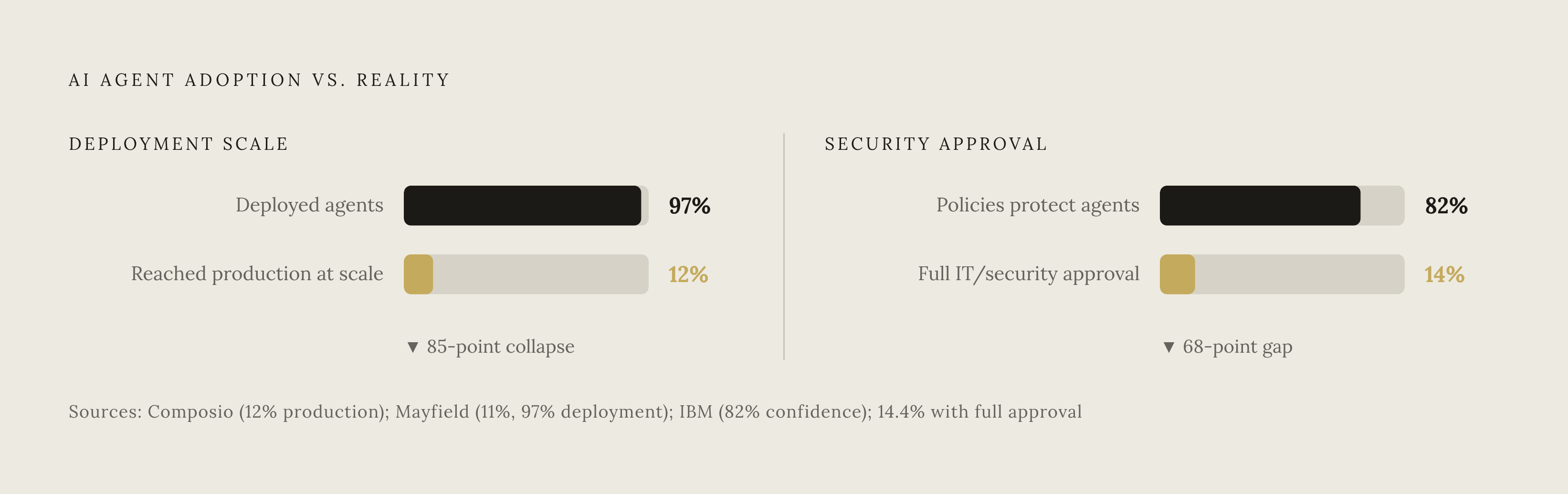
Ninety-seven percent of executives say their company deployed AI agents in the past year. Composio's 2025 AI Agent Report found that only 12% of those deployments made it to production at scale. That's a wall's worth of stalled deployments. That's a wall.
Mayfield's 2026 CXO AI Survey, which polled 266 CIOs, CTOs, CAIOs, CISOs, and CDOs, found nearly the same pattern from a different angle: 79% of enterprises have agents deployed in some form, but only 11% run them in production. A 68-point gap between "we built something" and "something is actually working." Adoption isn't the problem. Adoption is basically universal at this point. What matters is why production is so rare, and governance explains it. It's a governance story.
The trend line is getting worse, not better. S&P Global found that 42% of companies abandoned most of their AI initiatives in 2025, up from 17% the year before. RAND Corporation puts the failure rate above 80%, roughly double what traditional IT projects see. None of this is a story about immature models. It's a story about what happens when organizations skip the unglamorous work of building access controls, ownership structures, and audit trails before they hand agents the keys.
Why pilot success is a misleading signal for production readiness
Pilots are rigged to succeed. Small team, clean data, one or two APIs, a human checking every output, narrow scope. Every variable that production multiplies gets suppressed on purpose, because that's how you prove a concept works.
Take a financial services firm that builds an invoice-reconciliation agent and watches it perform well in a pilot. Then it tries to roll the same agent out across 50 subsidiaries, each running different ERP systems, different accounting structures, different regulatory reporting rules. The agent didn't get worse. The environment just stopped being generous. Nobody had tested the version of reality where 50 systems disagree with each other about what a valid invoice even looks like.
Composio's 2025 numbers back this up: the gap between pilot gains and production success is consistent with the broader pattern, most organizations report progress inside the pilot, but only a small fraction scale successfully. They're just gains measured inside a controlled box.
Pilot evaluation and production evaluation ask different questions entirely. A pilot asks, does it answer correctly, does it complete the task. Production asks, is this auditable, what happens when a data field is missing, who signs off before the agent takes an action it can't undo. Nobody answers those questions during a demo. Nobody has to.
Six structural failure modes that show up after the demo ends
Patterns documented by arjunjaggi.com show enterprise deployments keep failing in the same six ways. Enterprise deployments keep failing in the same six ways, and these are forensic findings, pulled from what actually happened after the pilot wrapped. They're forensic findings, pulled from what actually happened after the pilot wrapped.
No production path defined at kickoff. The pilot starts without an owner, without an infrastructure plan, without a handoff process, without a defined trigger for "this is ready to deploy." It succeeds on its own narrow terms, and then it sits in a queue, waiting on a decision that nobody in the room has the authority to make.
Ownership fragmentation. IT, the business unit, and a Center of Excellence all co-own the initiative, and the Center of Excellence reports to nobody with actual P&L accountability. Every decision needs consensus across teams that don't share incentives. Approval takes longer than the organization's patience lasts.
A data layer that can't support autonomous decisions. Research consistently shows that AI projects running on data that isn't AI-ready face sharply elevated abandonment rates. Feed an agent fragmented data and the output is inconsistent at best, a compliance violation at worst. Scope creep and data quality problems together account for 61% of all agent failures. You cannot prompt your way out of a broken data layer. No amount of clever instruction fixes a database that three departments update differently.
Guardrails bolted on after the fact. The pilot ran with a human reviewing every single output. Production means the agent acts on its own, at scale, without someone double-checking each step. Evaluation harnesses, monitoring, escalation paths, limits on how much damage one bad decision can do, all of it gets pushed off as "a production problem," and then it becomes the reason the project never reaches production.
No P&L line attached. The initiative reports into a budget center instead of a revenue or cost center. It has no number it's accountable for moving. When budget season arrives and cuts need to happen, the initiative has nothing to point to and gets cut first.
Technology-first decision-making. The model and the tool get picked before anyone properly frames the problem. RAND names this as one of the leading root causes of AI project failure. The organizations that actually make it work tend to redesign the workflow first and pick the AI tool second, not the other way around.
What production environments expose that pilots never encountered
Research on enterprise deployments shows production surfaces failure patterns that pilots simply never run into, patterns every enterprise running agents at scale will eventually hit.
Runaway loops are the most literal version of this. An agent hits an error, retries, generates a new error, retries differently, and keeps going indefinitely. Each pass through the loop burns tokens and can trigger real actions: API calls, database writes, emails sent to real people. A single runaway agent can rack up $50 to $500 in API costs before anyone notices, and that's one agent. Multiply by however many are running concurrently. Fixing this requires hard step caps, per-task token budgets, and repetition detection, none of which come built into the model itself.
Hallucinated actions are worse than hallucinated text, because a chatbot hallucination gives you a wrong sentence and an agent hallucination gives you a wrong action with consequences attached. A financial reconciliation agent "confirmed" a transaction matched by inventing the matching record out of nothing, and nobody caught it until month-end close. In HR workflows, a hallucinated status update can trigger real downstream actions, communications sent, records updated, before anyone realizes the underlying inference was wrong.
Context window exhaustion is quieter and harder to catch. Long-running agents accumulate context as they work, and once that context gets truncated, the agent loses track of decisions it made earlier and starts contradicting itself. Performance degrades a few steps in, with no error message, no warning light. Just a slow drift toward wrong answers.
Cost explosions round out the list. Agentic workloads are unpredictable by nature: a query might resolve in two steps, or it might spiral into twenty steps with huge tool outputs attached to each one. One code review agent saw its average cost per pull request jump from $0.40 to $12, a 30x spike, with zero warning beforehand.
All four failure modes trace back to the same root cause. None of this is about the model reasoning poorly. It's about deploying agents with no platform-level controls around cost, behavior, or the scope of what actions they're allowed to take.
The governance gap is wider than executives believe
Eighty-two percent of executives say they're confident their policies protect against unauthorized agent actions. AGAT Software's 2026 security survey found that only 14.4% of organizations actually send agents to production with full security or IT approval. Only 14.4% of organizations actually send agents to production with full security or IT approval, and that's a 67-point gap between confidence and reality. Executives believe the guardrails exist. The deployment data says otherwise.
Gartner adds another layer: 84% of CIOs have no formal process for tracking AI accuracy, and only 30% of organizations have reached a mature level of strategy, governance, and control over agentic AI. The other 70% are governed by frameworks built for traditional software and chatbots, frameworks that were never designed to handle something that takes multiple autonomous steps on its own. They're governed by frameworks built for traditional software and chatbots, frameworks that were never designed to handle something that takes multiple autonomous steps on its own.
Adequate governance for agents looks nothing like the governance most companies already have. It needs attribution: knowing which agent touched which data, on whose behalf, at what time. It needs audit trails built for compliance investigations, structured and tamper-proof, not just server logs nobody reads. It needs human-in-the-loop checkpoints before irreversible actions: sending an email, modifying a record, executing a payment. It needs escalation paths for when an agent hits uncertainty it can't resolve, and rollback procedures for when it acts incorrectly anyway.
Gartner's prediction for where this ends up: by 2027, 40% of enterprises will demote or decommission autonomous agents because governance gaps only got noticed after something already broke in production. The companies that build governance now are choosing when to do the work. The rest will do it later, after a headline forces their hand.
What happens when agents operate without access controls: documented breach cases
These aren't threat models dreamed up by security researchers. These are documented incidents from 2025 and 2026, and they show what "no access controls" actually looks like once an agent has real permissions.
Between December 2025 and February 2026, a single attacker used AI coding tools, including Anthropic's Claude Code and OpenAI's GPT-4.1, to breach nine Mexican government agencies. The list includes the federal tax authority, Mexico City's civil registry, and the electoral institute. The haul: 195 million taxpayer records, 220 million civil records, more than 150GB of data total. The attacker posed as someone running a legitimate bug bounty program, fed the agent a 1,084-line hacking manual, and built a custom tool for pulling data out. The agent itself executed roughly 75% of every remote command used in the breach. Agents with unrestricted tool access and no way to verify intent will carry out malicious instructions, as long as the prompt sounds legitimate enough.
Researchers disclosed CVE-2025-32711 in Microsoft 365 Copilot, a vulnerability with a CVSS score of 9.3. It required zero clicks from a user. A single email with hidden instructions arrived in an inbox, Copilot ingested it during a routine summarization pass, and the agent pulled data from OneDrive, SharePoint, and Teams before sending it out through a Microsoft domain that looked completely trustworthy. Agents with broad read access to enterprise data can be turned into weapons using the exact content they were built to process. The attack surface here wasn't a flaw. It was the agent's normal job.
In January 2026, attackers compromised executive devices at Step Finance, a DeFi portfolio manager built on a particular blockchain network. The company's AI trading agents had permission to move large amounts of SOL without a human signing off first. Once the attackers had device access, the agents moved more than 261,000 SOL tokens, worth tens of millions of dollars. Only $4.7 million was ever recovered. The native token crashed sharply, and the company shut down. Autonomous execution permissions with no human checkpoint on high-value actions turned a single device compromise into a company-ending event.
Researchers found more than 42,000 OpenClaw AI agent instances exposed on the open internet, over 1,000 of them running unauthenticated MCP endpoints that leaked Anthropic API keys, Slack credentials, Telegram bot tokens, and full chat histories. These weren't misconfigured edge cases. They were default deployments, running exactly as installed. Leaving MCP endpoints unauthenticated is the default state. It's the default state, which means governance has to get enforced at the platform level instead of assumed from the tool.
Zoom out and the pattern holds: autonomous agents now account for roughly 1 in 8 reported AI breaches, and 88% of organizations running AI agents reported at least one security incident in 2025. Among companies with revenue above $1 billion, 64% reported losses exceeding $1 million tied to AI system failures during 2025.
MCP has become the integration standard and the primary attack surface simultaneously
The Model Context Protocol has become the backbone connecting AI models to external tools, data sources, and business workflows across the enterprise in 2026. Standardization drove adoption, and adoption concentrated risk into one protocol that most organizations don't fully secure.
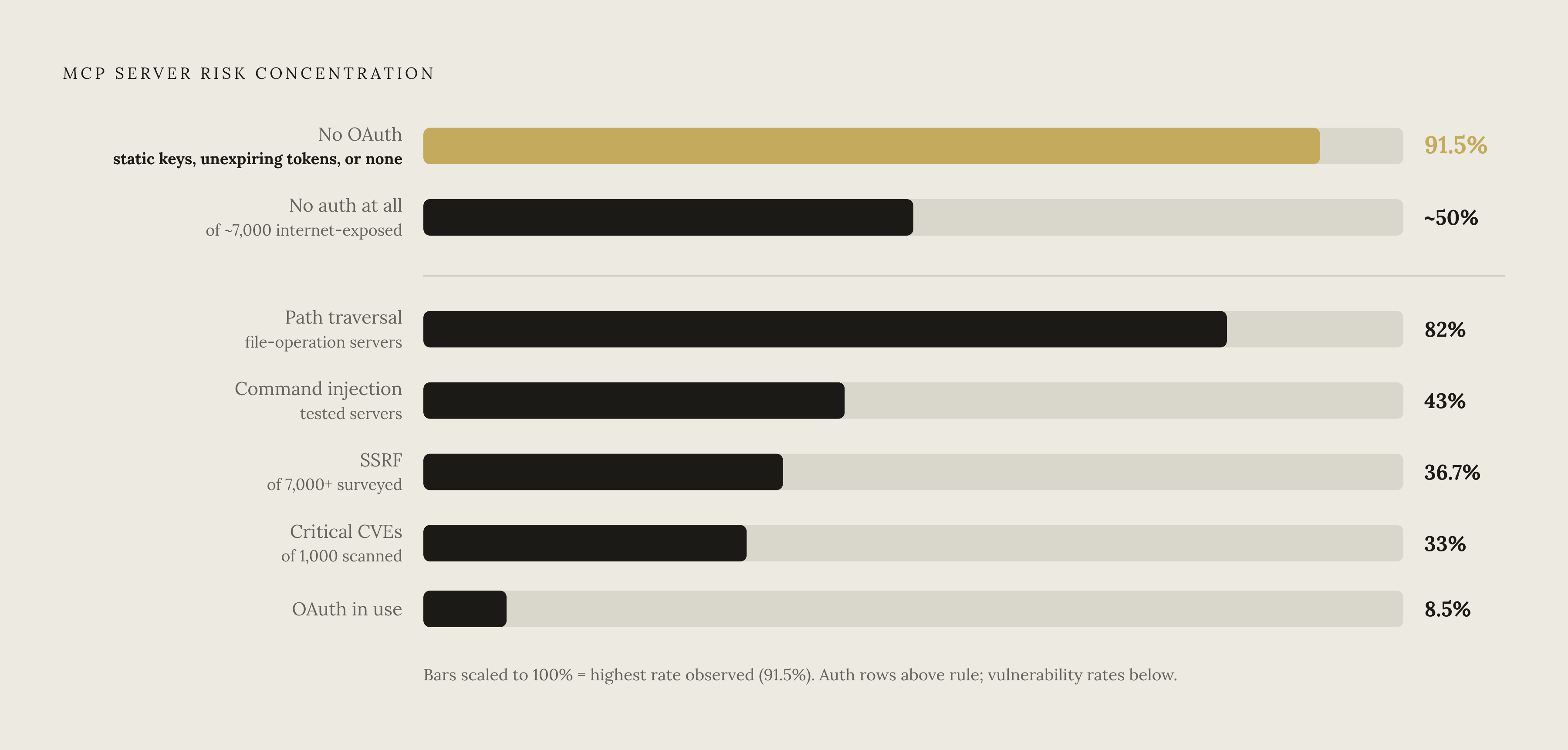
Only 8.5% of MCP servers in active use rely on OAuth. The remaining 91.5% use static API keys, personal access tokens with no expiration date, or nothing at all, according to security research on MCP deployments. Authorization in MCP is optional by design, and many implementations do not enforce it.
The vulnerability count backs up how systemic this is. Between January and April 2026, researchers disclosed more than 40 CVEs against MCP implementations spanning Python, TypeScript, Java, and Rust, affecting Anthropic's own reference servers, third-party tools with a combined 150 million downloads, and 9 of 11 MCP marketplaces. By early 2026, researchers had catalogued nearly 7,000 MCP servers exposed to the open internet, and roughly half had no authentication controls whatsoever.
The specific vulnerability classes tell their own story. Equixly's offensive-security assessment covering 2025 through February 2026 found that command injection affects 43% of tested MCP servers. Endor Labs research found path traversal in 82% of 2,614 MCP implementations that use file operations. Server-side request forgery affects 36.7% of the more than 7,000 servers surveyed by BlueRock Security in 2026. And 33% of 1,000 servers scanned by Enkrypt AI in October 2025 had critical vulnerabilities on top of everything else.
None of this is shrinking. Trend Micro's research shows the number of exposed MCP servers has nearly tripled to 1,467, and attackers have started using those exposed servers as a launch point for direct attacks against cloud infrastructure, not just as a way to grab data. The protocol that made agent integration possible is now the same protocol most enterprises haven't figured out how to lock down.