LLM Inference Cost Management in Agentic Pipelines
Agents consume 10-20x more tokens per task, turning cheaper models into bigger bills.

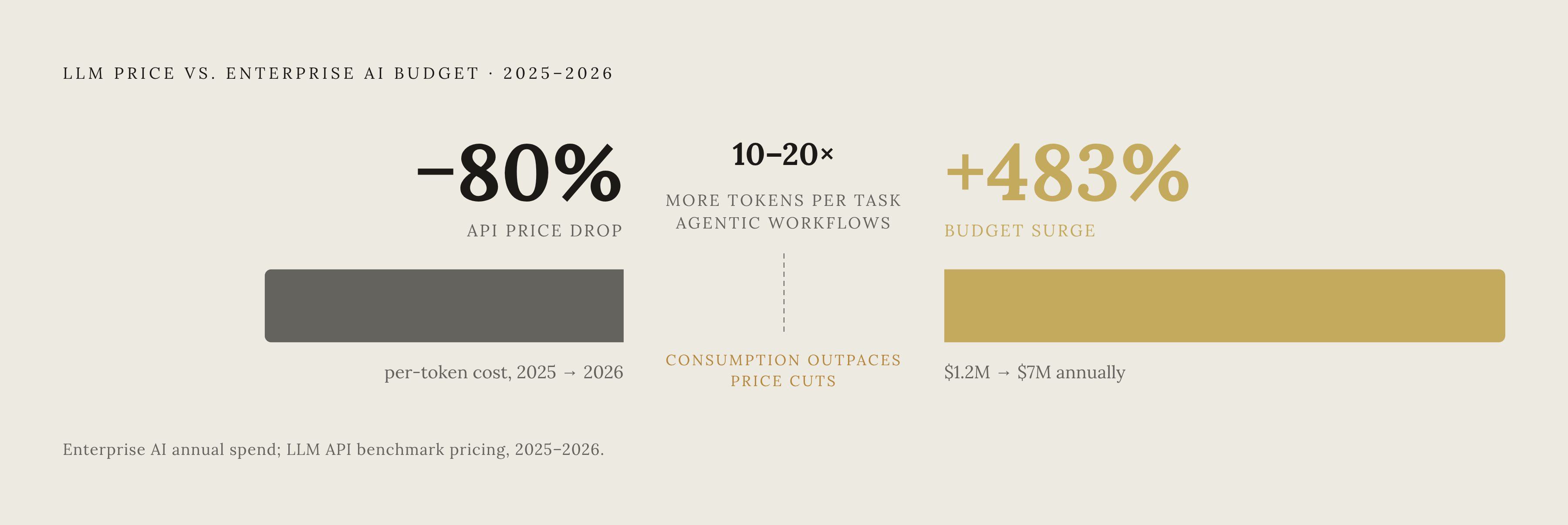
LLM API prices dropped roughly 80% between 2025 and 2026. Enterprise AI budgets grew 483% over the same stretch, climbing from $1.2M to $7M annually. Inference now accounts for 85% of enterprise AI budgets, and the two numbers sitting side by side expose the real problem: this was never a pricing problem.
Cheaper tokens should have meant cheaper bills. Instead, consumption scaled faster than the price per token fell, and that gap is where enterprise AI budgets went. Agentic amplification explains the mechanism: agentic workflows consume 10 to 20 times more tokens per task than standard queries, because every planning step, every tool call, and every verification loop adds more context, and all of that context gets priced. Sixty percent of AI projects exceed original cost estimates by 30 to 50%, and the shortfall traces back to the same root cause every time: no systematic attribution connecting token consumption to teams, use cases, or business value. Without a cost attribution graph linking spend to who used it, why, and what it produced, any cost reduction is a one-time event. Price drops come and go. Attribution was missing the whole time.
How agentic pipelines structurally generate ungoverned consumption
Agentic pipelines generate cost through compounding, not through any single expensive call. Each loop iteration carries forward the full accumulated context: tool results, planning history, prior outputs, all of it. Context length grows with every step instead of resetting, so a ten-step agent task doesn't cost ten times a single query. It costs more, because step ten has to pay to re-read everything steps one through nine produced.
Multi-model sprawl makes the picture harder to see. Thirty-seven percent of enterprises ran five or more models in production as of 2025, up from 29% the year before, and that fragmentation spreads spend across providers with no single ledger against which to set policy. A team running five models has five separate billing relationships, and in most cases, it can't see what any given agent actually did to generate those charges.
The accumulation of context happens by structural default. Agents gather conversation history, tool results, and document chunks that grow without bound unless something explicitly manages that context, and Atlan's 2026 analysis puts the resulting multiplier at 10 to 20 times more tokens per task than standard queries. If a runaway loop goes unchecked for an hour, it can erase a month's worth of savings from every optimization effort that came before it. Stateful context growth also creates a cost driver that doesn't appear in single-turn benchmarks: as context accumulates across multi-step agent tasks, memory pressure pushes serving systems into a thrashing regime, degrading both compute efficiency and power efficiency in ways no standard inference benchmark was built to measure. None of this registers on a billing dashboard built for single-call pricing. These pipelines are structurally opaque to standard FinOps tooling, because the tooling was built to watch invoices, not to watch what an agent does between the first token and the last.
Why Standard Cost Controls Fail on Agentic Workloads
Budget alerts, aggregate dashboards, and per-API-key spend limits all operate at the billing level. They can tell a finance team that a team overspent. They cannot say which agent step, which tool call, or which decision branch caused it, and that gap between "what was spent" and "what caused it" is where agentic cost management actually breaks down.
Most organizations need centralized visibility but instead have cost data fragmented across SaaS tools, cloud AI platforms, and internal LLM deployments, none of it speaking to the others. Unified reporting is the baseline a working system requires before optimization means anything.
Agentic workloads need attribution at the level of the individual action, not the individual invoice. Research on cost-utility alignment for LLM agent trajectories points to profiling, attribution, diagnosis, adaptation, and evaluation, all applied at the trajectory step level, because coarser attribution can't tell a necessary tool call from a redundant one. A dashboard that aggregates spend by team or by model can't answer the one question that matters: did this specific call need to happen?
Even the benchmarks enterprises lean on to estimate cost are built on the wrong assumptions. XPerf's benchmarking work on agentic AI workloads found that most LLM serving benchmarks issue independent calls or simple multi-turn conversations, and those patterns don't represent how agentic applications actually behave. Performance and cost estimates pulled from that kind of benchmark are wrong for agentic use before a single production dollar gets spent.
None of this means optimization tactics are worthless. Model switching, prompt adjustment, and caching all produce real savings. But applied without attribution underneath them, those savings erode, because the behavior actually driving consumption, which agents call which tools and how many times, stays unobserved and ungoverned the whole time. That's the argument for building measurement first.
The three-tier governance structure that makes cost management systematic
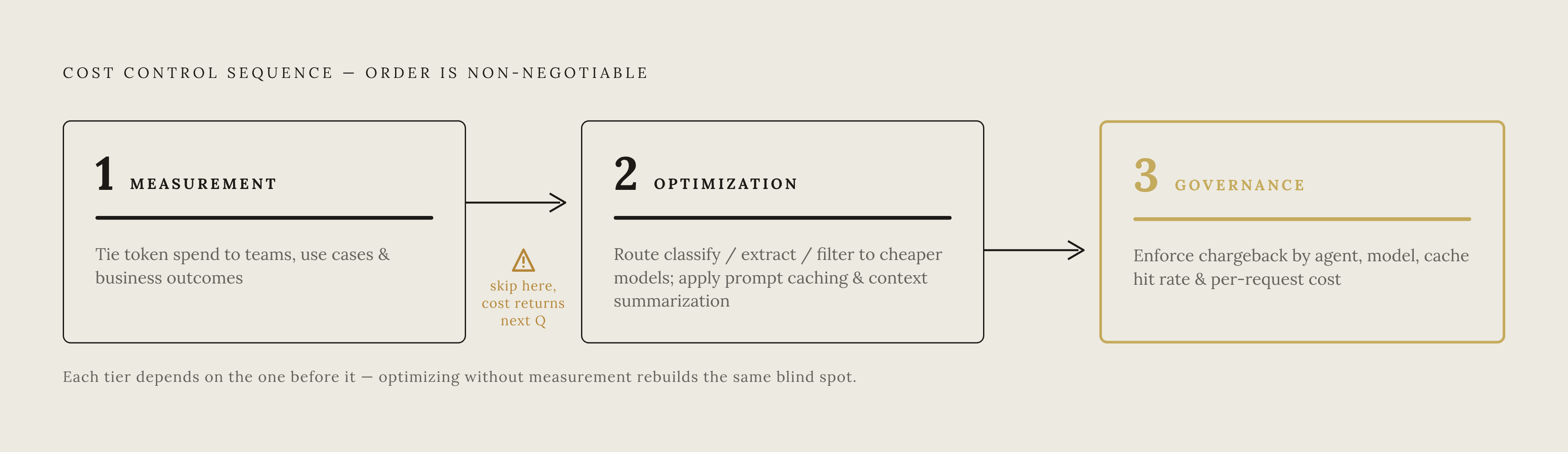
Three tiers, applied in sequence, turn cost management from a recurring fire drill into a system: measurement, optimization, governance. Skipping the first tier and jumping straight to the second means the savings from the second tier won't hold. That's the mistake most teams make, and it's the reason the same cost problem keeps reappearing a quarter after someone "fixed" it.
Measurement comes first because nothing else works without it. Cost attribution has to connect token spend to teams, use cases, and business outcomes, not just to API keys or model names. Mature FinOps practice requires tracking granular enough to break down by model, department, and individual user, because without that granularity, chargeback and accountability are both impossible to enforce. Per-agent budget caps turn that attribution into an operational control, not just a reporting exercise. Requesty's budget configuration model, for instance, sets daily and per-task limits against named agents individually, with webhook alerts firing at 80% of the cap and again at the limit itself, pausing the agent automatically before it runs past the ceiling.
Optimization comes second, and it works because the measurement tier tells it where to aim. Intent-based model routing is the highest-leverage single tactic available: classify, extract, filter, and parse steps get routed to smaller, cheaper models, while architectural or complex-decision steps get routed to frontier models that can actually handle them. Prompt caching against a shared system prompt, run at high call volume, produces large daily savings from one configuration change, and that math compounds fast once multiple agents share the same base prompt. Context window management, summarizing completed work and resetting rather than letting context accumulate indefinitely, targets the exact amplification mechanism driving token growth. Deterministic orchestration, using rule-based logic to decide when an LLM call is even needed instead of running an always-on agentic loop, constrains spend by limiting when the model gets invoked at all, not just what it's asked to do.
Governance comes third and makes the first two tiers durable. Without policy enforcement, any model-routing configuration or caching setup can be bypassed the moment a new agent, a new team, or a shadow deployment shows up outside the system. Team chargeback reporting, broken down by agent, model used, cache hit rate, and per-request cost, turns governance from a policy document into something finance and engineering can actually act on.
Why MCP usage makes cost governance harder and the threat surface larger simultaneously
Shadow MCP usage, agents connecting to MCP servers deployed outside formal governance, is the agentic equivalent of shadow IT. Spend accumulates with no attribution attached to it, and the tools being invoked carry no policy controls.
The authentication gap across the MCP ecosystem makes this worse on both fronts at once. Only 11 to 14% of MCP pilots reach production, largely because of challenges in identity management and auditability, and that low production rate reflects a real structural problem: most MCP servers don't record which agent invoked a given tool call.
If identity isn't recorded at the tool-call level, cost attribution at the agent-action level is structurally impossible, because the cost consequence and the security consequence both trace back to that same gap. A team can't charge back, can't audit, and can't enforce policy on a tool call it cannot tie to a specific agent acting under a specific delegation. The gap that lets spend go ungoverned is the same gap that lets an agent invoke a destructive action with no record of who told it to.
What tool-call-level identity and policy enforcement require
Attribution at the action level requires every tool call to carry two pieces of identity: the agent that made the call, and the human on whose behalf it acted. Without that chain, a budget alert can fire but cannot identify which agent, which team, or which task caused the spend.
Identity has to bind at the tool level, not just at the application level. Agents need scoped OAuth tokens tied to a specific user identity through SSO and SCIM, because if credentials stand shared across multiple agents, you can't attribute cost, and you lose any chance of enforcing a per-agent budget. Just-in-time credential provisioning, issuing credentials for the duration of a single task and revoking them on completion, closes off both credential sprawl and the kind of persistent access that lets a runaway loop keep running. Token-exchange and actor-claim patterns let downstream systems record both the agent's identity and the human principal behind it, and you need that for chargeback, for audit, and for compliance traceability alike.
Policy has to enforce at the same depth. A tool allowlist enforced per agent, restricting which MCP servers and which specific tools a given agent can call, functions as both a security control and a cost control at once: an agent that can't call unnecessary tools can't generate unnecessary tokens. Human-in-the-loop approval gates for high-cost or irreversible actions, large document processing jobs, multi-step external API chains, destructive operations, enforce spend limits at the moment of the decision, not after the invoice arrives. A centralized MCP gateway gives an organization one inventory point where it can apply these policies consistently, instead of enforcing them unevenly across however many individual MCP server connections happen to exist.
What comes out the other end of good identity and policy infrastructure is an audit trail, and that trail serves two purposes at once. Automatic event logs with full OTEL tracing, tied to agent identity at every tool call, are the natural output of this kind of infrastructure, and they also happen to be the compliance artifact EU AI Act Article 12 requires high-risk systems to produce: automatic recording of events over the system's lifetime. Cost governance and compliance governance converge here, because the same log satisfies both demands.
Cost Governance as Compliance Infrastructure
Several regulatory deadlines are converging in 2026, and together they move agentic AI governance out of internal IT and into legal obligation for organizations operating in high-risk domains.
The EU AI Act's enforcement provisions for high-risk AI systems under Annex III take effect December 2, 2027, requiring documented provenance, audit trails, and proof that restricted actions are enforced at the API level. A system prompt telling an agent not to take an action does not satisfy that requirement. The tool interface itself must not expose the capability.
Singapore's IMDA published its Model AI Governance Framework for Agentic AI on January 22, 2026, at the World Economic Forum, and this is the first governance framework built specifically for autonomous agents. It requires each agent to carry a verifiable digital identity and a record of the capacity in which it acts, whether independently or on behalf of a named human user, with that identity tied to a supervising agent, a human user, or an organizational department. That is identity-binding and logging infrastructure, built for auditability, and it happens to be the exact infrastructure that also enables cost attribution.
US federal-facing requirements are moving in the same direction. The CISA Joint Advisory, published alongside guidance reported as NIST SP 800-5, pushes toward the same operational evidence standard the EU and Singapore frameworks demand. Screenshots and written declarations no longer satisfy regulators or enterprise clients. What's required now are operational records of what agents actually did.
A $7M annual AI budget with no attribution carries audit risk and compliance risk at the same time, because the same gap that leaves costs ungoverned leaves the organization unable to produce the provenance documentation regulators now require. Organizations that build attribution graphs, per-agent budget caps, tool-call-level audit logs, and identity binding satisfy the FinOps requirement and the compliance requirement from one investment, instead of building two separate systems that end up duplicating the same data. The enterprise that treats cost governance as governance infrastructure, rather than as a pricing exercise, ends up ahead on both fronts at once.