AI Agent Approval Workflows for New Tool Integrations
Governance gaps, not technology limits, explain why most AI agent pilots never reach production.
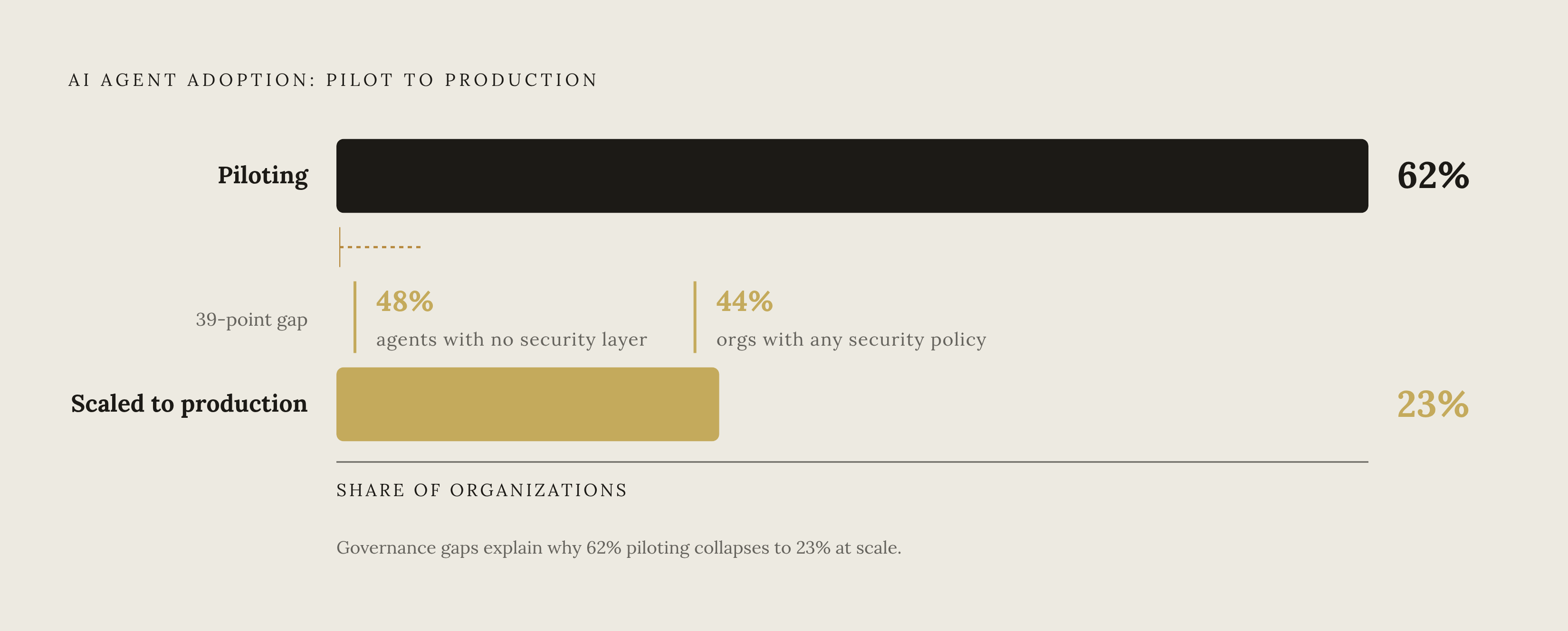
Roughly 40% of enterprise applications will ship with task-specific agents by 2026, up from under 5% just last year, Gartner found. But most of those deployments never make it past the pilot stage. Industry research found that 62% of organizations are actively piloting AI agents, yet only 23% have scaled them into production. That 39-point gap is a governance problem. It's a governance problem, and it's showing up in the numbers everywhere you look: Gravitee's State of AI Agent Security report found 48% of production AI agents running with no security or governance layer at all, and only 44% of organizations have any security policy for agents in place. Those numbers point to a pattern where governance gaps, not model failures, are derailing deployments before they reach scale.
What makes tool integration approval different from traditional software access control
Traditional API security is a solved problem, mostly. A client sends a request, the server checks credentials, the transaction goes through or it doesn't. Security teams have spent two decades building mature tooling around that model: rate limits, scopes, audit logs, the works.
MCP (Model Context Protocol) breaks that model in a structural way. Instead of one request and one response, an agent orchestrates an entire workflow across multiple tools, carrying context from one step to the next, making decisions on its own, chaining operations where step four depends on what happened in step two. There's no single transaction to check. There's a whole sequence, and each link in that sequence can fail on its own terms.
That's what makes the exposure different. The exposure spans more than one server or one credential. It's the entire web of contexts, agents, and tools acting together, where a flaw anywhere in the chain ripples through the rest of it.
An agent can hold a valid OAuth credential, the correct scope, a live token, every box checked on a traditional audit, and still be acting without any real authorization for what it's doing in that moment. Nobody approved this specific action, right now, with these exact arguments. Nobody could have, because the checklist that traditional access control uses doesn't have a box for "does this particular tool call, at this particular second, make sense."
That gap between technically authorized and contextually authorized is where production agent systems fail, and they tend to fail quietly, without an alarm going off.
The Cloud Security Alliance's AI Safety Initiative, in a paper published May 4, 2026, mapped MCP's risk surface across five distinct layers: transport and communication, authentication and identity, context integrity and confidentiality, authorization and privilege management, and supply chain security. Five layers means a single checkpoint, no matter how well built, cannot cover the exposure. Anyone building an approval workflow that checks one thing at one point in the pipeline is solving a fifth of the problem and calling it done.
The attack surface that approval workflows are protecting against
MCP came out of Anthropic in late 2024 and became the default way to wire AI agents into outside tools almost immediately. By early 2026, Claude, GitHub Copilot, and Cursor had all adopted it natively. Fast adoption, though, came before the protocol had hardened its edges.
The structural weakness sits right at the center of how MCP works: tool selection and invocation run through free-form natural-language descriptions that an LLM reads and interprets at the moment it's deciding what to do. There's no requirement baked into the protocol for both sides to authenticate each other, and no fine-grained way to attest to what a tool is actually allowed to do. The model reads a description and trusts it.
That trust gets exploited in ways that are already documented, not hypothetical.
OX Security's disclosure, nicknamed the "Mother of All AI Supply Chains," found a systemic flaw baked into Anthropic's own official MCP SDKs across Python, TypeScript, Java, and Rust. The STDIO transport passes parameters straight to the host operating system's shell with no input sanitization. OX estimated 200,000 vulnerable instances sitting across a supply chain with more than 150 million package downloads. Anthropic looked at the finding and confirmed the behavior was intentional, putting the burden of sanitizing input on individual developers.
Then there's the registry side. In an incident OX called the "Malicious Trial Balloon," researchers built a typosquatted clone of a popular database MCP server, naming it with a double "s" at the end so it would slip past anyone skimming a package list. The clone ran the real functional code plus a silent payload that quietly sent the host's metadata, hostname, working directory, Node version, OS platform, to an outside server the moment it was installed. Nine out of eleven major MCP directories and community hubs accepted and published it. Not one ran an automated security scan, a source code review, or a publisher verification check first.
Tool poisoning is the threat that's most specific to approval workflows, because it doesn't sneak in through the perimeter. It arrives inside a legitimate-looking tool call. A malicious MCP server crafts its tool description or its response payload to nudge the model toward doing something it shouldn't. A study from Wang et al. at AAAI 2026 measured this directly and found a peak attack success rate of 72.8%, with the mean across all tested models running around 36.5%. One supply-chain attack, separately documented, silently BCC'd outgoing emails across more than 437,000 environments.
The CVE record backs all of this up with volume. More than 30 CVEs surfaced in a single 60-day window in 2026, including CVE-2026-33032, which scored a 9.8 on the CVSS scale and was being actively exploited in the wild. CSA's report counted at least seven confirmed high- or critical-severity CVEs spread across major MCP-integrated platforms, among them MCP Inspector, LiteLLM, Cursor IDE, LibreChat, and Windsurf.
A preprint from Hou et al., still unreviewed and best treated as directional rather than settled, found that 43% of open-source MCP servers carry OAuth flaws that let a token get reused without authorization, another 43% are open to command injection, and only 8.5% use OAuth. Take the exact numbers with a grain of salt. The direction they point in doesn't need one.
The lesson for anyone designing an approval workflow: the threat rarely knocks on the front door. It rides in inside a tool call that looks completely normal.
Why the July 2026 MCP spec revision left the authorization gap open
The MCP spec revision that landed on July 28, 2026 was the biggest rewrite the protocol had seen since launch, and it gave legacy versions a transition window before deprecation kicked in. It's a real improvement in places: a stateless core and credential-issuer checks tighten up the connection layer in ways that matter.
What it didn't do is close the authorization gap. The spec still marks authorization as optional. MCP servers remain exposed without authentication unless the people building them choose to add it. Nothing forces the issue.
Security researchers ran a connection-layer defense that put human approval on every single call and still let six out of ten modeled attacks through. The spec revision got covered in the security press as a fix. The data says otherwise.
Enterprise-Managed Authorization, or EMA, went stable on June 18, 2026, and it's a genuinely useful piece of the puzzle. EMA moves the authorization decision up to the organization's identity provider. An admin approves a server one time, and every employee who's authorized inherits that access automatically, no individual consent screens to click through. The mechanism runs through an SSO login, which triggers the identity provider to issue a token that the client then exchanges for a real MCP access token. Right now it's live in Claude's Team and Enterprise plans, with Okta as the first supported identity provider.
EMA sits on top of the OAuth 2.1 foundation as a provisioning layer. It answers who gets to touch a given server. It says nothing about what that person, or that agent acting for them, is allowed to do once they're in.
That's the gap that's still open after all this. EMA can confirm an employee is cleared to use a connector. It cannot confirm that a specific tool call, with these specific parameters, for this specific task, is something anyone actually signed off on right now.
One pattern starting to close that gap is session-scoped authorization. Instead of handing an agent a long-lived OAuth token it can use indefinitely, access gets tied to the length of one task. When the session ends, the access ends with it. The agent can't renew its own session; a human has to approve the next one explicitly. It's a small architectural shift, but it puts a hard stop where there used to be an open-ended credential.
The spec gives enterprises a sturdier foundation to build on. It does not hand them a finished workflow. That part is still on them.
The four layers every tool integration approval workflow must address
Think of this less as a product to buy and more as a pattern engineering and security teams can build against directly.
Layer 1 is identity verification before a tool ever gets admitted. CSA's May 2026 guidance is blunt about this: treat every MCP server as an untrusted third party until it's verified, full stop. That means checking publisher identity, tracing source code provenance, weighing registry reputation, and running an actual supply chain audit before anything touches production. The registry incident from earlier, where nine of eleven hubs waved through a malicious clone, proves that a package being publicly listed says nothing about whether it's safe. The output of this layer should be a curated, approved catalog. Agents call tools from that list. Anything outside it needs a fresh review before it's added.
Layer 2 is permission scoping done at registration, not improvised at runtime. Overbroad permissions are common and dangerous: agents and the tools they call routinely get handed more access than the task requires, which turns one breached identity into a launchpad for a much bigger intrusion. Each tool integration should declare its minimum required permissions up front, and those permissions need to be enforced at the depth of the individual tool call, not just checked once at the connection level. The architecture to build toward uses cryptographic workload identity, SPIFFE/SPIRE-issued SVIDs or OIDC-federated tokens, instead of a shared API key everyone reuses. For multi-step calls made on a user's behalf, OAuth 2.0 Token Exchange under RFC 8693, using the "act" claim, keeps the delegation chain intact so you always know who authorized what. Non-human identities are now widely reported to vastly outnumber human ones across enterprise environments. Static, long-lived secrets shared across agents create serious initial-access risk, and if multiple agents share one credential, a hijack on any one of them wipes out attribution for all of them.
Layer 3 is contextual authorization at the level of the individual action; a human belongs in the loop here. This is the layer built to close the gap described earlier: a token can be valid, scoped correctly, and still not carry approval for the specific thing it's about to do. Human-in-the-loop needs to run as a runtime control: the agent has to stop, ask, and wait for a real decision before it takes any action with real-world consequences.
Where to put the gate matters as much as having one. Keep a checkpoint only where the action is hard to undo, visible to people outside the team, expensive to get wrong, or somewhere a human genuinely has context the agent lacks. Everything else should run without a human standing in the way; gating safe, low-stakes operations just trains reviewers to click through without reading. Review has to happen before the risky step executes, not after: a person who checks a sensitive email after it's already been sent is doing damage assessment, not approval. And repeated identical calls should carry an approval scope forward, so the fifth time an agent asks to do the exact same thing in the same session, it doesn't sit in a queue again.
OpenAI's Agents SDK builds this in directly, letting a tool call pause mid-execution, wait on a human decision, and resume from that exact state once approved or rejected. Google's Gemini Enterprise Agent Designer gives a visual layer for the same idea, with support for both single-step and multi-step approval flows. Platforms that make the governed path the easy path, rather than a separate hurdle, end up enforcing this layer without turning it into a bottleneck for the non-technical staff who actually need to use these tools day to day.
Layer 4 is ongoing monitoring after a tool has already been approved and put into use. Approval at the moment of registration, or even at first use, isn't the end of the story. Tool poisoning, intent drift, and rug-pull attacks (where a tool behaves fine for weeks and then changes behavior) can all happen well after admission. The Layered Attack Surface Model, published by Chu on arXiv in May 2026 (arXiv 2604.23338), makes a sharp point here: a control built for one layer has zero detection power against an attack that's happening at a different layer. Monitoring has to span the whole stack. Every MCP tool call should leave behind a tamper-proof log entry carrying identity, parameters, and outcome, and OTEL tracing gives visibility end-to-end across chains where one agent call sets off five more. CSA's May 2026 guidance frames MCP governance as an ongoing program, not something you patch once and walk away from.
Calibrating gate placement to avoid approval fatigue
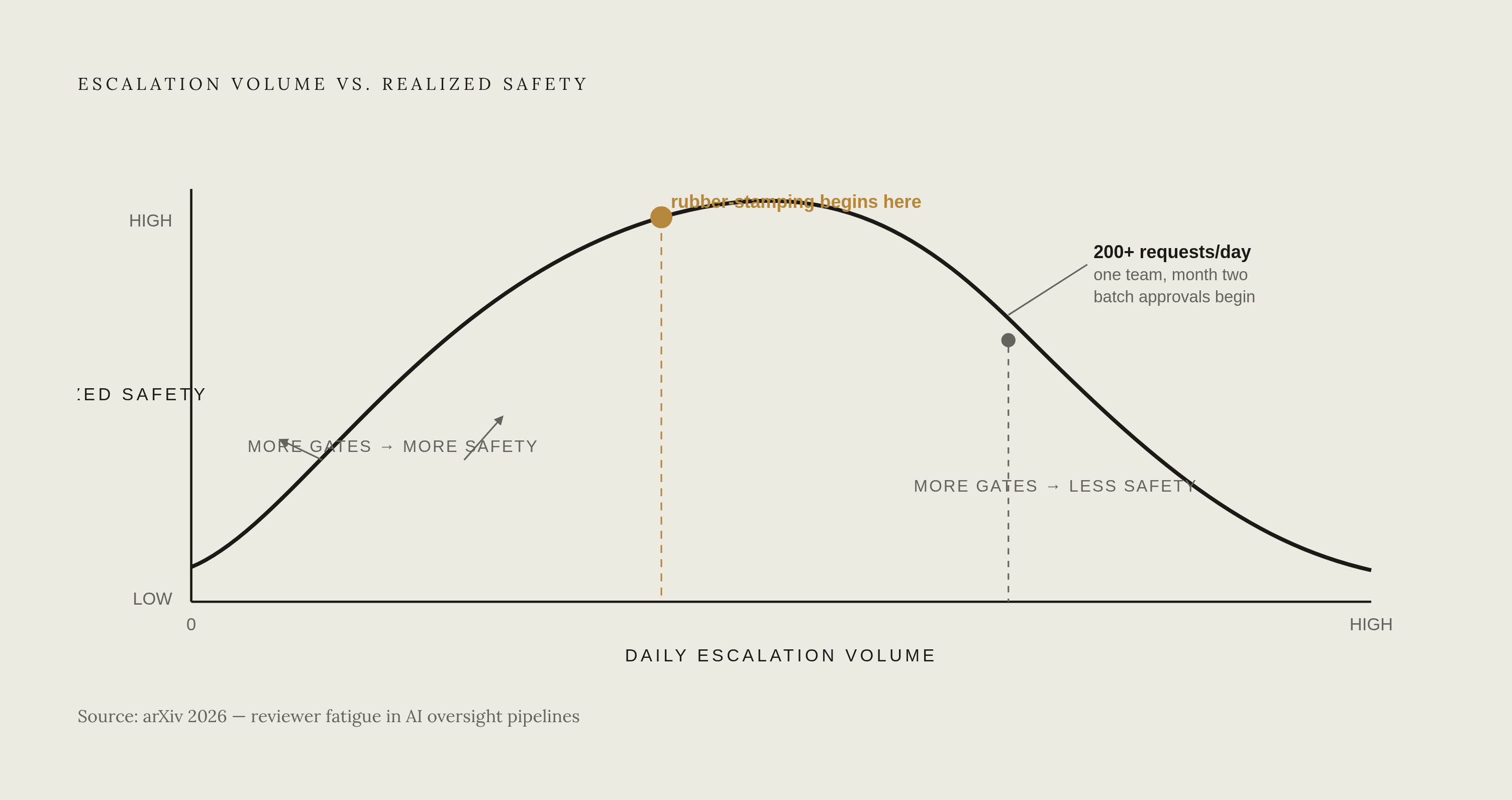
One engineering team built a human approval gate for every agent action above a set risk score. By the second month, more than 200 review requests were sitting in the queue every day. Reviewers, buried, started batching approvals just to keep the backlog from growing, which quietly defeats the point of having a human check anything.
A 2026 arXiv study modeling reviewer fatigue found that realized safety follows an inverted U as the rate of escalations climbs. Past a certain threshold, adding more approval requests doesn't make a system safer. It makes it less safe, because the humans reviewing them start rubber-stamping out of sheer volume.
So calibration matters as much as the gate itself:
- Gate anything irreversible or externally visible: sent emails, modified records, initiated payments. These are the actions where fixing a mistake after the fact isn't good enough.
- Skip gating read-only work, internally scoped actions, or anything easily reversible. That's exactly where letting the agent run on its own creates real value.
- Give repeated identical calls an approval scope. Once a human signs off on "summarize this document," the next five identical requests in that session shouldn't re-queue.
- Use time-bound sessions to cut down on fatigue at the source. Session-scoped authorization limits access to the length of one task, so humans are approving sessions instead of clicking through individual calls one by one.
The underlying principle: let agents run free on the safe stuff, and put deliberate, well-placed gates on the small number of high-risk functions where a mistake actually costs something. Build lightweight feedback loops so a time-sensitive decision doesn't stall the entire workflow waiting on one person to check their inbox.
None of this is a decision made once and left alone. The audit data coming out of the monitoring layer should feed straight back into where gates sit. Actions that prove out safe over time can get deprioritized from review. Anomalies should trigger a fresh look. The calibration keeps moving as the behavioral record grows.
Human oversight as a regulatory requirement, not a design choice
In some cases, a human isn't in the loop because the law requires it, not because someone judged it the smart engineering choice. It's there because the law says it has to be. Regulated industries, financial services, healthcare, anywhere decisions carry legal or safety consequences, are increasingly building rules that assume a person, not just a system, bears responsibility for a given action before it happens.
That changes what an approval workflow actually is in those settings. It stops being a risk-management layer a team chose to add on top of the agent stack. It becomes a compliance boundary, and the audit trail built in Layer 4 turns into the record regulators or auditors will actually ask for, no longer just a nice-to-have for debugging.
The organizations that get this right treat the four-layer workflow, identity, scoping, contextual approval, and ongoing audit, as one continuous structure rather than four separate boxes to check once. Skipping any one of them doesn't just create a security gap. In a regulated setting, it can make a system compliant or noncompliant, no matter how well the agent itself performs.
Sources
- Medium
- A Systematic Survey of Security Threats and Defenses in LLM-Based AI Agents: A Layered Attack Surface Framework
- MCP Security Crisis: Systemic Design Flaws in AI Agent Infrastructure
- MCP Security Statistics 2026: CVEs, Vulnerabilities & Breach Data - Practical DevSecOps
- blog.modelcontextprotocol.io