Golden Path Programs for Enterprise AI Agents
Companies need safe default paths for enterprise agents, not surveillance gates.
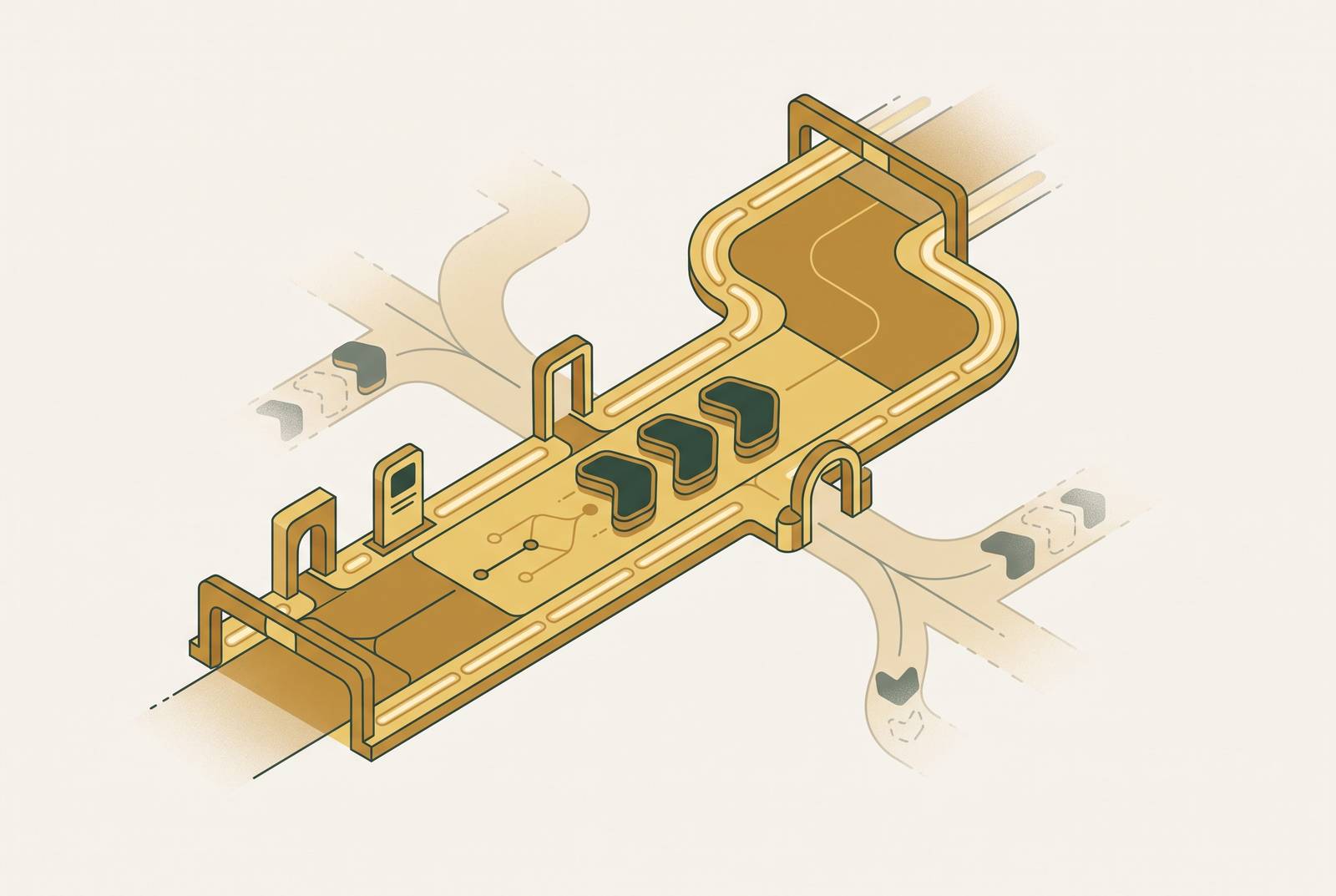
The golden path concept: its origins in developer tooling and its evolution into an agent governance framework
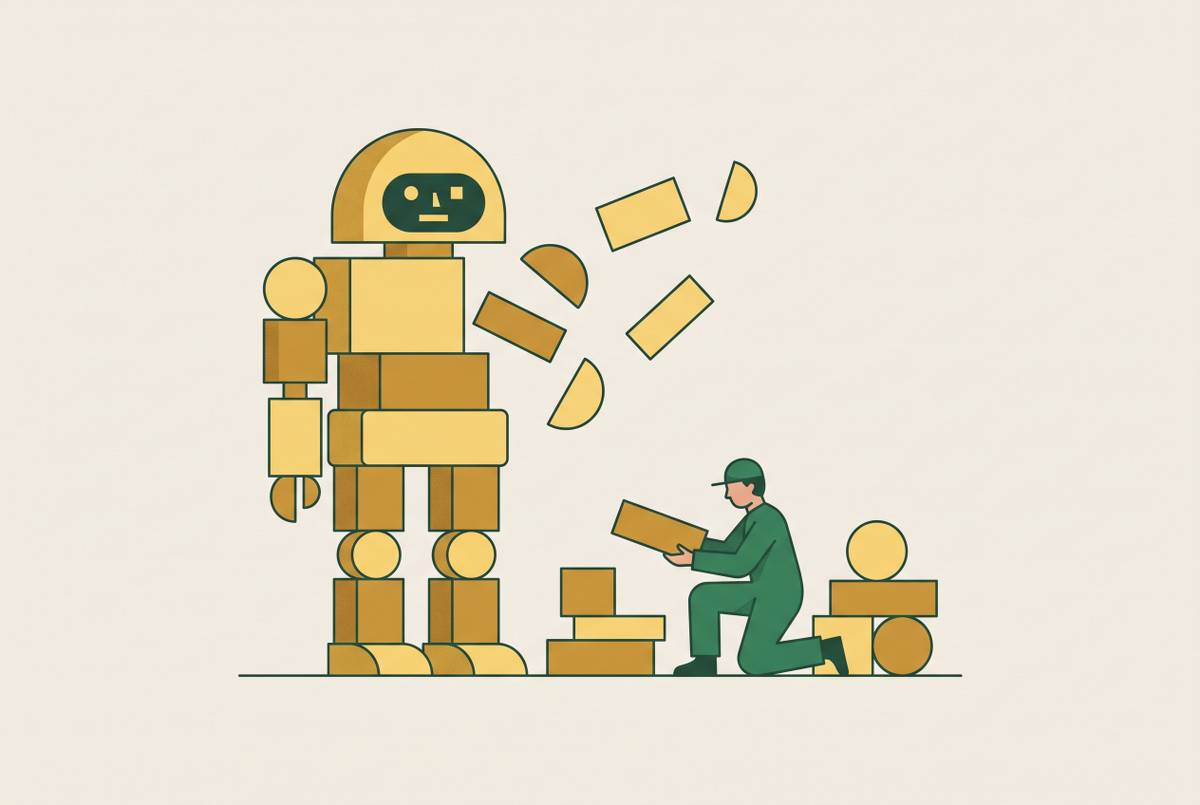
Enterprise AI agents are multiplying fast, and most companies still have no safe, default way to let employees use them. The real gap sits with the large majority of workers who aren't power users. They have no paved road to follow, and that absence is what's driving every headline about AI governance right now. The golden path, a concept borrowed from developer platform teams, is becoming the fix. Most companies are about to reinvent it badly on their own, so understanding how it actually works is worth the time.
Golden paths started life as a platform engineering idea. Industry platform engineering guidance describes them as curated, pre-approved blueprints: standardized infrastructure-as-code modules, self-service portals, that kind of thing, built so the secure, compliant choice is also the easiest one to grab. Move at the speed of your best developers, while the company stays protected from its worst surprises. That was the pitch.
Now that idea has to stretch to cover a new kind of user: the agent itself. Datadog reports that agents already call self-service APIs, query internal catalogs, and provision resources on their own, around the clock, with nobody watching each individual action. Gartner has responded by treating agents as a formal user persona, coining "agent experience" (AX) throughout its 2026 Hype Cycle for Agentic AI. The industry has shifted toward building governance infrastructure around agents as first-class actors, rather than treating them as a novelty add-on.
Two separate meanings of "golden path" are floating around right now, and both matter, just for different problems. One is the platform engineering version: standardized workflows with machine-readable contracts and dispatch controls that let agents safely touch internal developer platforms. The other is what John Boren, writing on Medium in 2025, calls the behavioral golden path: watch thousands of agent runs, spot the patterns that produce good outcomes, and distill those patterns into cheaper, leaner execution paths. Different mechanisms, same underlying logic: figure out what works, make it the default, stop bolting governance on after the fact. The CNCF's 2025 Technology Radar backs this up on the infrastructure side, noting that MCP and other agentic AI standards have reached "adopt" status. The plumbing beneath agents is finally catching up to how fast the agents themselves are moving.
The gate-building trap that kills adoption before it starts
Platform teams see agent chaos and reach for the obvious lever: build a gate. Stop everyone, announce that no one moves until there's an official, sanctioned enterprise AI platform, then spend the next 18 months evaluating vendors and picking a standard model. InfoWorld laid this pattern out clearly, and the ending is predictable every time. By the time the platform ships, the model it standardized on has already been surpassed, probably more than once, by something cheaper and sharper. This is the wrong move, and the data on shadow IT proves it.
The delay is where the real damage happens. Developers who need to ship work don't sit around waiting for a platform that's already behind the curve. They route around it, sometimes paying for API access on personal credit cards, and that creates an unmonitored blind spot sitting right at the center of the business. Call it shadow IT, the same disease that's plagued IT departments for two decades, except now enterprise data is flowing through it unchecked.
A single monolithic platform can't work here, and the reason is simple: AI itself isn't one thing. A model that's excellent at summarizing legal contracts can be genuinely bad at writing Python. A model tuned for marketing copy has no business anywhere near financial projections. Forcing all of that through one prescribed workflow ignores how different these tools actually are, and the CNCF's 2026 framing gets this right: the platform engineer's job is to curate and quality-control a set of AI-powered golden paths, not crown one true path. Curate a handful of good options, quality-check them constantly, and best practice becomes the default without anyone having to think about it.
None of this makes governance optional. Governance has to be flexible and opinionated enough to channel velocity, instead of standing in front of it holding up a stop sign.
Behavioral golden paths and efficiency in early agent deployments
Picture a frontier model running in full agentic mode on something genuinely messy, an insurance claim, say. Boren's write-up notes a single claim might involve 1,000 micro-decisions spread across 50 API calls. At that exploratory stage, the cost runs a couple of dollars per claim, and each run takes about 45 seconds. Fine for a pilot. Not fine at scale, not even close.
The fix is a method, not a bigger model: log every decision, every tool call, every reasoning step in a structured format. Run a multi-stage evaluation across all those logged paths, sorting them into "this worked" and "this didn't." Find the patterns that recur in the successful runs, then encode those patterns directly into a leaner system. Boren's numbers on the payoff are stark: cost drops to $0.02 per claim, and latency drops to 3 seconds. Whether an agent system is something you demo once or something you run in production at volume depends on that gap: a couple of dollars versus two cents, 45 seconds versus 3.
The loop repeats: explore, log, evaluate, distill into a lighter and more specialized model, redeploy, then explore again on the next workflow. The first version any team deploys is never the final one. Golden paths get discovered by watching what agents actually do, not declared in a committee meeting. Datadog's own adoption numbers show why this matters at scale: agent framework adoption nearly doubled year over year heading into 2026, climbing from just over 9% of organizations in early 2025 to almost 18% a year later, with 69% of companies now running three or more models across increasingly tangled agent workflows. At that volume, discovering paths systematically is the only lever left for keeping costs sane.
The architecture of a production-grade golden path for AI agents
A golden path that holds up in production mixes two modes of decision-making. Agents get to use judgment on plenty of steps, but anything consequential sits behind a deterministic gate: automated tests, policy checks, human approvals, deployment rules that don't bend for anyone. This hybrid model, part probabilistic, part hard-coded, is emerging as the pattern among the more sophisticated organizations building agent infrastructure.
None of that holds together unless machine-readable contracts define every capability an agent can touch. Each contract needs to spell out inputs, outputs, version, rate limits, side effects, preconditions, and whatever approval it requires. And when something breaks, the contract has to return a structured error that actually distinguishes bad input from access denial, from throttling, from a temporary failure, from an outright policy rejection. A generic "failed" response just leaves the agent guessing, which defeats the point.
Catalog metadata acts as a trust signal too. Before letting an agent take a consequential action, the golden path should check that the required metadata exists and hasn't gone stale or contradictory. If it's missing or looks wrong, the appropriate response is to drop the agent back to read-only, or force human review scaled to how much damage a mistake could do.
Identity and secrets aren't negotiable anywhere in this. Secrets get pulled at runtime, never baked into an agent's code. Authorization runs through the same enterprise identity and access management systems already governing human employees. The goal is folding AI into hardened patterns that already exist, rather than inventing a brand-new attack surface nobody's tested yet.
Audit telemetry has to be built into the path from day one, not tacked on after an incident forces the issue. That means capturing model calls, which tools got picked, what context got retrieved, latency, errors, retries, evaluation scores, and cost, on every single run. For anything touching an external system, log the task identity, which credential or workload identity was used, what resource got touched, what operation was requested, whether it was approved, when it happened, and what the outcome was. Datadog's own Audit Trail implementation separates the agent, listed as the actor, from the user, listed as the delegator, so it's always clear who did the thing and under whose authority they did it.
Escape hatches matter too. Sometimes someone genuinely needs to step off the golden path, and that should be possible, but it shouldn't be free. InfoWorld's reporting describes a "proceed with justification" flag built directly into the platform, where stepping outside the guardrails triggers extra logging, a targeted security review, and a tighter budget, and every exception gets reviewed weekly to feed back into how the guardrails evolve. The CNCF frames the whole system as four distinct pillars: golden paths, guardrails, safety nets, and manual review workflows. Each one does a different job, and none of them can cover for the others.
MCP as the connectivity layer golden paths must govern
Model Context Protocol, MCP for short, is the open standard Anthropic released in November 2024 to standardize how agents connect to external tools, data, and services, running on JSON-RPC 2.0 under the hood. In December 2025, Anthropic donated it to the Agentic AI Foundation, a directed fund under the Linux Foundation, with OpenAI, Google, Microsoft, AWS, Anthropic, Block, Bloomberg, and Cloudflare signed on as Platinum members, and Salesforce and Snowflake among additional founding members. That's about as broad a coalition as any protocol gets.
The adoption curve backs up the urgency. SDK downloads hit roughly 97 million a month by early 2026, and about 41% of technical leaders in the software industry say their organization already has MCP running in production somewhere, limited or broad. Public MCP servers indexed across the major registries topped 9,400 by mid-2026, and private, enterprise-internal servers run conservatively three to four times that number. That's an enormous, mostly unaudited surface for agents to discover and connect to, and almost none of it was built with this much traffic in mind.
MCP's security model hasn't kept pace with its popularity, and it shouldn't surprise anyone: much like the early web protocols, it shipped flexible and underspecified. The NSA's Cybersecurity Information Sheet from May 2026 points out that MCP flips a familiar pattern, since servers query and sometimes execute actions on behalf of connected clients, opening attack paths nobody's finished mapping yet. Authentication is a real gap too. OAuth 2.1 only made it into the MCP spec formally with the March 2025 revision, and got locked down further in late 2025. Before that, servers leaned on transport-layer security alone, and plenty of already-deployed servers still haven't implemented authentication.
A golden path that routes agents through MCP without identity controls, credential governance, and real-time monitoring is a well-paved road straight to exposure.
The four MCP-specific threats a golden path must detect and contain
Tool poisoning tops the list, appearing among the leading entries in the OWASP Agentic Top 10. An attacker edits a tool's description so the model misreads what it actually does: the agent thinks it's calling a search function, but the tool quietly exfiltrates data instead. Microsoft's Incident Response team published a detailed walkthrough tracing the attack across four stages. A silently modified tool description enabled dynamic re-trust without any re-approval step, the agent then executed the poisoned call, and data left through what looks like an approved action the entire time. This attack pattern was publicly disclosed in early 2025. The MCPTox benchmark, published in August 2025, tested 45 live MCP servers and 353 real tools against a broad set of modern LLMs, and found attack success rates above 60% for many popular agents, topping out at 72%. The more capable models often did worse, not better: their stronger instruction-following made them more obedient to malicious metadata rather than more skeptical of it. Even Claude-3.7-Sonnet, the most resistant model tested, only refused poisoned tool calls in under 3% of cases.
Agent goal hijack, tagged ASI01, works through prompt injection: hidden instructions get buried inside a web page, a document, or tool output the agent processes as ordinary data. The agent reads it, follows the buried command as though it came from its actual task, grabs credentials, and sends them off to an attacker's endpoint. No malware file, no exploit code, just text the model happens to interpret as an instruction. That's why signature-based detection tools mostly miss it.
Intent drift is the quieter threat: an agent's behavior slowly wandering away from what it was originally asked to do, across a long, multi-step workflow. It's genuinely hard to catch unless every tool call gets traced back against the task identity that kicked the whole thing off. Credential or data exfiltration remains a live risk any time an agent has broad tool access without its MCP connections scoped and watched at the level of individual tool calls.
Static policy checks and perimeter defenses don't do anything against threats like these. Detection has to happen at the tool-call level, in real time, with every action logged against an identity in a way that can't be edited after the fact.
Giving non-technical employees a golden path, not just developers
Datadog's State of AI Engineering 2026 shows agent adoption nearly doubling year over year, but that growth is still concentrated among technical teams. The other 95%, people who've never touched an API and never will, stall out without something built specifically for them. This is the blind spot most governance programs never fix, because they build for the users already comfortable with credentials and API keys, not the ones who need the work done invisibly.
A golden path aimed at non-technical employees can't assume anyone knows what a credential flow is or how to pick between models. It has to show up inside tools people already use, Slack, email, whatever SaaS workflow already runs their day, and just work without asking anything of them. That means the catalog of agent capabilities has to be curated and governed ahead of time, well before anyone touches it. Nobody should hand a marketing coordinator a menu of 9,400 public MCP servers and ask them to pick one. They need a sanctioned, narrow set with identity already wired in behind the scenes, invisible to the person using it.
OAuth, credentials, all of it needs to disappear from the user's view. The governance lives in the foundation, built into the system before anyone has to fill out a form to get their work done. IBM's internal rollout is a useful data point on what's possible when this gets built right: AI usage across its internal systems climbed from 25% to 75%, contributing to a $3.5 billion cut in operating expenses, alongside a cultural shift where employees just work alongside agents without a second thought. InfoWorld's 2025 framing nails the principle: the right way to use AI should also be the easy way. Security doesn't belong bolted on as friction the user has to push through. It belongs in the foundation, out of sight.
Platform teams make this real by curating the catalog, pre-approving the connectors, and enforcing policy down at the tool-call level. Done right, the security team is what makes adoption possible in the first place, not the thing slowing it down.
Datadog's data-driven golden path program: how it was built and measured
Datadog's Frontend Augmented by AI guild built its golden path program on usage data instead of committee guesswork. The method was straightforward: track how AI actually gets used internally, tailor tooling around what that data shows, then turn the results into standardized paths teams can adopt directly rather than debate in a meeting room.
The guild didn't start by asking engineers what they wanted. It started by watching what they already did, which tools kept showing up in real workflows, which patterns produced work that shipped versus work that got thrown away. That distinction matters. A golden path built from a survey reflects what people say they need. A golden path built from usage logs reflects what people actually do, and those two things diverge more often than any platform team wants to admit.
More than 50 development teams inside Datadog now use the paths that guild has produced. That's the real test of the whole idea. A golden path program grounded in actual usage data gets adopted at scale because it was built on evidence rather than a guess. Everything else, no matter how well-organized, is still just a guess wearing a nicer outfit.
Sources
- The autonomous enterprise and the four pillars of platform control: 2026 forecast
- Building a golden path to AI
- The Golden Path: Engineering Optimal AI Agent Behaviors Through Iterative Discovery and Distillation | by John Boren | Medium
- Walking the golden path to AI value | IBM
- How to adapt Golden Paths for autonomous AI agents | Datadog
- How we built data-driven AI Golden Paths at Datadog | Datadog
- theagentics.co
- langprotect.com