AI Agent Total Cost of Ownership Beyond Licensing
Security and integration costs often dwarf the per-message license fee in enterprise AI deployments.

Microsoft publishes its Copilot Studio billing rule in plain language: a billable message is a request or message sent to the Copilot that triggers an action or response, priced at $0.01 per message. That's a clear number on a clear page, but it covers one meter out of several: Dataverse capacity, Managed Environments, and voice or reasoning add-ons all run on separate rate schedules documented elsewhere. The structure of the pricing itself guarantees that the number on the page describes model access, while integration, governance, security, maintenance, and compliance get built, staffed, and paid for somewhere else.
That budgeting failure happening across the industry right now comes from this mechanism: the license fee measures model access, not the full cost of building, securing, and running the deployment. First-year total cost of ownership typically lands well above the build number once infrastructure, usage, integration upkeep, and governance get counted alongside it. None of that is vendor bad faith. It's a structural feature of how this software gets priced and sold.
Treating the license fee as a conservative estimate, a safe floor to budget from and build up, misunderstands what the number represents. The license fee measures what the meter charges for model access. It does not measure what the work costs to build, secure, and run. Those are two different calculations, and enterprises that collapse them into one end up budgeting for a fraction of the deployment while committing to the whole thing.
Six pricing models, each hiding cost in different places
As of September 2026, enterprise AI agent vendors price their products six ways: per seat, per interaction (conversations, actions, executions, or credits), per compute and tokens consumed, per agent or bot deployed, per outcome, and scoped engagements that bundle platform access with implementation. Switching vendors doesn't fix this, because the model you sign determines which costs stay invisible, not whether they do.
Per-seat pricing charges for access, not for work performed. Integration engineering and SOP maintenance sit outside that number, and so does the human escalation team that picks up every case the agent can't resolve.
Most vendors don't pick one model and stick with it. Salesforce Agentforce runs per-user pricing, per-conversation pricing, and Flex Credits side by side on the same pricing page. Three meters can run simultaneously on a single deployment, and the quote rarely explains how they interact. The market is still working out how to charge for software triggered by events instead of logins, and that instability is itself a budget risk enterprises need to price in.
Integration is where that instability does the most damage, and it consumes more of first-year total cost of ownership than any other single line item, almost none of it visible on a pricing page. Cost scales with the number of systems the agent touches, not with how ambitious the prompt sounds.
Every system an agent connects to needs authentication, a permission model, an error path, and you need a decision for what happens when that system goes down. Whether a tool offers a documented API or MCP server predicts the budget directly: formal integration paths produce costs that can be forecast, while browser-automation paths cost more to build and more to maintain, because they break every time the vendor changes a button or a menu.
That maintenance cost doesn't end once the integration ships. A Swiss banking pilot, described in published case material, shows what that looks like in practice: an HR chatbot that looked cost-effective during the pilot, limited to token costs and license fees, more than doubled its initial budget once it moved to production and picked up internal data preparation, secure interface implementation, payroll system synchronization, and access management engineering. Integration is structurally underbudgeted because none of that work appears on the page where the pricing decision gets made.
Security infrastructure as a recurring operating cost, not a one-time add-on
Every integration built to connect an agent to a system is also a door, and that door needs to stay locked on an ongoing basis, not just at launch. Security costs for AI agents are an operating expense that grows as agent autonomy and integration depth grow, not a purchase-time line item, and most enterprises haven't budgeted for them.
The exposure is already widespread. By early 2026, security researchers had catalogued thousands of internet-exposed MCP servers, and about half ran with no authentication controls. The agent reads the instruction and executes it, no human in the loop to catch the substitution.
Microsoft's Defender Security Research Team, with researchers Uri Oren, Amit Eliahu, and Dor Edry, published findings showing how prompt injection escalated into full remote code execution inside popular AI agent frameworks. That escalation has already shown up in the wild at supply-chain scale. The Sandworm_Mode campaign, running in February 2026, used npm typosquatting to install rogue MCP servers through malicious packages, exfiltrating SSH keys, AWS credentials, and npm tokens via prompt injection against users of Claude Code, Claude Desktop, Cursor, VS Code Continue, and Windsurf.
Wiz Research disclosed a separate incident in June 2026 involving Amazon Q and VS Code: a malicious repository achieved arbitrary code execution and cloud credential theft simply by having a developer open it, because workspace MCP server configurations auto-load, and the spawned processes inherited the developer's full environment. The protocol itself shifted more of this burden onto enterprises, not less. The July 2026 MCP enterprise specification revision hardened the protocol, but it also moved responsibility onto server developers and implementers. Security boundaries the protocol used to enforce now depend on how carefully each implementer builds them, so the risk of implementation flaws rises, and so does the engineering burden enterprises carry to catch them.
Every one of these incidents points to the same budget line: detection tooling to catch tool poisoning before it executes, incident response capacity to contain a compromised agent, and remediation engineering to patch the gap once it's found. None of that gets funded once and left alone. It gets funded every year the agent stays in production.
The identity and credential gap that turns latent risk into hard cost
Agents acquire and hold credentials differently than traditional service accounts do, so they create a category of liability that existing identity and access management processes were never built to catch. A traditional service account gets provisioned deliberately: it's tied to a known application and a change ticket someone signed off on. Agents multiply by a different logic entirely: a team spins one up for an experiment, a workflow spawns a sub-agent to handle a subtask, and a single platform can mint far more identities than any review process designed for a slower provisioning cadence was built to track.
About half of enterprise non-human identity credentials are long-lived API keys, and when non-human identity security incidents happen, many trace back to identities that had more privilege than their task required. The 2026 CISO AI Risk Report surveyed enterprise security leaders, and most said they lack full visibility into their own AI identities. A majority report that AI systems already have access to core business platforms, including ERP, CRM, and financial systems, and only a small minority govern that access with any real effectiveness.
Shadow agents turn that visibility gap into a direct cost liability. Research presented at the Gartner Security & Risk Management Summit found that a majority of organizations already have unsanctioned AI agents running somewhere in their environment. Nearly half have already experienced an AI agent-related security incident.
Identity-centric intrusions grew sharply from 2025 into 2026, and the pattern behind most of them is consistent: agents using long-lived API keys, shared service accounts, or secrets embedded directly in configuration files. Authorization and credential isolation aren't standardized at the protocol level, so enterprises have to build that discipline themselves, at their own cost, on their own timeline.
Compliance overhead as a compounding cost, not a one-time audit
Agentic AI breaks the assumptions baked into existing compliance frameworks, so enterprises have to fund new audit and oversight infrastructure rather than stretch what they already have to cover a system it wasn't designed for. Compliance tied to the EU AI Act and sector-specific regulation adds materially to European deployments, and estimates put it at 10 to 25 percent of project cost.
A legal analysis by Nannini, Smith, and Tiulkanov concluded that high-risk agentic AI systems with untraceable behavioral drift can't currently satisfy the essential requirements of the AI Act. Auditability under that standard is an architectural requirement that has to be built into the system from the start, not something that ends when the documentation is finished at go-live.
Shadow AI tools compound the problem: Ollama instances, MCP servers, LangChain agents running outside sanctioned deployment paths often bypass IAM logs and cloud inventories entirely, creating governance blind spots that only get closed with purpose-built detection and logging infrastructure, not with policy memos. Agent operation runs continuous and cross-departmental, and oversight built for the old pattern doesn't translate to the new one.
Incident response has to be rebuilt from the ground up for the same reason. The AgentIndex benchmark found that fewer than a fifth of surveyed enterprise deployments run any form of cross-session behavioral monitoring. Most enterprises are accumulating compliance liability they haven't measured yet, and that liability starts building on day one of deployment, not at the next scheduled audit.
What a complete three-year TCO picture looks like
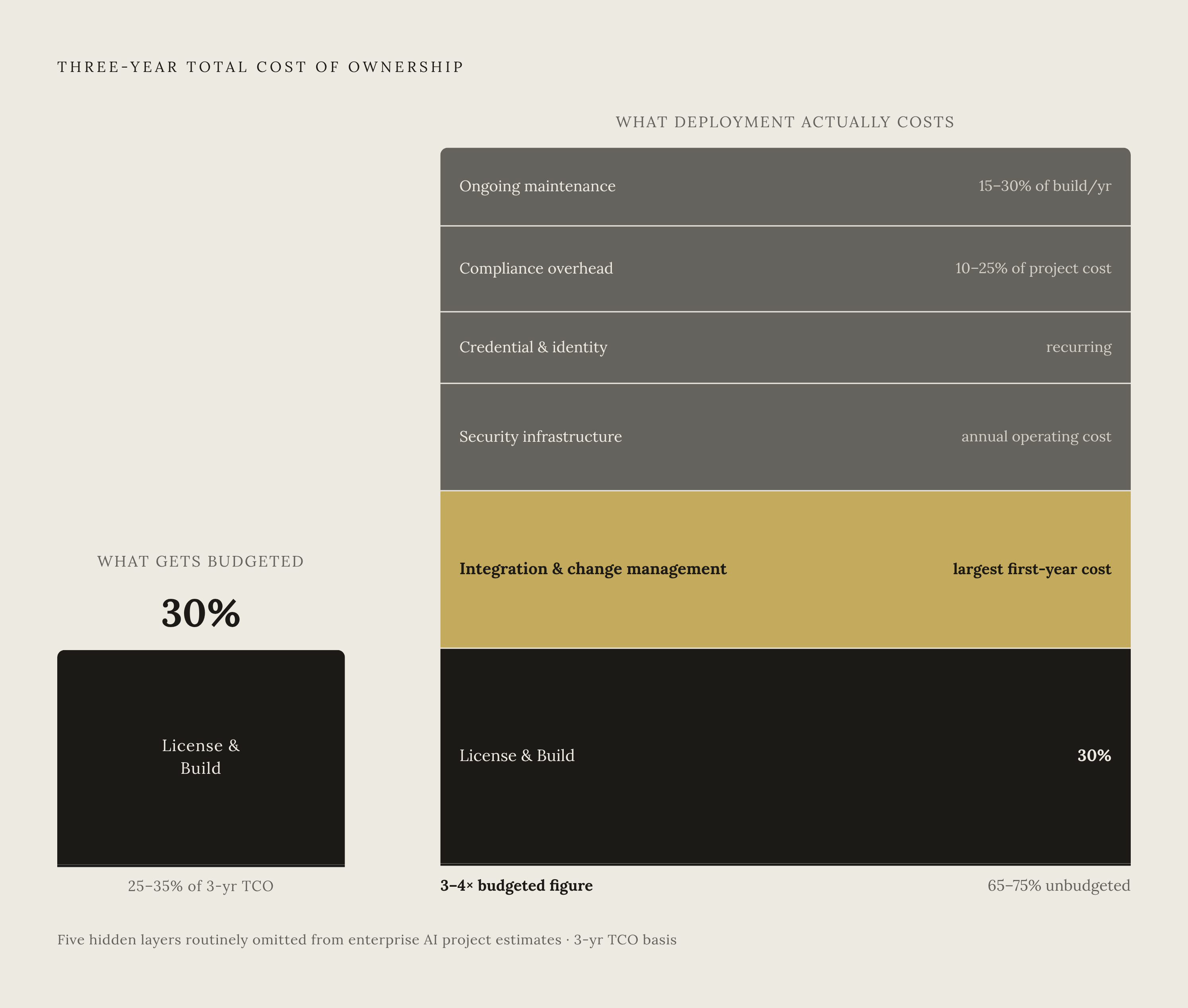
Integration, security infrastructure, credential management, compliance, and maintenance add to the build and license numbers, bringing the total three-year cost of an enterprise AI agent to three to four times what the initial build or license figure suggested. It's the number that results from counting what the deployment actually requires.
Development cost makes up only 25 to 35 percent of three-year total cost of ownership. The evolution phase, covering prompt tuning, model upgrades, reindexing, compliance audits, and incident response rebuilds, compounds annually.
Integration and change management form the single largest category of first-year total cost of ownership, and it's the one enterprises most often underestimate, because it looks like ordinary software engineering. Compliance infrastructure adds materially to projects that would otherwise cost far less, particularly where HIPAA, SOC 2, ISO 27001, or EU AI Act coverage applies.
None of this means enterprise AI agents cost more than they're worth. It means the deployments that come in on budget are the ones that priced all five layers from the start. The overspend hits the enterprises that budgeted for the license and assumed the rest would stay small.
Scoping and budgeting so the full cost is visible before signing
Autonomy level, integration surface, and governance architecture are the three decisions made before a contract gets signed that keep the total cost predictable instead of turning it into a string of unpleasant surprises.
Autonomy level carries the most weight of the three. An agent that drafts output for a human to approve costs a fraction of what an agent acting unsupervised costs, because every step up the autonomy ladder adds to build cost and raises the governance infrastructure the deployment needs to run safely by a lot.
Before signing, check the integration surface system by system. For each one the agent will touch, confirm whether it offers a documented API, an MCP server, or some other published integration path. Tools that require browser automation cost more to build and more to maintain, and both costs need to be budgeted explicitly before launch.
Scope one process, not a capability. "Handle tier-one support" can't be scoped or priced. "Resolve password and access requests for the internal helpdesk, escalate everything else" can. When the narrow, named version ships, it earns trust, and that shows the organization what the second deployment should actually cover.
Budget the second year before approving the first. Annual maintenance running 15 to 30 percent of the original build is a structural cost of operating any system with live dependencies on other systems that keep changing on their own schedules.
Before signing, ask the vendor what the second meter charges. What happens when the conversation in progress finishes and the next one starts? What counts as a billable interaction? What triggers the per-execution charge? What falls outside the seat fee or the subscription? Those questions belong in the procurement conversation, not in the first invoice that doesn't match expectations.
Compliance infrastructure is not a decision to defer to phase two. HIPAA, SOC 2, ISO 27001, and EU AI Act requirements need to be scoped into the architecture before the build starts, because retrofitting them after go-live consistently costs more than building them in from the beginning. Governance and credential management architecture, meaning who owns agent identities, how credentials get issued and rotated, how tool access gets scoped, and how audit records get produced, belongs in the project brief itself, not left for the implementation team to improvise during the build.
Platform teams that build the governance foundation once, covering identity, access, audit, and security detection together, let every later deployment draw on that same foundation. That turns a cost paid separately on every project into shared infrastructure that lowers the marginal cost of each new agent that follows. A unified platform covering enablement, access control, and security detection in one place, rather than three tools procured separately, changes that math directly for enterprises deploying at scale.
Enterprises that do this scoping work before signing aren't paying more than enterprises that skip it. They pay accurately for what the deployment actually requires, so they avoid the substantial year-one overspend that comes from budgeting the license fee alone. The total cost of an AI agent is predictable once the full architecture is visible. The cost was never the problem. The invisibility was.